

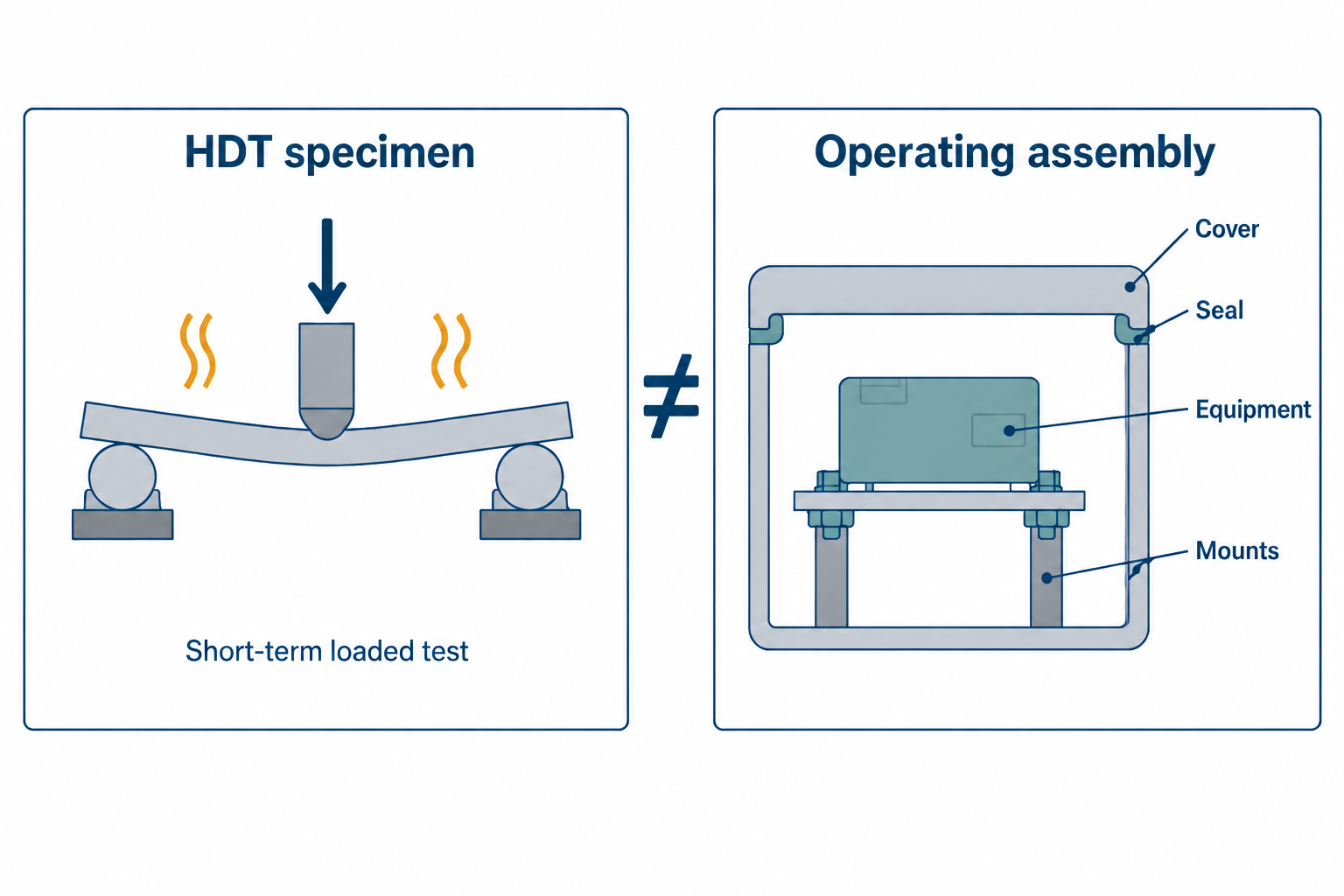
A plastic enclosure’s usable temperature range is determined by the finished assembly in its operating conditions. The body, cover, mounting features, seals and installed equipment must each stay within applicable limits at the temperatures they actually experience. A resin’s heat deflection temperature cannot supply that range: HDT describes a material specimen deforming under a specified short-term load. [214]
Start with the outdoor or indoor ambient range, then add the effects of equipment heat and sun exposure. Select the material and cooling arrangement against that thermal picture. Choosing the highest temperature printed in a catalog can miss the part of the assembly that limits the design.
Separate ambient temperature, internal hot spots and solar load
Ambient temperature is the air temperature around the enclosure. Internal air temperature results from heat generated by the equipment and the routes available for removing it. A local hot spot can be warmer than the bulk air, especially beside a heat-producing component or where airflow is restricted. Bud Industries explains enclosure heat transfer through conduction, convection and radiation, with practical cooling directed both at heat removal and at the places needing cool air. [212]
In a hypothetical layout, a power supply mounted close to the upper wall may warm nearby plastic more than a sensor near the bottom of the box would indicate. Increasing enclosure volume could help the layout, but it does not by itself demonstrate that the wall, mounting boss or power supply stays cool enough. The relevant evidence is the temperature at those locations under the proposed operating load.
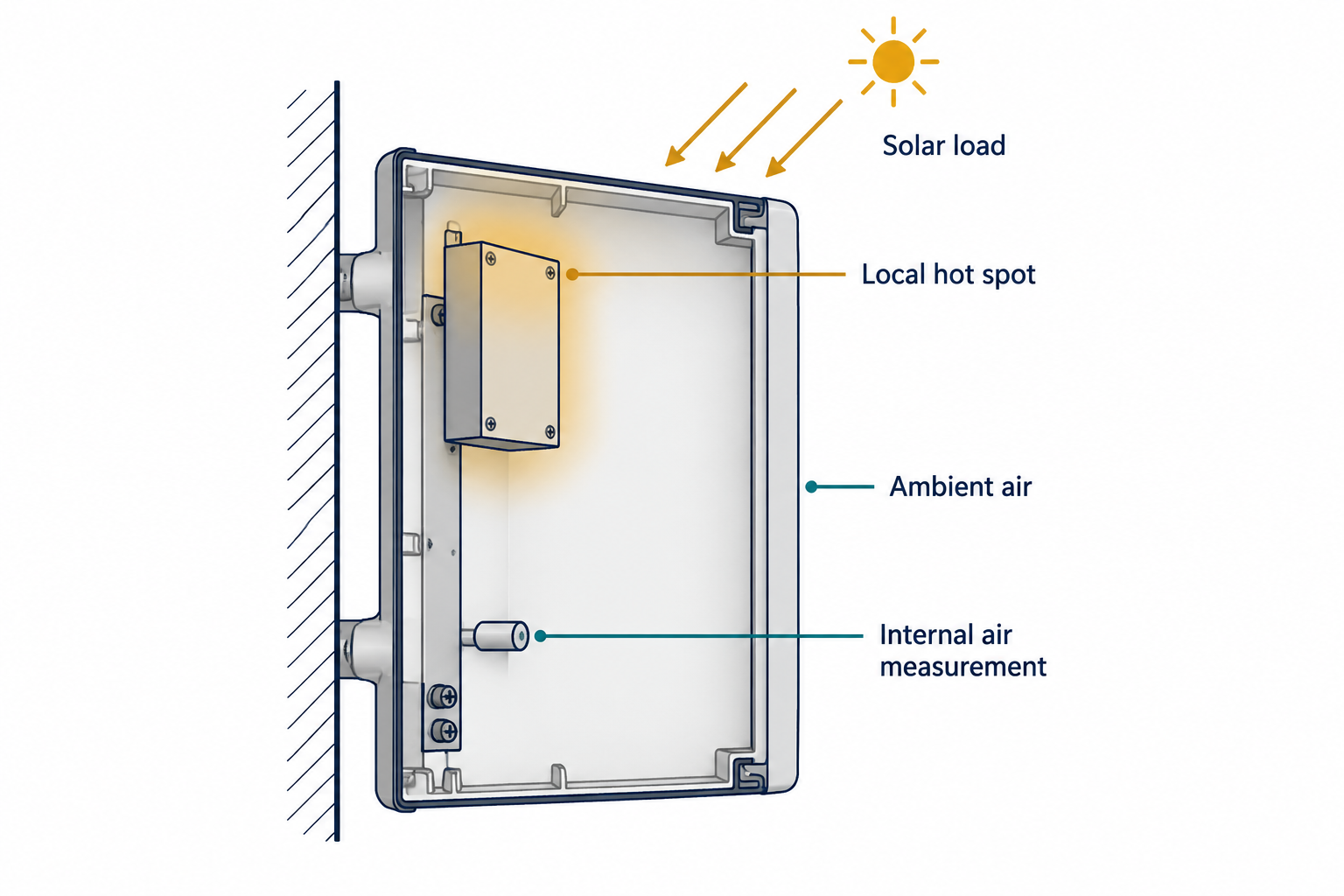
Solar load adds another heat source. Surface temperature depends on properties including color, infrared absorption, thickness and backing; it is not simply the surrounding air temperature. Atlas discusses those effects in weathering specimens. For an installed enclosure, the implication is to include the exposed surface and installation arrangement in the thermal assessment, rather than copying a shaded-air reading into the material specification. [159] Sunlight also calls for a separate review of the housing’s UV and weathering evidence.
The lower end of the range also needs an operating condition. A box left undisturbed in cold storage faces a different mechanical demand from one whose lid is opened or struck while cold. Ensinger notes that lower temperature can increase thermoplastic stiffness while reducing impact strength, with shock and vibration influencing successful use. [215]
An enclosure body can remain within its permitted temperature range while moisture condenses on the equipment inside. Condensation forms when a surface reaches or falls below the dew point of the surrounding air, which can happen as the cabinet cools after sunset or shutdown. Broad droplets on cold surfaces point toward that mechanism; a localized trail below a gland or door seam points toward a possible leak. The enclosure condensation diagnosis uses surface temperature, internal humidity and the timing of the water to distinguish the two, which may also occur together.
Read material data without treating it as a finished enclosure rating
Different thermal values describe different behavior. HDT compares specimens under bending load during a short-term test. Long-term thermal aging considers property retention over time. Thermal conductivity describes heat flow through a material. None of these values incorporates every joint, accessory and component in a complete enclosure. [214][165][212]
A YONGTONG SMC catalog provides a useful example because several thermal figures appear across two pages:
| Catalog entry | What the photographed pages show | How to use it |
|---|---|---|
| Material temperature-range description | −40°C to +160°C, accompanied by a statement about retaining physical and mechanical properties | The statement needs its applicable grade, duration, load and retained-property basis before it can support a service-temperature claim |
| Heat deflection temperature | 240°C; the method column cites GB/T1634 | Read as a reported HDT value, with the test load and full conditions still needed; do not specify a 240°C operating limit |
| Long-term heat-resistance temperature index | Entries including 155 and 150; the unit column contains a dash; the method names a WEL-type aging instrument test | Obtain the original method, units and acceptance criteria; do not add °C or relabel the figures as UL RTI |
| Thermal conductivity | 0.75–0.92 W/m-k | Treat as a catalog material value whose grade and measurement conditions need identification, not as a prediction of cabinet temperature rise |
These are supplier-catalog entries, not FN finished-enclosure ratings. [SMC36][SMC37]
The HDT distinction has an immediate design consequence. A material can retain its shape in a short test at a high temperature yet require a lower limit for a long-lasting loaded part. Ensinger describes HDT as a comparative test of short-term heat resistance. A usable operating limit therefore needs the material’s relevant long-term data and the actual loading and geometry. [214]
A named thermal index also has a defined evaluation behind it. RTP Company’s material-recognition description includes heat aging, periodic testing of selected properties and analysis before a relative thermal index is assigned. The unidentified long-term figures in the photographed catalog cannot be assumed to represent that procedure. [165]
Low thermal conductivity needs equally careful interpretation. It can reduce heat transfer through a wall, but the direction of useful heat flow matters. An internally heated enclosure needs to release energy; a wall that slows external heat entry also slows conduction outward under the reverse temperature difference. The complete balance includes convection and radiation, so a conductivity figure alone cannot prove that a cabinet runs cooler. [212]
Assess bosses, inserts, seals and sustained loads
A warm enclosure may remain visually intact while a loaded feature changes enough to affect service. Thermoplastics can creep under sustained stress, with higher temperature increasing the concern. For a mounting boss, that makes the supported mass and clamping arrangement relevant to the temperature limit. A short room-temperature pull test does not answer the same question as prolonged loading in warm operation. [62]
Plastic and metal parts can also expand by different amounts. Ensinger highlights thermal expansion where tight tolerances or metal-plastic combinations are involved. In an enclosure, the affected relationships may include an insert in a boss, a metal mounting plate fastened to plastic, or the alignment of a cover and latch. These interfaces deserve attention where temperature cycling could change fit or load. [213]
The seal has a separate function: it must remain properly seated and compressed through the proposed temperature range. A heat-resistant housing does not establish the temperature capability of its gasket, adhesive or cable-entry seals. Those parts need identified materials and applicable limits at their local temperatures.
RTP Company’s Linvatec case shows why a material-family choice may still need development at the part level. The manufacturer reports that unfilled PPSU charging cases experienced dimensional variation and moisture buildup during repeated steam sterilization. A modified PPSU compound was developed to improve dimensional behavior and thermal conductivity while preserving electrical insulation. The case concerns a medical charging case, not an SMC cabinet, but the selection lesson is relevant: a promising base resin did not settle the assembled product’s thermal behavior. [295]
Choose the thermal-management route with the equipment designer
The first distinction is whether the surrounding environment can accept heat at the desired internal temperature. An ambient-air cooling method needs a usable temperature difference. If the environment is hotter than the intended enclosure interior, adding airflow from that environment cannot provide the required temperature.
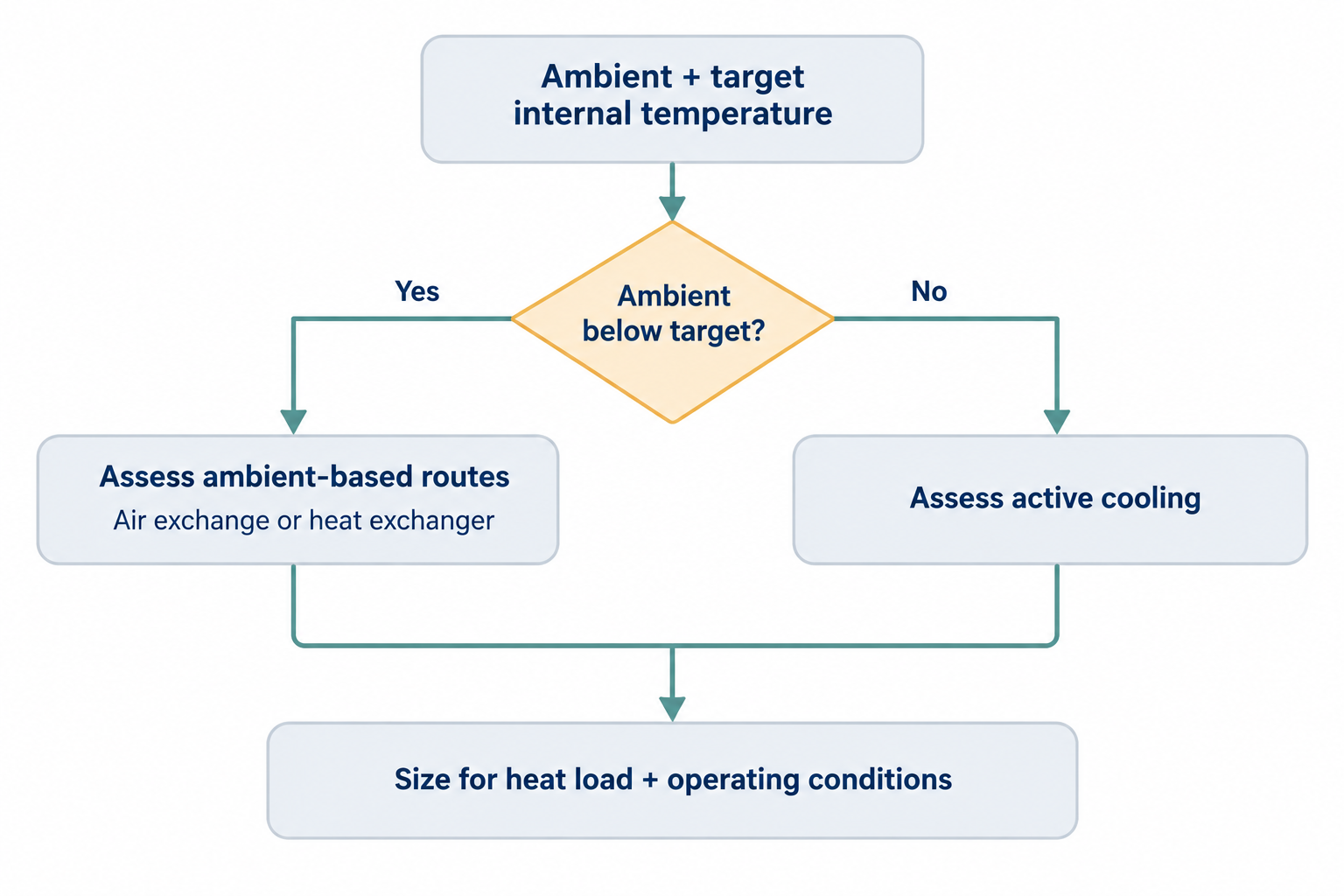
Pfannenberg identifies that condition as a reason for active cooling. [203][205]
| Operating condition | Thermal route to investigate |
|---|---|
| Heat generation is modest and the permitted temperature rise is sufficient | Heat transfer through the enclosure and natural internal circulation, supported by a thermal assessment |
| Ambient air is cooler and suitable for admission | Ventilation or filtered forced airflow, with the resulting ingress and maintenance requirements addressed |
| Ambient air must remain separate, but is cooler than the enclosure interior | A closed-loop air-to-air heat exchanger sized for the available temperature difference |
| The required internal temperature is below ambient, or passive transfer is insufficient | Active cooling sized at the actual application temperatures |
The air-to-air option transfers heat between separated air streams; it does not cool below the external air that receives that heat. A refrigeration cooling unit can work across a different temperature relationship, but its capacity still varies with operating conditions. Pfannenberg’s sizing guidance therefore uses the customer’s application temperatures, not just a catalog headline capacity. [203][205]
Cooling equipment changes the enclosure assembly. Openings, mounting interfaces, condensate handling and access become part of the design. The equipment designer and enclosure supplier need a shared layout so that a suitable cooler does not create an unsuitable sealing or maintenance arrangement.
Pfannenberg’s Gotthard Tunnel case adds a useful cold-weather example. The project combined cooling in warmer tunnel areas with heaters near the colder portals, while also addressing pressure changes, moisture and dust. That published project illustrates why “temperature management” can include heating and condensation control. Its enclosure material and project-specific performance cannot be transferred to an unrelated plastic cabinet. [296]
The operating duties of fans, filters, heaters and enclosure air conditioners are different. A filter fan brings ambient air into the enclosure, so dust loading gradually restricts the airflow unless the filter is maintained. A heater supplies heat to address low temperature or help keep surfaces above the dew point; it does not remove the equipment’s waste heat. An air conditioner removes heat without deliberately mixing outside air into the enclosure, but introduces power, mounting-space and condensate-handling requirements.
Record temperature assumptions and verification responsibilities
A usable temperature specification describes the duty as well as the limits. Record the ambient range, sun exposure, installed heat dissipation, relevant operating modes and the proposed cooling or heating arrangement. Include those conditions in the plastic enclosure RFQ, together with the exact enclosure, mounting features, seals and fitted accessories.
The system designer can then define the equipment temperature limits and heat load. The enclosure supplier can identify the proposed materials, construction and available evidence. Any thermal test should represent the assembled layout and measure the locations that could govern the design, including nearby plastic and loaded joints rather than only free air.
Acceptance should describe what must still work after the exposure: component temperatures remain acceptable, the mounting arrangement retains its function, and the cover and sealing joint remain serviceable. Where operation includes temperature cycling or cold handling, those conditions belong in the evaluation too.
This produces a meaningful purchasing requirement: an identified enclosure configuration suitable for stated operating conditions. It avoids asking a resin data-sheet number to answer a system-level question.
FAQ
Is heat deflection temperature the enclosure’s continuous operating limit?
No. Heat deflection temperature describes a material specimen’s short-term deformation under a specified load. A continuous operating limit must also account for long-term material behavior, part geometry and sustained loading. The enclosure’s seals, mounting features and installed equipment have their own temperature limits, so the highest material figure in a catalog cannot define the complete assembly’s operating range. [214][165][62]
Can a fan cool an enclosure below the surrounding air temperature?
A fan that draws in ambient air cannot cool the enclosure below that air’s temperature. A closed-loop air-to-air heat exchanger also needs cooler outside air to receive the heat. If the required internal temperature is below ambient, the design needs an active cooling method sized for the actual operating temperatures. [203][205]
Does low thermal conductivity make a plastic enclosure run cooler?
Low thermal conductivity slows heat flow through the wall in either direction. It can reduce heat entering from a hotter exterior, but it also restricts heat leaving an internally heated enclosure. Cabinet temperature therefore depends on the equipment heat load and the available conduction, convection and radiation paths; the wall material’s conductivity alone does not predict it. [212]
Sources
[62] ABS vs PC: Material Properties, Cost, and Injection Molding Differences
[159] Measure Sample Surface Temperature Inside a Weather-Ometer with S3T
[165] Obtaining Material Recognition
[203] The Technology of Cooling Part 2: Cooling with Closed Loop Air to Air Heat Exchangers
[205] The Technology of Cooling Part 3: Cooling with Closed Loop Cooling Units
[212] Basics of Enclosure Cooling White Paper
[213] Dimensionally stable plastics
[214] High temperature resistance
[215] Plastics’ fitness for use at low temperature
[295] Battery Sterilization Case
[296] Pfannenberg’s enclosure cooling units installed in the Gotthard Tunnel
[SMC36] YONGTONG SMC supplier catalog, photographed page 36, supplied for this project. Edition and publication date were not provided. This is catalog evidence, not an FN test report.
[SMC37] YONGTONG SMC supplier catalog, photographed page 37, supplied for this project. Edition and publication date were not provided. This is catalog evidence, not an FN test report.