

A useful plastic enclosure RFQ defines the delivered assembly, the interfaces it must fit and the evidence needed for acceptance. With those items fixed, you can compare prices. Without them, a low quote may cover an empty shell while another includes machining, a mounting plate, hardware and inspection. Manufacturers describe these as separate modification and assembly operations, which is why a material name and outside dimensions are not a complete purchasing specification. [25]
Start by separating requirements that would reject the enclosure from preferences that can change. A connector opening that does not align with the PCB prevents assembly. A preferred shade of gray may allow an agreed alternative. That distinction lets the supplier offer useful options without quietly changing the function.
Define the material, configuration and supply boundary
Define the delivery state in the RFQ: an unmodified enclosure, a machined enclosure, an accessory kit or a mechanically assembled housing. The distinction changes what your team must complete after delivery. A kit may contain loose rails and fasteners; mechanical assembly can include their installation, but does not by itself include electrical wiring, programming or completed-panel testing. The enclosure-versus-control-panel boundary should therefore be explicit in the quotation, with the lid, gasket, locks, hinges, mounting plate and fasteners listed as included, optional or buyer-supplied where relevant.
Material should be specific enough to preserve the properties the application uses. “Plastic” leaves the polymer unidentified. “Fiberglass” identifies reinforcement but does not name a complete compound or construction. For a critical material requirement, ask the supplier to identify the proposed grade, color and the enclosure model that uses it. Record acceptable alternatives separately, with the requirement they must continue to meet. [53]
A supplier catalog is useful for finding a candidate. The purchase record needs the next connection: catalog entry to proposed model, material record and delivered configuration. If a catalog offers several grades, its strongest value cannot be assigned to every product pictured beside the table. UL’s explanation of component recognition likewise emphasizes specific conditions of use rather than an unrestricted transfer of component evidence to a complete product. [172]
Describe the operating environment in terms that change selection. “Outdoor” is incomplete when one enclosure sits under a canopy and another faces direct spray. “Chemical-resistant” leaves the substance and contact conditions unstated. Use the actual exposure, installation location and temperature requirements, and separate mandatory limits from points on which a supplier may propose an alternative. For chemical contact, the substance, concentration, temperature and duration give the material supplier a defined exposure to assess. [58]
Submit drawings, dimensions and interface requirements
Send a controlled drawing or assembly model with a revision identifier. Include the outside installation envelope and the usable space required inside. The latter must account for the component body, terminals, plugs and wiring routes, as well as the lid in its closed position.
Show how the enclosure will be mounted and serviced, including the internal component mounting layout. A plate can fit inside the box yet be impossible to remove past a connector. A door can clear the electronics but hit the adjacent machine frame. These are assembly relationships, so isolated shell dimensions cannot communicate them reliably.
Put tight tolerances where they serve a function. Bud Industries contrasts a flexibly wired switch with a PCB-mounted data port: the port opening has to align with the PCB supports, while the switch may allow more positional freedom. It also explains how separately acceptable feature deviations can accumulate into a failed fit. Reference the mating features together and tell the supplier which relationship is critical. [122]
Protolabs uses critical-to-quality dimensions to distinguish functional requirements from less critical features. Apply that principle to the RFQ: mark the dimensions that control fit, sealing or mounting, and leave noncritical dimensions at an agreed general tolerance. Applying the tightest tolerance everywhere can add work without improving the assembly. [109]
| Drawing information | What it allows the supplier to resolve |
|---|---|
| Component and enclosure reference surfaces | How cutouts and mounting points align |
| Mating-part numbers and mounting drawings | Hole shape, wall-thickness compatibility and hardware clearance |
| Internal assembly and service envelope | Usable depth, cable access and removal paths |
| Critical dimensions with acceptance tolerances | Which measurements determine whether the sample passes |
| Finish, graphics and visible-face requirements | What the delivered appearance includes |
Request model-specific rating and material documents
Ask for the document that answers the requirement, rather than collecting certificates indiscriminately. A material data sheet can identify a compound and its reported properties. A test report describes particular specimens or assemblies and their test conditions. A product certification has a defined model and use scope. The proposed enclosure and its configuration must be traceable to whichever evidence is being offered.
UL distinguishes Recognized Components from complete Listed products and explains that components have conditions of acceptability. A plastics recognition or a recognized subcomponent can be useful evidence, but it does not certify the complete standalone enclosure or the assembled control system. The supplier’s response should name the relevant record and explain what it covers. [172]
A quality-management certificate answers a different question. Protolabs describes ISO 9001 in relation to its quality-management system and manufacturing processes. Such a system certificate can support supplier assessment; it is not the test result for the enclosure’s ingress protection or material flammability. Requesting both may be appropriate, but they should occupy different rows in the comparison. [105]
A performance requirement may also be specific to your equipment. Integra’s Allterco Robotics case describes testing wireless signal strength and frequency with the device inside and outside candidate enclosures. The reported result belongs to that equipment and test arrangement; the public case does not disclose enough detail to turn it into a universal polycarbonate claim. For an RF-sensitive product, it supports making a representative-device trial part of sample acceptance, rather than approving the housing from the material name alone. [278]
For each required result, record the proposed model, the document reference, its covered configuration and any unresolved difference. An unmodified-shell report and a drawing containing additional openings are not identical records. The supplier should state how the finished version’s requirement will be demonstrated before that version is approved.
Compare quantities, tooling, inspection and delivery terms
Normalize quotations to the same quantity and supply scope. Compare the first order separately from repeat orders, because tooling, setup or sample work can be one-time charges. Injection-mold cost also responds to geometry and surface requirements; a supplier proposing a different design may be changing more than the recurring price. [88]
A practical comparison separates the following costs and commitments:
| Comparison item | What should be stated |
|---|---|
| Recurring supplied assembly | Enclosure, operations, included accessories and assembly state |
| One-time work | Tooling, fixtures, engineering, artwork setup and sample charges where applicable |
| Inspection and documents | Agreed critical dimensions, acceptance evidence and delivered records |
| Quantity basis | Sample order, first batch, repeat batch and minimum-order conditions |
| Delivery basis | Packing scope, destination or delivery point, and the agreed shipping responsibilities |
| Change treatment | Material substitutions, drawing revisions, tooling changes and approval before implementation |
The delivered-price comparison can be expressed simply: quoted parts and one-time charges, plus any excluded work and delivery costs needed to reach the same agreed scope.
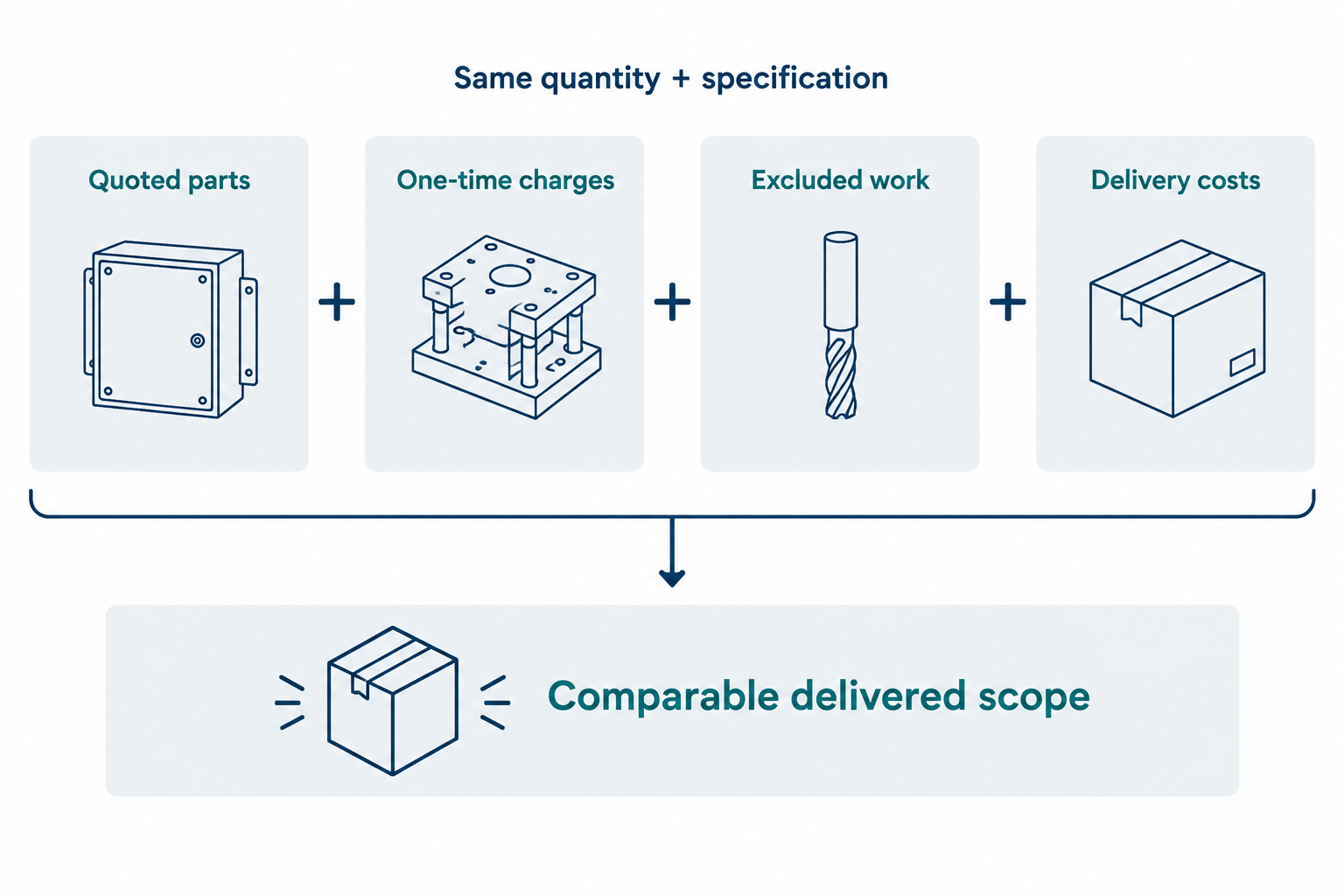
Use actual quoted values. Do not assign a guessed cost to an unconfirmed inspection or machining service just to make the spreadsheet look complete.
Tie the schedule to its starting event. Drawing approval, sample approval and receipt of specified materials can be different milestones. A lead-time statement is ambiguous if the supplier counts from final approval and the buyer counts from the purchase order. Record the proposed milestones and which response or approval releases the next stage.
Export packaging addresses transit risks that an enclosure’s in-service water or dust rating does not cover. Finished faces need protection from rubbing, and projecting handles need clearance from the crate or adjacent load. Loose hardware should be secured in separate, labeled packs rather than left free to strike the panels. Enclosure export packaging also needs restraints at approved structural points, away from thin doors or instruments. Packing materials, restraints and the shipping base belong in the quoted scope; a lower freight estimate is not comparable if those items are excluded.
Use a quotation comparison and first-article checklist
A supplier response is easier to evaluate when each requirement receives one of three answers: included as specified, proposed deviation with explanation, or excluded.
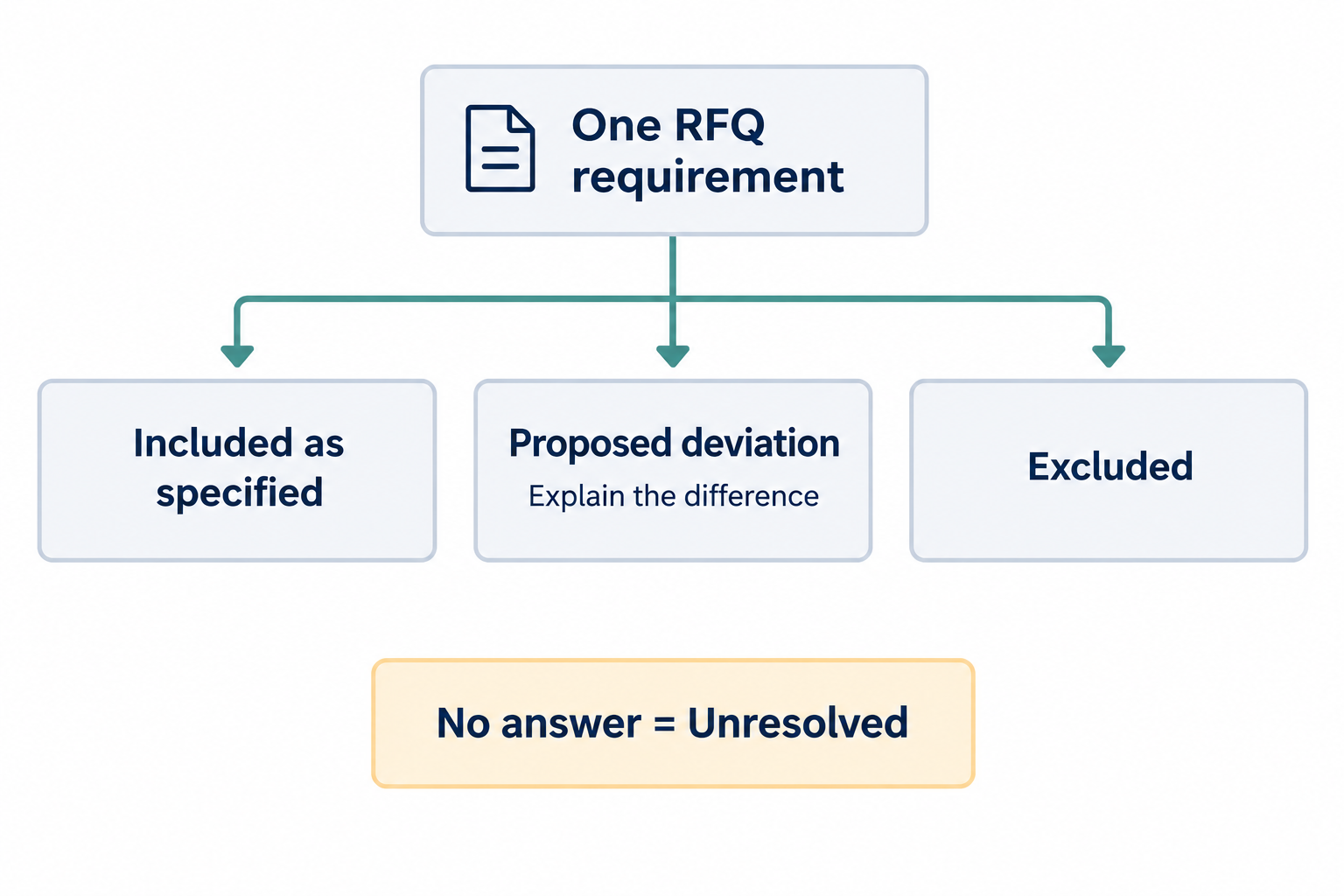
Silence should remain unresolved rather than being counted as agreement.
The following brief can form the body of the RFQ:
Please quote the enclosure assembly defined by the attached revision-controlled drawings and component list. Identify the proposed model, material grade and color, and separate any alternatives. State the included machining, finishes, accessories and assembly operations. List exceptions to the drawings or performance requirements explicitly. Separate one-time charges from recurring costs, describe the sample and inspection records included, and identify the documents supporting the proposed configuration. Give the quantity and delivery basis, approval milestones and treatment of subsequent changes.
The first-article plan then turns that written scope into acceptance evidence:
- Identity: the sample, drawing, material and accessory records refer to the same proposed configuration.
- Fit: the critical dimensions meet the agreed tolerances and the actual mating parts assemble without interference.
- Function: the required opening, closure, service access and application-specific trials work under their defined conditions.
- Repeatability: the supplier records the approved configuration and the controls for subsequent changes.
These checks answer different questions. A sample that fits establishes that sample’s fit; it does not by itself establish every production unit’s conformity. Protolabs describes process traceability as connecting material and process selection, production information, inspection and shipment documentation. The useful purchasing lesson is to keep the approved revision and relevant production records connected, with an inspection plan appropriate to the order. Its particular service package should not be assumed to apply to another supplier. [117]
Where a deviation affects the function, settle it before placing a production order. Where it only changes a preference, record the accepted alternative. That produces a comparison based on what will actually be supplied rather than on which quotation contains the fewest qualifications.
For an FN plastic enclosure inquiry, send the drawing revision, quantity and required supply scope, together with the installation environment and required performance documents. List unresolved requirements separately from the fixed dimensions and interfaces. The supplier’s response should identify the proposed configuration, included work and exceptions, allowing both parties to judge whether the offer matches the RFQ before comparing its price.
FAQ
What should a plastic enclosure RFQ include before prices are compared?
Define the same delivered assembly for every supplier: the proposed material and model, drawing revision, openings, finishes, accessories and assembly scope. Separate one-time work from recurring costs, and state the quantities, inspection records and delivery basis. Otherwise, a lower quotation may simply exclude machining, hardware or other work that another supplier included. [25][88]
Does an ISO 9001 certificate prove an enclosure’s IP or flame rating?
ISO 9001 concerns the supplier’s quality-management system. It is not an ingress-protection test result or a material-flammability record for the enclosure. Performance evidence needs to identify the relevant material or model and the configuration tested or certified; system certification and product evidence answer different purchasing questions. [105][172]
What does approval of a first enclosure sample establish?
Approval establishes the results actually demonstrated by the identified sample under the agreed acceptance conditions. A successful fit trial does not establish every production unit’s conformity or an untested performance rating. Keep the approved drawing, material and accessory configuration connected to the production records and inspection plan so later changes do not silently replace the approved assembly. [117]
Sources
[25] How To Specify Customized Plastic Enclosures For Your Electronics
[53] FRP vs. Fiberglass
[58] How to Specify Custom SMC: Technical Requirements and RFQ Checklist
[88] Understanding Injection Mold Cost for Parts and Tooling
[105] Why Your Parts Supplier Should be ISO 9001 Certified
[109] Let’s Get Critical (to Quality) with Injection Molding Part Design
[117] Traceability in Manufacturing and Why it Matters
[122] How to Modify Enclosures to Get the Design You Need for Less Time and Cost
[172] The UL Component Recognition Classification
[278] Case Study: Providing IoT Solutions with Allterco Robotics