
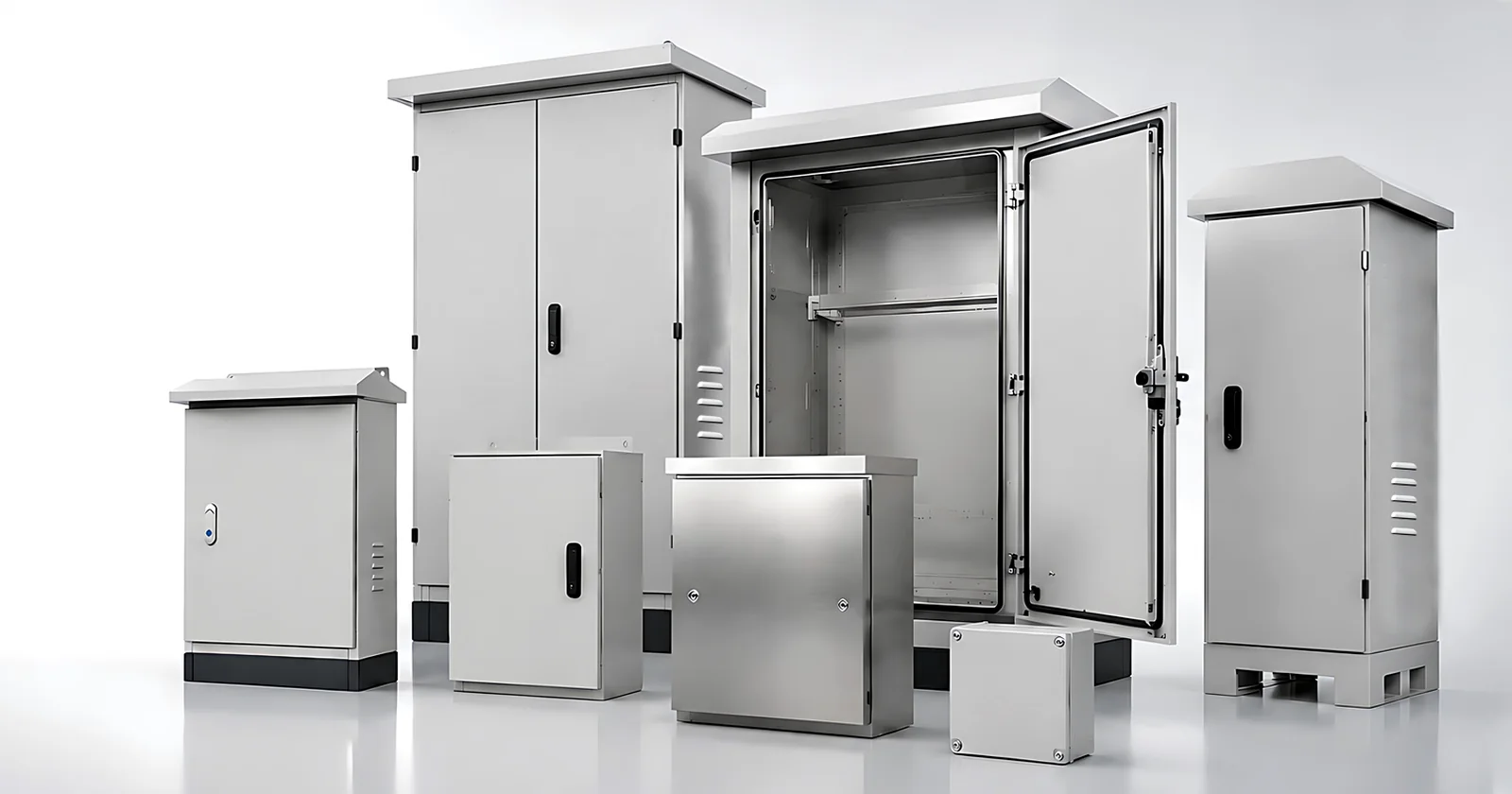

The quick answer: use fans and filters when the outside air is cooler and clean enough, use heaters when the real problem is condensation or low temperature, and use an enclosure air conditioner when the enclosure needs active cooling without mixing dirty or hot outside air into the cabinet. If the enclosure is outdoors, sealed, exposed to dust, or installed in a hot plant, do not choose by accessory price alone. Choose by heat load, ambient temperature, protection requirement, and how clean the surrounding air is.
For a filter-fan-specific selection, continue to the electrical enclosure filter fan guide. If the symptom is moisture rather than heat, use the condensation diagnosis guide before adding ventilation. For protection terminology, consult the official IEC 60529 publication page; a rating reference does not select the thermal method for a particular installation.
In simple terms, a fan moves heat out, a filter protects the airflow, a heater keeps moisture and cold from becoming a problem, and an air conditioner removes heat in a closed loop.
Start With the Real Question
Before choosing any cooling accessory, ask this:
What problem are we solving?
- The enclosure is too hot.
- The enclosure sweats or has condensation.
- The components fail during summer.
- The filter clogs too quickly.
- The cabinet must stay sealed.
- The site is dusty, wet, coastal, or chemically harsh.
- The electrical load changes during the day.
Those are different problems. A fan may solve one of them and make another worse. A heater may sound strange in a cooling article, but it is often part of outdoor enclosure climate control because moisture and low-temperature cycling can damage components just as much as heat.

Quick Selection Table
| Option | What it does | Best when | Be careful when |
|---|---|---|---|
| Fan only | Moves air inside or through the enclosure | Internal air circulation or simple ventilation | It may not protect against dust or water by itself |
| Filter fan / fan-and-filter unit | Pulls cooler outside air through a filter and exhausts warm air | Ambient air is cooler than the desired cabinet temperature and reasonably clean | Filters need maintenance; dirty air or high ambient temperature can make it unsuitable |
| Exhaust filter / passive vent | Lets warm air leave or pressure equalize | Low heat load or paired with a fan | Not enough for high heat load |
| Heater | Keeps temperature above dew point or prevents low-temperature issues | Outdoor cabinets, condensation risk, cold climates, shutdown periods | It does not cool; it may need a thermostat or humidistat |
| Air conditioner | Actively cools enclosure air in a closed loop | Ambient air is hot, dirty, humid, or the enclosure must stay sealed | Higher cost, power use, condensate handling, installation space |
Fans and Filters: Good When Outside Air Can Help
Fans and filters are the simplest enclosure cooling solution. They work by moving cooler ambient air into the enclosure and pushing warmer air out. Hammond describes blowers and filter fans as forced convection cooling, where ambient air flows through a filter into the enclosure to cool heated components.
This is useful when:
- The surrounding air is cooler than the target enclosure temperature.
- The environment is not too dirty, oily, wet, or corrosive.
- The heat load is moderate.
- The enclosure protection requirement allows filtered airflow.
- The maintenance team can clean or replace filters.
Rittal\’s technical catalog makes the same practical point: fan-and-filter units are cost-effective when ambient air is relatively clean and cooler than the desired internal enclosure temperature.
The mistake is using a filter fan where the outside air is already too hot or contaminated. In that case, the fan can bring heat, dust, moisture, or chemical exposure into the cabinet.
What Filters Actually Do
A filter is not just an accessory. It is part of the cooling system.
It helps reduce dust and debris entering the enclosure, but it also adds airflow resistance. When the filter becomes dirty, airflow drops. When airflow drops, internal temperature rises.
That is why filter maintenance matters. A cooling design that works on day one may fail after months of dust buildup if nobody checks the filter.
For quote and design discussions, always confirm:
- Airflow direction
- Filter location
- Replacement access
- Dust level at the site
- Whether the enclosure is indoor or outdoor
- Whether a rain hood or protective cover is needed
- Whether the protection rating can still meet the project requirement after cutouts are added

Heaters: Not for Cooling, but Still Part of Climate Control
Heaters do not cool an enclosure. They solve a different problem: condensation, low temperature, and temperature cycling.
Outdoor enclosures often cool down quickly after sunset or after equipment shuts down. If the enclosure surface drops below the dew point, moisture can condense inside. A heater can help keep the internal temperature above the dew point, especially when used with a thermostat or humidistat.
Rittal\’s outdoor climate-control guidance describes heaters as a way to avoid condensate formation, especially in outdoor installations. Hammond also lists heating products and temperature controls as part of its enclosure climate-control range.
Use a heater when:
- The enclosure is outdoors.
- The cabinet has condensation after shutdown.
- The site is humid or coastal.
- Components need a minimum operating temperature.
- The enclosure is sealed and moisture is trapped inside.
- Temperature swings are more dangerous than peak heat.
Do not choose a heater as a \”cooling\” fix. Choose it when moisture or cold is the real problem.

Air Conditioners: Use When the Cabinet Must Stay Cooler Than the Environment
An enclosure air conditioner is different from a fan. It actively removes heat from the enclosure. Many enclosure air conditioners are closed-loop systems, meaning the internal enclosure air is cooled without mixing with outside air.
Hammond describes its indoor enclosure air conditioners as closed-loop cooling that recirculates clean enclosure air without mixing it with contaminated ambient air.
Use an enclosure air conditioner when:
- Ambient air is hotter than the desired enclosure temperature.
- The cabinet contains drives, PLCs, power supplies, or other heat-sensitive electronics.
- The site is dusty, oily, wet, or chemically harsh.
- The enclosure must remain sealed.
- Filter fans cannot remove enough heat.
- The cost of downtime is higher than the cost of active cooling.
Air conditioners are not always the first choice because they cost more, need power, need space, and may create condensate that must be handled correctly. But when the enclosure must stay cooler than the outside air, a simple fan cannot do that.

When a Fan Is Not Enough
A fan cannot cool below ambient temperature. It only exchanges air or improves convection.
If the outside air is 40 C and the components need the cabinet to stay below 35 C, a fan will not solve the problem. It may only move hot air faster. If the outside air is dirty or humid, the fan may also bring that problem inside.
A fan is usually not enough when:
- Ambient temperature is higher than the required internal temperature.
- The site has heavy dust, oil mist, salt air, or chemical exposure.
- The enclosure needs a high sealing level.
- Heat load is high.
- Filters clog quickly.
- There are hot spots around drives or power supplies.
- The cabinet sits in direct sun without thermal planning.
What Information a Supplier Needs Before Recommending Cooling
Do not ask only \”Should I use a fan or air conditioner?\” Send the project conditions.
Useful information includes:
- Enclosure size
- Material and color
- Indoor or outdoor installation
- Maximum ambient temperature
- Minimum ambient temperature
- Sun exposure
- Dust, oil, moisture, salt, or chemical exposure
- Component heat load or component list
- Required internal temperature
- Required protection level
- Available power supply
- Space for side, door, or roof mounting
- Door opening frequency
- Condensation history, if any
If heat load is unknown, send the component list and layout. The supplier can at least identify likely heat sources and ask for missing data before selecting a cooling method.

A Practical Decision Path
Use this sequence:
- Check the heat source: what inside the enclosure produces heat?
- Check the environment: is outside air cool and clean enough?
- Check the protection target: can the enclosure have air openings?
- Check condensation risk: does it need heating or humidity control?
- Check maintenance reality: who will clean filters and inspect accessories?
- Choose the simplest method that still protects the components.
That last line matters. Overdesign adds cost. Underdesign creates failures. The right answer is not always the most expensive product. It is the one that matches the heat, air, moisture, and maintenance reality of the site.
Common Mistakes
| Mistake | Why it causes trouble | Better approach |
|---|---|---|
| Choosing a fan because it is cheaper | It may not cool enough or may pull dirty air inside | Check ambient temperature, heat load, and air quality first |
| Ignoring filter maintenance | Cooling performance drops as filters clog | Plan filter access and replacement interval |
| Using a heater as if it cools | It solves condensation, not high temperature | Use heaters for dew point and low-temperature problems |
| Adding cutouts without checking protection | Openings may affect sealing and water/dust protection | Confirm accessory rating and installation method |
| Choosing air conditioning without layout review | Unit may not fit or airflow may be blocked | Review mounting space, airflow path, and component layout |
| Forgetting condensate | Cooling can produce water that must be handled | Confirm drainage and installation instructions |
FAQ
Are fans and filters enough for most electrical enclosures?
They are enough when the ambient air is cooler than the desired internal temperature, reasonably clean, and the heat load is moderate. They are not enough when the site is hot, dirty, sealed, or has a high heat load.
Does an enclosure heater cool the cabinet?
No. A heater is used for condensation control, low-temperature protection, and dew point management. It is part of climate control, not cooling in the strict sense.
When should I use an enclosure air conditioner?
Use an air conditioner when the enclosure must stay cooler than the surrounding air or when outside air is too dirty, humid, or corrosive to bring into the cabinet.
Can a fan cool below ambient temperature?
No. A fan can move air and improve heat removal, but it cannot cool the enclosure below the surrounding air temperature.
Do filters reduce airflow?
Yes. Filters add resistance, and dirty filters reduce airflow further. That is why filter size, access, and maintenance matter.
What should I send for a cooling recommendation?
Send the enclosure size, component list, heat load if known, ambient temperature, installation environment, protection target, available power, and layout drawing.
If you are not sure whether your enclosure needs a fan, filter, heater, or air conditioner, send the enclosure drawing, component list, ambient temperature, and installation environment. The cooling method should be selected from the actual heat load and site conditions, not from accessory price alone.