

A UV-resistant plastic enclosure should retain the properties its installation needs after sunlight exposure: enough impact strength to withstand service, a sound surface around hinges and fasteners, and a cover that still closes correctly. The choice of plastic enclosure material alone does not establish that performance. Resin formulation, color and surface protection all affect UV resistance, so a useful specification connects those details to weathering results for the proposed product. [139][141]
For selection, give priority to evidence of retained mechanical performance and sealing function. Color stability matters where a faded label, cloudy window or discolored housing would impair use, but an attractive surface cannot substitute for evidence that the enclosure remains fit for service.
Separate water ingress protection from UV durability
A water-ingress rating and a weathering result answer different questions. The first addresses water entering an enclosure under specified test conditions. Weathering evidence describes what exposure does to the materials over time. A box can pass its original ingress test while its long-term behavior in sunlight remains undocumented; an IP marking alone therefore gives no outdoor service-life figure. [137][152]
That distinction matters most at the joints. Water protection relies on the relationship between the cover, gasket, fasteners and enclosure rim. UV-related changes in a plastic part may become important when they affect the geometry or strength that keeps that joint closed. The useful question is whether the weathering evaluation addresses the functions the installation relies on, rather than whether the catalog uses the word “outdoor.” Material and product testing have different scopes. [156]
Exposure also needs a location. A cabinet under a canopy, a pole-mounted roadside box and a housing behind glass do not receive the same combination of light, heat and moisture. Atlas describes separate exposure arrangements for natural sunlight and sunlight filtered through window glass. A report for one arrangement should not quietly become evidence for another. [156]
A UV-resistant enclosure can still take in water if roof runoff collects at a cover seam or a cable approaching from above carries water toward its gland. Mounting orientation and cable routing determine which openings remain wet, while access around the box determines whether seals can be inspected. These outdoor enclosure design details need their own review alongside the polymer’s resistance to sunlight.
Understand discoloration, embrittlement and surface changes
UV exposure can trigger chemical changes in polymers. The resulting damage may appear as yellowing, fading, loss of gloss, fine surface cracks or reduced mechanical strength. These effects do not necessarily progress together. Atlas identifies appearance changes and loss of strength as separate outcomes of weathering, which is why a single “passed UV testing” statement is too vague to compare products. [150][152]
A small color shift may be acceptable on an opaque cabinet in a service area. The same change could be unacceptable in a clear inspection window if it makes indicators harder to read. Cracks at a hinge attachment have a different consequence: they affect a loaded connection, even when the rest of the cover looks unchanged. Acceptance should follow the part’s function.
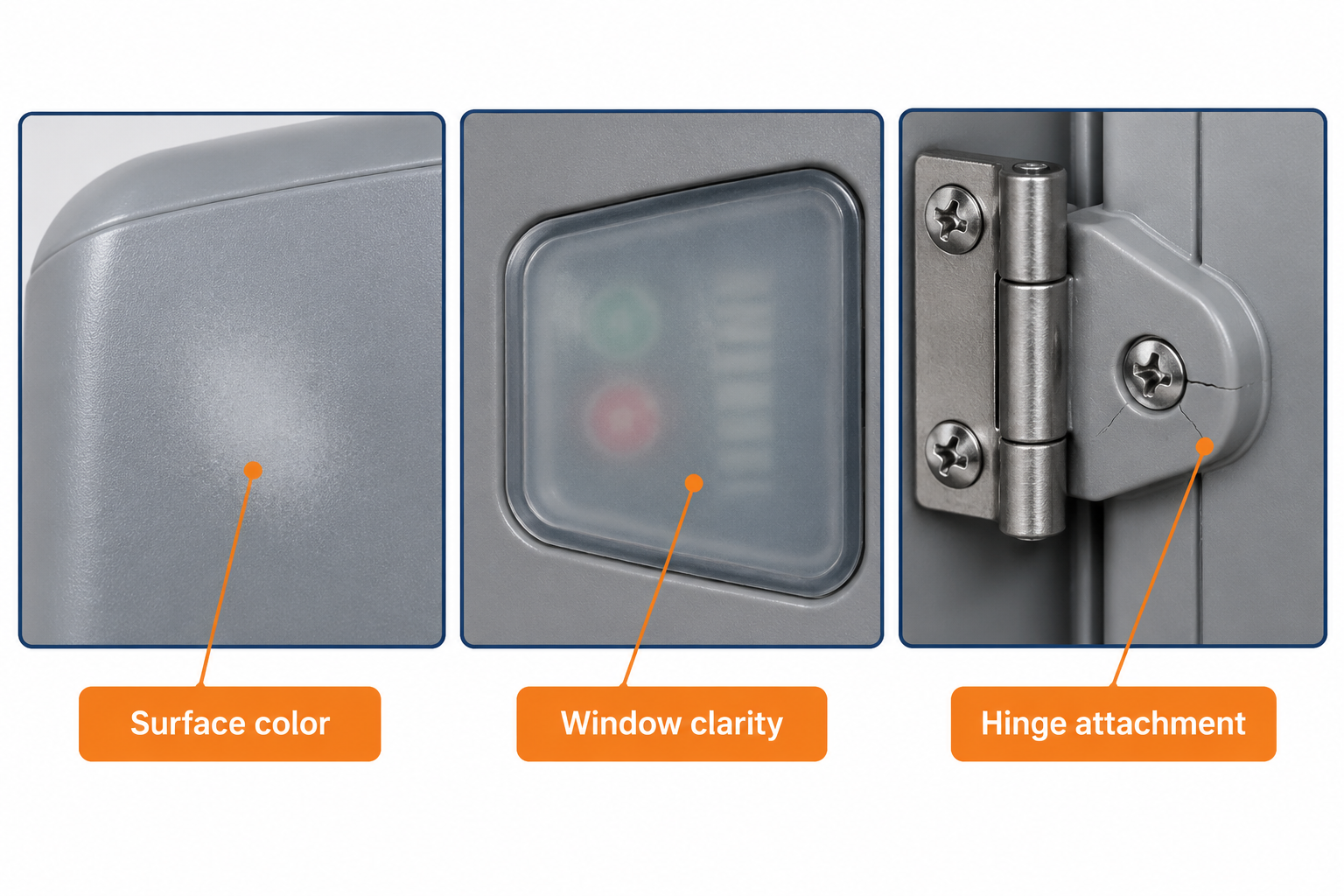
For a coated fiberglass enclosure, the protective finish is part of the selected construction. Allied Moulded explains that a coating can absorb UV before it reaches the underlying material. A result for an intact coated surface therefore does not establish the performance of an uncoated or damaged area. Treat the surface condition and any approved repair process as part of the material decision. [7]
A practical maintenance record can separate appearance from function: photographs of the same exposed faces, observations at loaded joints, and any change in cover alignment or gasket seating. That makes deterioration easier to track without pretending that a visual inspection measures residual strength.
Check resin grade, color and weathering evidence
UV stabilizers, pigments and coatings can alter how a plastic responds to sunlight. Ensinger lists stabilizing additives, black pigmentation and protective coatings among the ways UV resistance can be improved. This is a formulation issue, not a reason to assume every black plastic or every painted surface is suitable outdoors. [139]
Color belongs in the material specification because it can affect both appearance testing and the specimen’s temperature during exposure. Atlas notes that color, infrared absorption, thickness and backing influence surface temperature and degradation behavior. Two tests with the same chamber setting may therefore expose different specimens to different thermal conditions. [159]
The most useful weathering evidence joins three things: what was tested, how it was exposed and what changed afterward. For example, a named gray resin tested for retained impact strength gives a clearer basis for a gray, impact-exposed enclosure than a color-change result for an unidentified white sample. Neither result automatically covers the finished assembly.
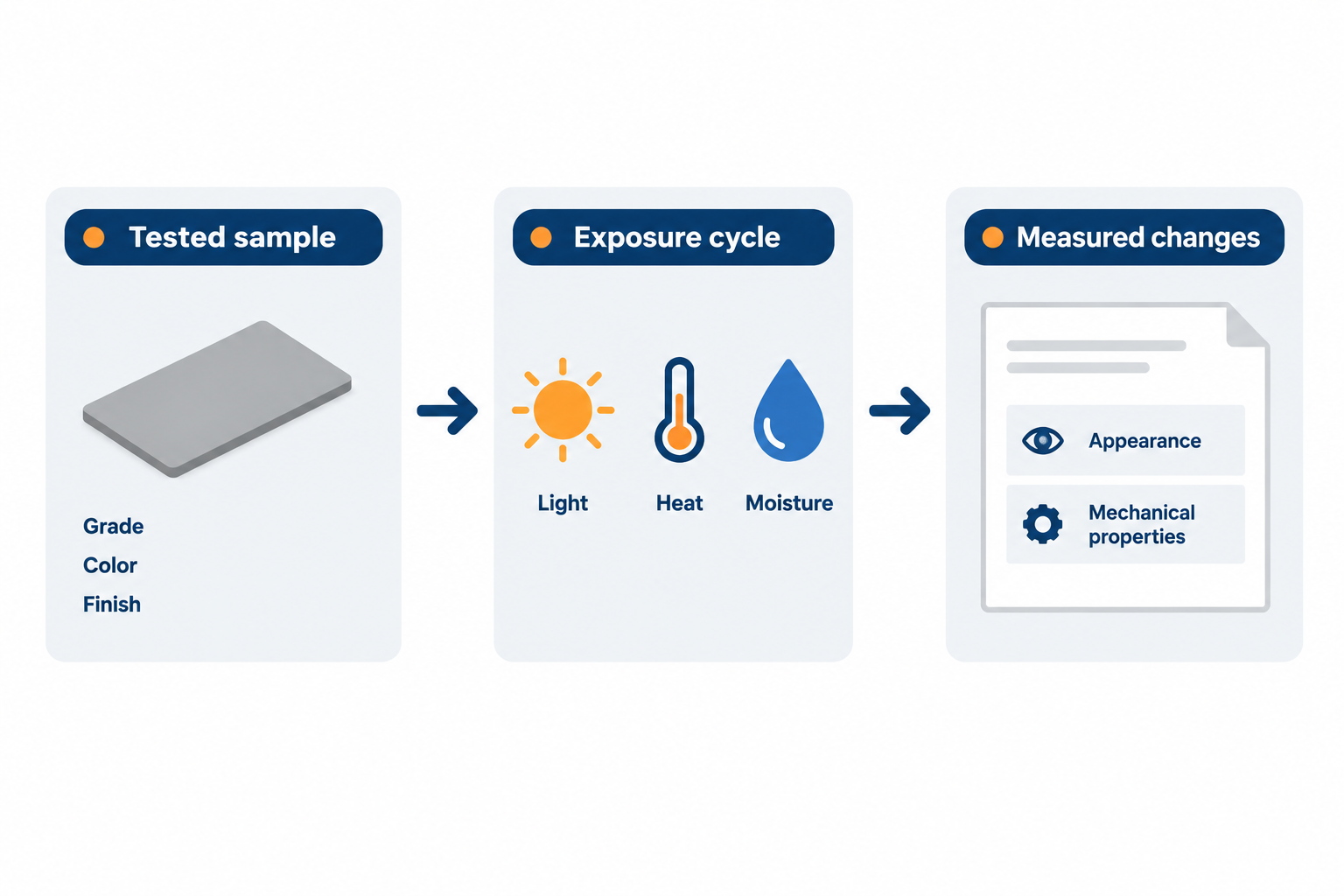
Test methods also differ. Fluorescent-UV and filtered xenon-arc equipment use different light sources and moisture arrangements. Atlas explains that full-spectrum xenon exposure is particularly useful when evaluating color and appearance changes that involve more than a narrow UV band. A method name without its exposure cycle and acceptance criterion leaves the result difficult to interpret. [150]
What a supplier’s SMC catalog can tell you
A YONGTONG SMC catalog describes resistance to ultraviolet light and aging. That statement identifies weathering as an intended material attribute, but the photographed page does not supply a test method, exposure duration or retained-property results. It can support a discussion with the supplier about the relevant grade and finish; it cannot supply a number of outdoor service years. [SMC36]
The same restraint applies to accelerated-test hours. Atlas cautions that matching a laboratory UV dose to outdoor radiation ignores temperature, moisture and other weather effects. A service-life relationship needs demonstrated correlation for the material, property and exposure being discussed. “Tested for a certain number of hours” is meaningful only with the test conditions and measured outcome. [154]
Review solar heating, seals and installed exposure
Sunlight creates a thermal problem as well as a weathering problem. The exposed surface temperature may differ from the surrounding air temperature, and Atlas identifies specimen temperature as an important driver of degradation. A resin’s UV test cannot replace an assessment of heat generated inside the enclosure or of the temperature reached at the cover, seal and mounting points. [159]
Shading is worth examining where direct sun is unnecessary. The proposed shade must leave room for the door to open, avoid obstructing ventilation and allow maintenance. Those are design decisions for the installation; they do not establish an untested material’s outdoor durability.
Fibox’s case study of the Poznań Intelligent Transportation System illustrates how these requirements meet. The manufacturer reports supplying pole-mounted ARCA cabinets for traffic equipment, with UV exposure, rain, snow, humidity and temperature variation among the application demands. The cabinets housed equipment including AC/DC devices, routers and batteries. The useful lesson is to specify the installed cabinet and its contents together. The case does not publish the weathering data needed to derive a general PC enclosure lifespan. [287]
An outdoor enclosure gasket ages separately from its rigid housing. Compression set means the seal fails to recover its original thickness after being squeezed; stress relaxation means it exerts less force while held at the same compressed height. A gasket can therefore still touch the frame without applying its original sealing pressure. The closed-door gap and selected gasket’s working compression range govern that joint, which is why gasket compression and aging belong in the enclosure’s service assessment even when the body remains sound.
Build an inspection and material-verification checklist
Use the evidence to make a selection, rather than collecting documents without deciding what they mean.
| Evidence or observation | What it helps decide |
|---|---|
| Named resin grade, color and surface finish | Whether the offered enclosure matches the material represented by the weathering data |
| Exposure method, light source and moisture cycle | Whether the test addresses the relevant sunlight and wetting conditions |
| Retained mechanical properties | Whether the evidence covers functional durability as well as appearance |
| Finished-part or assembly evaluation | Whether joints, covers and interacting materials were included |
| Exposure history and repeat photographs in service | Whether visible changes are progressing at important locations |
Prefer the enclosure with applicable, traceable results over one supported only by a higher test-hour headline. If two products have similarly relevant evidence, compare their actual installation constraints next: mounting, access, sealing details and heat management.
Where weathering evidence is missing, the uncertainty is specific: retained performance after the proposed exposure has not been established. Resolve that gap before treating the enclosure as qualified for the intended outdoor duty. The next useful step is a comparison of the candidate material and test records against the installation, not a promise of service life based on the polymer name.
FAQ
Can accelerated UV-test hours be converted directly into years outdoors?
No general conversion is reliable. Matching a laboratory UV dose to outdoor radiation leaves out temperature, moisture and other weather effects. A service-life estimate needs demonstrated correlation for the particular material, measured property and exposure. Without that correlation, the useful result is what changed under the stated test conditions, not a promised number of outdoor years.[154]
Does fading prove that a plastic enclosure has lost its strength?
Fading and loss of mechanical strength are different weathering outcomes, so one cannot establish the other. Appearance changes still matter when a window becomes hard to read or a label becomes unclear. Cracks at a loaded attachment or changes in cover alignment deserve separate attention because those observations concern the enclosure’s function, not just its color.[150][152]
Is black plastic automatically UV resistant?
Black pigmentation can help improve UV resistance, but color alone does not qualify an enclosure for outdoor use. The formulation, surface protection and weathering results still need to match the proposed product. Color also influences surface temperature during exposure, so evidence for a different color cannot simply be assumed to describe the supplied version.[139][159]
Does an IP rating establish the outdoor life of a plastic enclosure?
An IP water-ingress result describes water entry under specified test conditions; it does not give the housing’s service life in sunlight. Outdoor selection also needs weathering evidence for the supplied materials and the functions they support, such as cover closure and loaded attachments. A successful original ingress test leaves those aging questions unanswered.[137][152]
Sources
[7] How Are Non Metallic Enclosures Protected from UV Exposure?
[137] Selecting an IP67 Enclosure for Outdoor Electronics Applications
[139] UV resistant plastics
[141] SPECIFYING UV RESISTANT ENCLOSURES
[150] Major Differences between Xenon-Arc and Fluorescent-UV Devices
[152] Weathering Testing Standards for Polymers
[154] How Long do I Need to Test? Part 2: Estimations Based on Radiant Exposure
[156] The Differences Between Material and Product Testing
[159] Measure Sample Surface Temperature Inside a Weather-Ometer with S3T
[287] Poznań, Poland
[SMC36] YONGTONG SMC supplier catalog, photographed page 36, supplied for this project. Edition and publication date were not provided. This is catalog evidence, not an FN test report.