
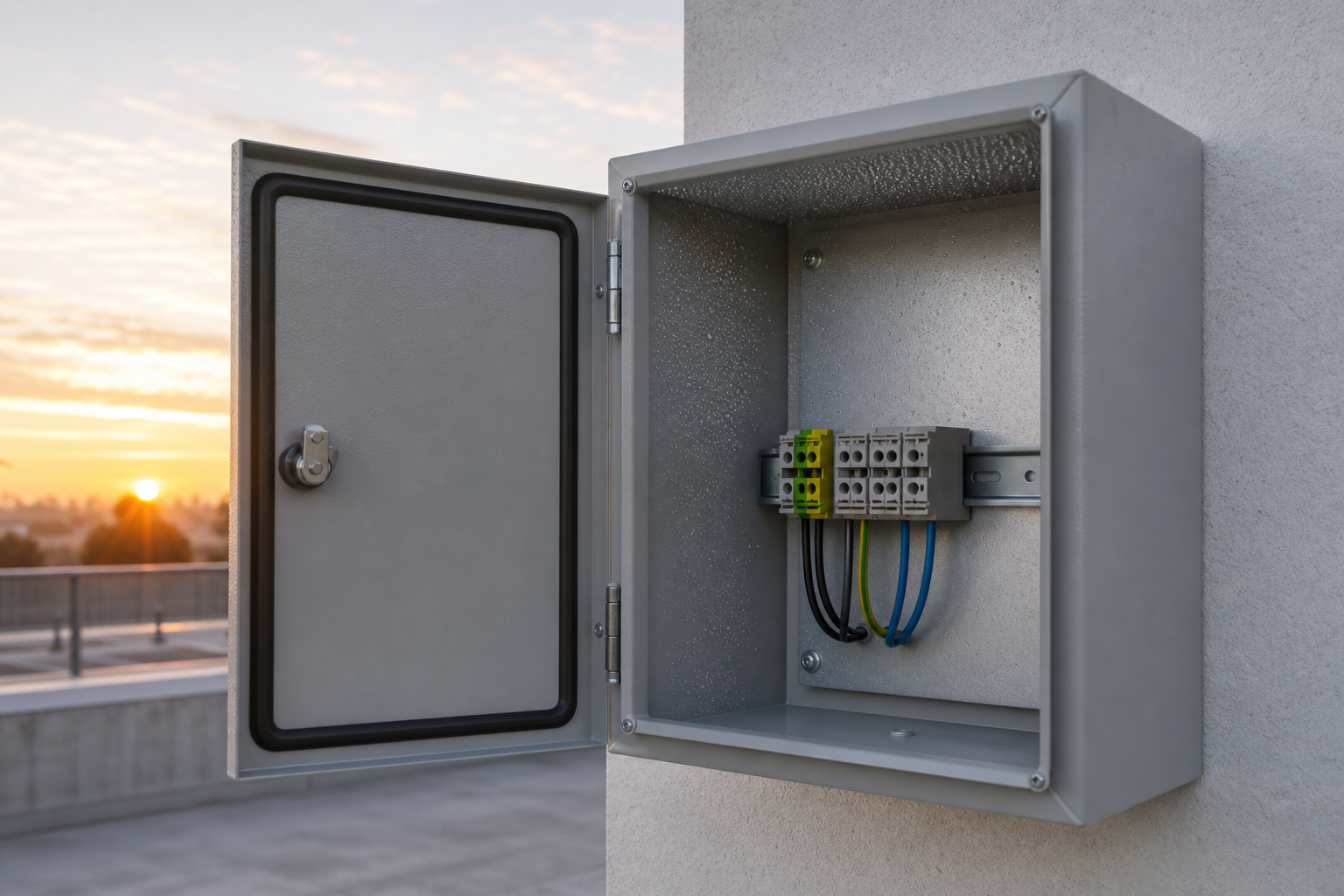

Condensation or water ingress?
A film of water or widespread droplets on cold surfaces after sunset or shutdown points toward condensation. A trail below a gasket, gland, conduit, cutout, or seam after rain or washdown points toward direct water ingress.
Check both possibilities. A leak can add moisture that later condenses, and cold rain can cool the enclosure enough to trigger condensation.
Before choosing a heater, fan, gasket, or enclosure: log the internal temperature and relative humidity, measure the coldest surface, and note when and where water first appears. Compare that surface temperature with the calculated dew point.
01 / Record the conditions
Measure before you choose a fix
Log the cooling or shutdown cycle that produces the water. A reading taken while the cabinet is warm may miss the event.
Work safely. Do not touch wet components or open an energized enclosure to take these readings. Qualified personnel should follow the site’s electrical isolation and lockout/tagout procedures before inspection or sensor installation. Set up logging so the enclosure can stay closed during operation. See OSHA electrical safe-work practices.
Record the event time alongside the air readings, surface temperatures, and photos. Add the corrective change and result when you repeat the test.
| Evidence | What to record | Why it matters |
|---|---|---|
| Event timing | Date, time, equipment state, sunset or startup time, rain, washdown, and recent weather change | Separates shutdown cooling and night cycles from direct rain or cleaning events |
| Internal air | Temperature, relative humidity, logger location, and time interval | Provides the inputs needed to estimate the dew point and shows how fast the air changes |
| Cold surfaces | Roof, door, wall, mounting plate, or thermal-bridge temperature near the event | Tests whether a real surface reached or crossed the dew point |
| Moisture pattern | Photos of the highest wet point, broad film, droplets, trails, stains, and the bottom puddle | Broad films favor condensation; localized trails help trace an ingress path |
| Openings and seals | Gasket continuity, latch pressure, glands, conduit, vents, drains, windows, cutouts, fasteners, and field changes | Identifies completed-assembly paths that an empty-enclosure rating cannot diagnose |
| Corrective test | One change, the date it was made, and the result over comparable cycles | Prevents several simultaneous changes from hiding the real cause |
Surface-to-dew-point margin =
coldest surface temperature − internal dew point
Calculate the internal dew point from temperature and relative humidity readings taken at the same time. A surface at or below that temperature can develop condensation. A positive margin at one location does not rule out a colder surface elsewhere or an earlier event.
Note where the logger sits and how often it records. Compare similar weather and operating cycles, changing one variable at a time. A single reading or an intact gasket is not enough to identify the cause.

02 / Choose a response
What to check before buying components
A confirmed leak calls for repairs to the seal or entry path. If a surface reaches the dew point, review internal climate control. Also check whether the enclosure and accessory layout suit the outdoor exposure.
| What you find | What to check or select next | Relevant guide |
|---|---|---|
| A localized water path at a door, gland, seam, or cutout | Check gasket continuity and compression, door fit, latch pressure, glands, and accessory installation. Repair the identified path first. | Foam gaskets: compression, aging, and sealing |
| Cold surfaces reach the dew point during shutdown or night cooling | Assess controlled heating, moisture reduction, pressure cycling, and permitted drainage. Size and verify the control for the actual cycle. | Compare enclosure cooling and heating options |
| Heat removal is needed and outside-air exchange is being considered | Check ambient temperature, humidity, contamination, airflow, ingress target, and maintenance. A fan is not a general-purpose dehumidifier. | Electrical enclosure filter fans |
| The enclosure or accessory layout does not fit the outdoor exposure | Review the base enclosure, entry locations, shading, ventilation, drainage, and installation conditions before fixing the layout. | Outdoor electrical enclosures Custom enclosure review |
If a leak and condensation occur together, include both leak repair and condensation control in the plan.
03 / Check the pattern
How to distinguish a leak from condensation
Compare when the water appears, where it starts, and whether it forms a broad film or a local trail. Use the temperature and humidity record to check the pattern over similar weather and operating cycles.
| Clue | Condensation is more likely | Direct ingress is more likely | Next check |
|---|---|---|---|
| Timing | After sunset, shutdown, a cold front, or rapid cooling | During or soon after rain, washdown, or spray | Compare the event with temperature, humidity, weather, and duty-cycle records |
| Moisture pattern | A broad film or many small droplets on the roof, walls, or mounting plate | A local trail, drip line, or wet area below one opening or seam | Trace the highest wet point, not only the puddle at the bottom |
| Location | Coldest metal surfaces and thermal bridges | Door edge, gland, conduit, vent, window, field cutout, or fastener | Inspect compression, fit, accessory installation, and conduit routing |
| Repeatability | Returns during similar night or shutdown cycles | Returns during similar rain or cleaning events | Record several cycles before changing multiple variables |
| Door and gasket | May look intact because trapped moisture can still condense | Visible damage, uneven compression, loose latches, or contamination may point to ingress | Check the full sealing chain: door flatness, gasket continuity, hinges, and latch pressure |

Use the guide to foam gaskets for electrical enclosures to review compression and aging. Check door flatness, hinges, and latch pressure too; seal replacement alone may leave other leak paths unchanged.
Hypothetical diagnostic pattern
Dry while running. Wet by sunrise.
An outdoor control cabinet stays dry throughout the afternoon. By sunrise, droplets cover the inside roof. The gasket looks intact, with no obvious water trail from a gland or door edge.
- While running: internal heat keeps the roof warm.
- After shutdown: the metal roof cools faster than the trapped air.
- By sunrise: the roof crosses below the internal dew point.
- What appears: broad droplets with no clear entry trail.
This is an illustrative example, not an FN customer case. Check whether the same sequence occurs in your installation using air and surface readings recorded at the same time.
When should you investigate?
- Dry at noon, wet at dawn? Check the night-cooling cycle.
- Wet after shutdown? Check what lost its standby heat.
- Water after washdown? Trace a direct entry path first.
- Condensation after a cold rain? Compare roof temperature with dew point.
- Moisture below a conduit or cable entry? Trace the highest wet point.
- Check the coldest surface before replacing the gasket.
04 / Understand the mechanism
Why does moisture condense inside an enclosure?
Condensation in electrical enclosures forms when moist internal air contacts a surface at or below its dew point. The air next to that surface reaches saturation, and water vapor can turn into liquid.
Inside and outside air temperatures alone cannot show whether condensation will form. Compare surface temperature with dew point. Air near powered equipment may stay warm while the metal roof or door cools enough for water to form.
A rule such as “condensation starts at 60% RH” leaves out temperature. Dew point depends on both temperature and moisture content. The US National Weather Service’s dew-point guide explains this distinction. The ASHRAE psychrometrics chapter covers saturation and dew-point calculations.
The three-condition check
Condensation needs three conditions:
- Moisture is present inside the enclosure.
- A wall or component falls to or below the dew point.
- The condition lasts long enough for a film or droplets to form.
Controlling moisture, surface temperature, or the duration of exposure can reduce the risk. Use the readings to decide which condition to address.
A simple example
At 30 °C (86 °F) and 70% relative humidity, the air inside a cabinet has a dew point of about 24 °C (75 °F). A roof that cools to 23 °C can develop condensation while the internal air is still warm.

Reading the surface-to-dew-point margin
Subtract the internal dew point from the coldest measured surface temperature. The table shows what positive and negative margins mean at the time of measurement.
| Example reading | Margin | What it means at that moment |
|---|---|---|
| Roof at 27 °C; dew point at 24 °C | +3 °C | The measured roof is above the dew point. Condensation is not expected on that surface at that reading. |
| Roof at 23 °C; dew point at 24 °C | −1 °C | The surface is below the dew point. Condensation can form if moisture and contact time are sufficient. |
The margin can turn negative after sunset, shutdown, cold rain, or a drop in internal heat. It describes the conditions at the measured surface and time, not a product rating or guarantee. A daytime reading can miss the event.
05 / Follow the operating cycle
Why are outdoor electrical enclosures especially vulnerable?
Outdoor enclosures heat and cool throughout the day. Their metal skin often changes temperature faster than the equipment inside.
- Daytime heating: Sunlight and powered equipment warm the cabinet and internal air.
- Air expands: Pressure rises and some internal air moves out through normal interfaces.
- Rapid cooling: Sunset, shutdown, cold rain, or wind cools the roof and walls.
- Moisture condenses: Pressure falls, humid air may enter, and cold surfaces cross the dew point.
What changes after shutdown
Equipment heat may keep surfaces above the dew point during operation. After shutdown, that heat falls away and the cabinet can cool for hours with moist air still inside. A panel that was dry while running may therefore be wet by morning.
How temperature changes move air
Internal air expands as it warms and contracts as it cools. The pressure difference can move small amounts of air through cable entries, door interfaces, accessory openings, or conduits. Repeated cycles can add moisture without an obvious large leak.
A pressure-equalization membrane can reduce this pressure difference in a suitable installation. It does not dry the air or repair a leaking gasket or gland. STEGO explains the temperature-driven mechanism in its pressure compensation device guidance.

When choosing outdoor electrical enclosures, review the daily temperature swing, solar exposure, mounting position, cable entries, and shutdown heat load alongside the ingress-protection target.
Where does the moisture come from?
Moisture can enter as vapor or liquid through several paths:
- Assembly and maintenance: humid air enters when the door is open or when the enclosure is built and wired.
- Temperature-driven air exchange: repeated heating and cooling moves air through small interfaces.
- Cable and conduit paths: water or condensate can travel along a conduit, especially when the enclosure is a low point.
- Wet materials: damp cable, insulation, packaging, or standing water can release moisture after the door is closed.
- Process vapor: the application itself may release moisture.
- Direct ingress: damaged gaskets, loose latches, incorrect glands, unused holes, field cutouts, or poorly fitted accessories can admit rain or washdown water.
Condensation and a leak can happen together
A small leak can raise the moisture level inside the enclosure. When the roof or walls cool overnight, that moisture may condense across a much wider area. Repair the leak and check whether condensation continues.
What damage can repeated condensation cause?
A thin moisture film may dry before anyone opens the door. Corrosion or intermittent faults can remain even when no water is visible. Repeated condensation can cause:
- Corrosion on terminals, DIN rails, conductors, fasteners, and enclosure surfaces
- Higher contact resistance and localized heating at affected connections
- Lower insulation resistance, leakage current, nuisance trips, or short circuits
- Intermittent PLC, relay, sensor, or communication faults
- Sparking or arcing under adverse electrical conditions
- Shorter component life and more difficult troubleshooting
The nVent HOFFMAN condensation paper describes these failure modes. The risk depends on voltage, contamination, materials, spacing, maintenance, and how long components remain exposed to moisture.
Why an IP65 or IP66 rating does not eliminate condensation
An enclosure can pass specified external water-ingress tests and still develop condensation inside.
IEC 60529 classifies enclosure protection against access, solid foreign objects, and water ingress. Humid air trapped inside can still condense on a cold surface. An ingress rating does not control the internal climate.
IEC 62208:2023 applies to empty enclosures before electrical equipment is installed. Glands, cutouts, vents, drains, cooling units, wiring, mounting, and field changes all affect the completed configuration. Match accessories to the protection target and verify the final assembly.
Compare IP65 and IP66 enclosure ratings for external ingress, and assess internal moisture and temperature cycling separately.

09 / Select controls by cause
Preventing condensation in electrical enclosures: start with the cause
Repair leaking glands and provide suitable drainage for standing water. Then assess the moisture that remains or enters during each temperature cycle. Choose heating, ventilation, or desiccant only where it addresses the measured conditions.
Repair direct water-entry paths
Check the door seal, cable glands, conduit routing, cutouts, and accessory interfaces. After repairs, inspect again during comparable weather or cleaning conditions. Continue the dew-point measurements if condensation is still suspected.
Check whether a filter fan suits the conditions
A filter fan exchanges enclosure air with ambient air. This may remove equipment heat where the outdoor conditions and protection requirements allow it, but it can also bring in moisture or contaminants. Check shutdown conditions separately; ventilation alone may not prevent condensation.
Before making a fan cutout, use the electrical enclosure filter fans guide to check airflow, inlet and exhaust positions, environmental exposure, filter maintenance, and completed-assembly protection. Compare other options in the guide to fans, filters, heaters, and air conditioners.
Match the control to the mechanism
| Control | Best fit | Important limit |
|---|---|---|
| Gasket, gland, latch, and cutout repair | Known or suspected external water path | Does not remove moisture already trapped inside |
| Pressure-equalization membrane | Large temperature swings that create pressure differentials | Does not dehumidify the air or replace leak repair |
| Heater with suitable control | Cold nights, low standby heat, or shutdown condensation | Must be sized for enclosure, climate, surface area, and duty cycle |
| Closed-loop cooling or dehumidification | Hot, humid, dusty, salty, or contaminated ambient air | Needs condensate management, maintenance, power, and thermal sizing |
| Rated drain or breather drain | Residual liquid that can be safely routed out at a low point | Must suit the completed enclosure’s protection and installation requirements |
| Desiccant | Small, controlled volumes or short-term protection | Has limited capacity and becomes a maintenance item |
| Open ventilation | Clean, dry ambient air with acceptable temperature | Can make the problem worse in humid, dusty, salty, or corrosive locations |

Avoid improvised fixes
An uncontrolled lamp or heater provides no documented temperature or humidity control. Drilling a drain hole can change the enclosure’s ingress protection. Use components suited to the environment and completed configuration, and assign responsibility for sizing, controls, power, drainage, maintenance, and verification.
Check the result: document one change, then repeat the air and surface measurements under comparable weather and operating conditions. Confirm that the water no longer appears and that the change has not introduced overheating, ingress, maintenance, or drainage problems.
Airflow and dehumidification performance
An open-access simulation study of high-voltage switchgear found that dry-air dehumidification performance depended on airflow distribution and the difference between enclosure-wall temperature and return-air dew point. Its equipment and method do not provide a general sizing rule for outdoor enclosures. Evaluate a dehumidifier or dry-air system against the enclosure’s airflow, surface temperatures, moisture load, and operating cycle.
10 / Prepare the design review
What should a buyer send the enclosure supplier?
Discuss condensation before finalizing the drawing to help avoid rework. For a custom electrical enclosure review, send the operating conditions that determine dew point, heat flow, air paths, and accessory layout:
- Minimum and maximum ambient temperature
- Relative humidity range or installation location and climate
- Daily temperature swing, solar exposure, shade, wind, and cold-rain exposure
- Internal heat load and whether the equipment runs continuously or shuts down
- Enclosure dimensions, material, color, mounting position, and surrounding clearance
- Cable and conduit entry locations, routing, and low points
- Rain, washdown, dust, salt, chemical, and cleaning conditions
- Required ingress-protection target and any project-specific test documents
- Permitted heater, controller, vent, drain, cooling, and insulation provisions
- 2D/3D drawings, component layout, and available site photos
- Temperature/RH logs, cold-surface measurements, timestamps, and weather or shutdown records from the event
- Photos showing the highest wet point, moisture pattern, conduit routing, cable entries, and field modifications
These details let the supplier review structure, door fit, gasket compression, cable entries, cutouts, heat load, drainage, and accessories. A request for a “waterproof” or “condensation-proof” box leaves those conditions undefined. For each moisture-control accessory, agree who selects and sizes it, supplies power and controls, manages condensate, and verifies the completed configuration.
If cable entries, fan or heater provisions, drainage, door sealing, and mounting changes need to be coordinated, review custom electrical enclosures from your drawings before fixing the cutouts and accessory locations. Include the measurement record and photos with the dimensions.
Frequently asked questions
Can condensation form inside a sealed electrical enclosure?
Yes. Moist air can be trapped during assembly, installation, or maintenance. Temperature changes can also move air through small interfaces, cable entries, and conduits. If an internal surface falls below the dew point, water can form without an obvious rain leak.
Does an IP66 rating prevent condensation?
No. An IP rating covers specified external ingress conditions. It neither removes moisture already inside nor keeps every internal surface above the dew point.
Should I add ventilation to stop enclosure condensation?
Check the ambient conditions first. Ventilation may help in a clean, dry environment, but it can introduce moisture, dust, salt, or hot air in other locations. The method must also meet the completed enclosure’s protection requirements.
Does every outdoor electrical enclosure need a heater?
No. A heater may help when surfaces fall below the dew point. The project may instead need leak repair, pressure equalization, closed-loop cooling, dehumidification, rated drainage, or several of these measures. Choose according to climate, heat load, duty cycle, enclosure size, and installation details.
How can I tell whether water came from a leak or condensation?
Check when and where the water appears. A broad film on a cold roof or wall after night cooling or shutdown suggests condensation. A local trail below a gland, seam, door edge, or conduit after rain or washdown suggests ingress. Both can occur together; use temperature, humidity, and inspection records to confirm the cause.
Planning an outdoor enclosure?
Review condensation risk before the cutouts are fixed.
Send drawings, temperature and humidity logs, cold-surface readings, and photos showing where water first appears. Include the installation environment, duty cycle, and required protection target.
FN can review enclosure-side provisions for project-specified glands, vents, drains, heaters, or cooling equipment. Agree who will select and size each component, supply power and controls, and verify the finished installation.
The completed configuration still needs verification for moisture control and the required ingress-protection target.
Technical references
These references cover condensation mechanisms and design considerations. They do not certify an FN enclosure or a completed installation.
- US National Weather Service — Dew point vs. relative humidity
- ASHRAE Handbook — Psychrometrics
- STEGO — Pressure compensation device guidance
- nVent HOFFMAN — Condensation in electrical enclosures
- IEC 60529 — Degrees of protection provided by enclosures
- IEC 62208:2023 — Empty enclosures for low-voltage switchgear and controlgear assemblies
- OSHA 1910.333 — Selection and use of work practices
- Simulation study of dry-air dehumidification in high-voltage switchgear