
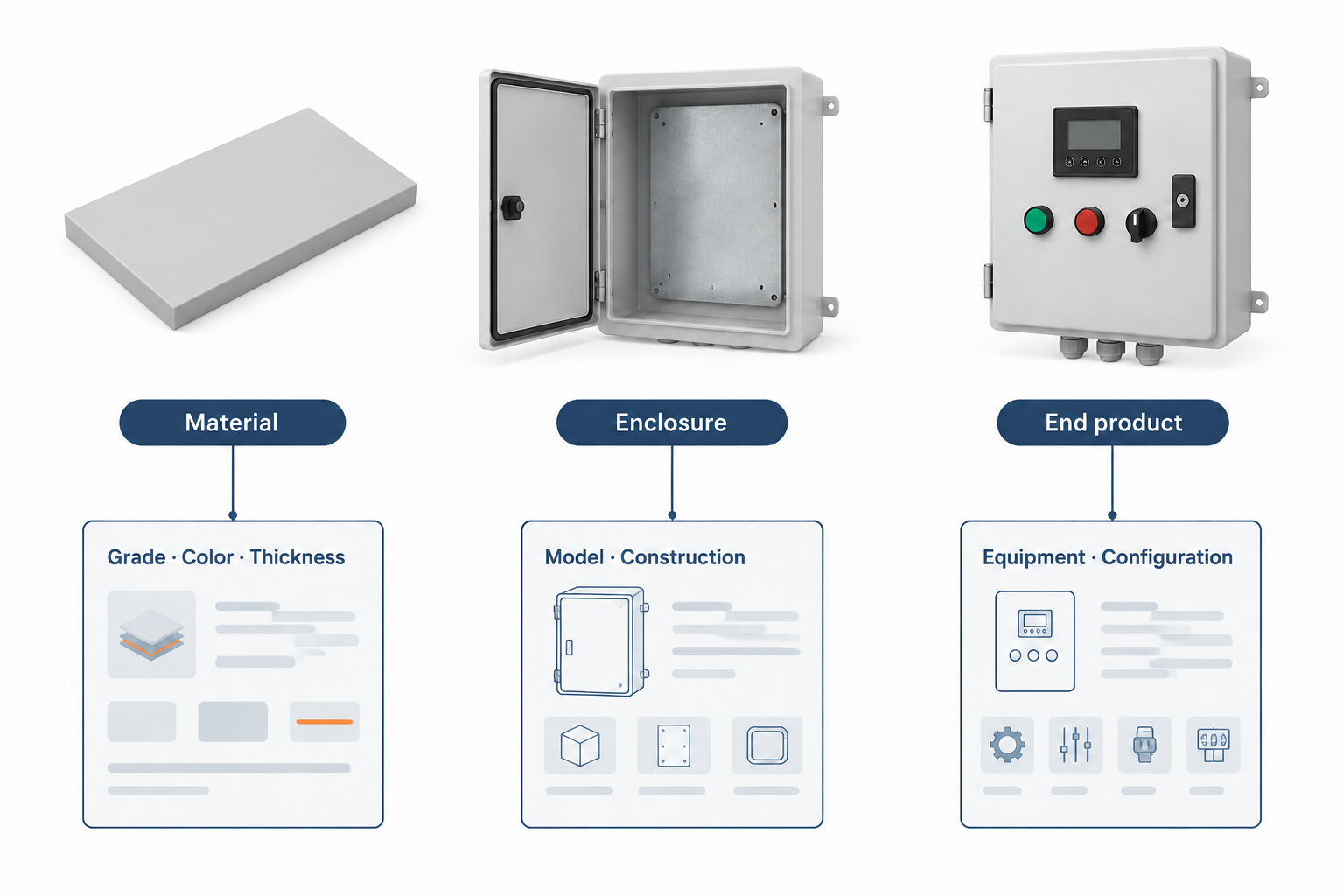
UL 94 describes how plastic test specimens behave when exposed to a flame under defined conditions. A UL 94 V-0 material claim does not, by itself, establish certification of the finished enclosure, its water protection or the electrical equipment installed inside it. For purchasing, connect the material record to the exact enclosure construction, then examine the separate evidence required for the enclosure and end product. [48][172]
This distinction prevents a common comparison error: treating a resin data sheet and a finished-product certification as interchangeable documents. Both can be useful. They support different parts of the decision.
Identify what each material or enclosure document covers
Begin with the object named in the document. A resin grade, a molded enclosure and an assembled control unit are different products, even when one is used to make the next.
| Document | What it can establish | Where its support stops |
|---|---|---|
| Material catalog or data sheet | The supplier’s published properties for a named grade | It does not prove that the offered enclosure uses that grade or that the complete product is certified |
| Material test report | Results for the identified specimens and test conditions | Untested thicknesses, formulations or other conditions are not established by the report |
| UL material or component recognition record | Evaluation of a component within its stated scope and conditions of use | It is not certification of a complete standalone end product |
| Finished-enclosure certification record | The listed product or product family and the applicable scope | It should not be extended to a different construction or an assembled machine without the relevant evaluation |
UL explains that Recognized Components are intended for incorporation into larger products and are evaluated with conditions of acceptability. Those conditions can address housing, wiring or temperature. A recognized component helps the end-product evaluation, but it does not complete that evaluation on its own. [172]
For example, an equipment specification asking for a flame-rated housing material needs material evidence. A specification asking for a certified enclosure with a particular environmental Type rating also needs evidence for that enclosure. If the purchasing team accepts only the resin document for both requirements, the second requirement remains unresolved.
The supplier’s name on a certificate is not enough to bridge the gap. The identifiable product and construction are what connect the record to the order.
Read the material grade, thickness and flammability record
UL 94 classifications apply under specified test conditions. The material grade and thickness are central to interpreting the result, and formulation changes can affect the classification. Protolabs specifically warns that a thinner wall, custom blend or colorant change can fall outside an existing material record. [164]
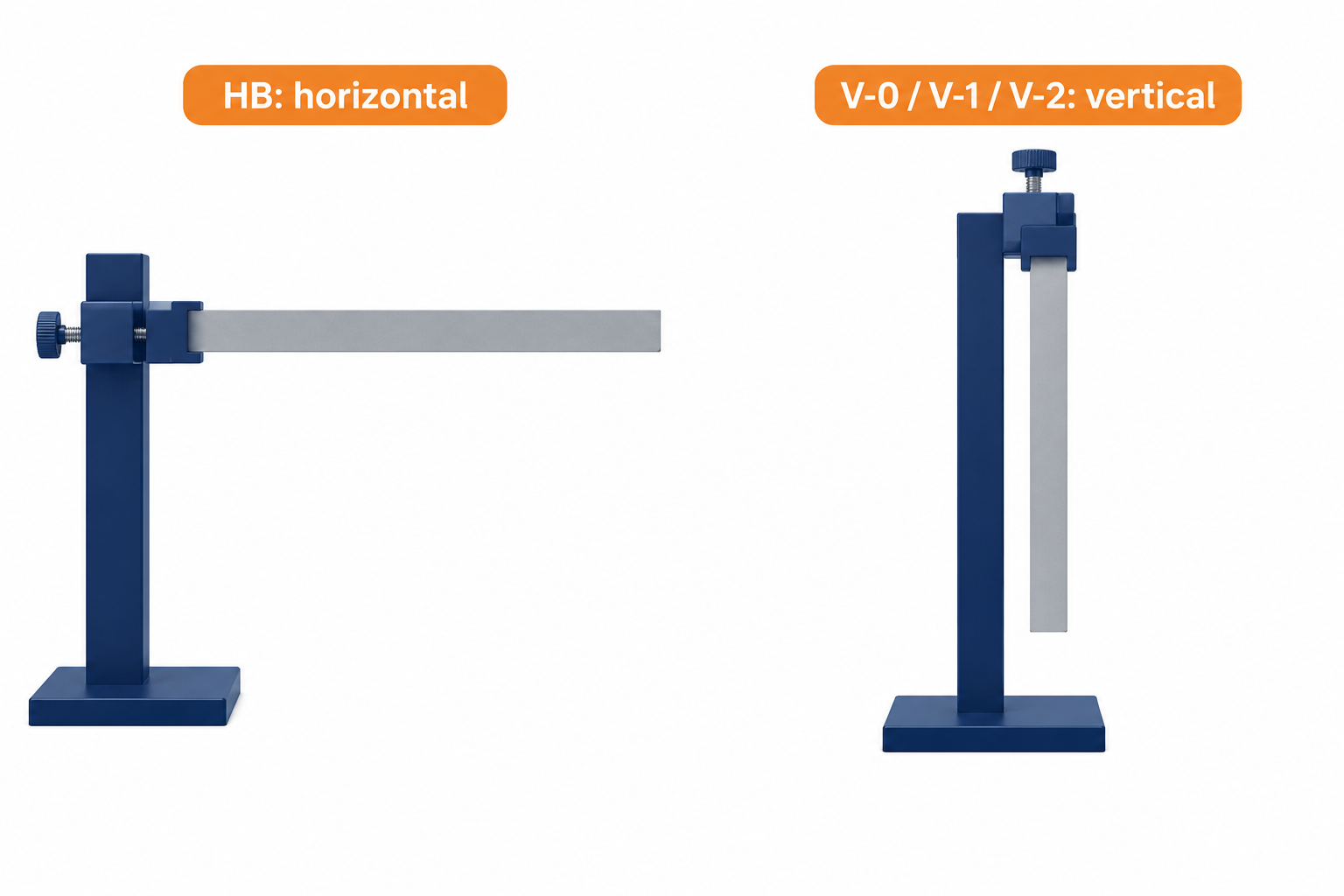
The familiar labels also represent different test behavior. HB concerns horizontal burning. V-0, V-1 and V-2 use vertical specimens. V-0 has tighter afterflame time limits than V-1 or V-2; V-2 permits flaming drips that ignite the cotton indicator, whereas V-1 does not. The full classification also includes other test criteria. These labels guide material selection; they do not measure how long a finished cabinet protects its contents in a building fire. [48][164][173]
Why one SMC catalog shows several classifications
The photographed YONGTONG material table lists several SMC grades under a row labeled “UL-94.” Four readable examples are:
| SMC grade | Classification printed in the catalog |
|---|---|
| HY1112 SMC | V0 |
| HY1243 SMC | HB |
| HY1221 SMC | V1 |
| HY4233 SMC | V2 |
The values above retain the catalog’s typography. They are supplier-listed values; the photograph does not supply specimen thickness, color coverage or the underlying report and recognition file. [SMC37]
For a fiberglass enclosure specification, “SMC” alone does not identify a flame classification. An order requiring a particular classification needs the relevant grade and supporting record. Choosing the highest value on the page and applying it to every cabinet would discard the differences the supplier’s own table shows.
The preceding catalog page uses wording that translates as “can reach FV0.” The qualifier and designation should be retained when discussing that statement. Without its original test basis, it should not be rewritten as proof that every pictured cabinet has UL 94 V-0 material recognition. [SMC36]
Thickness changes matter for the same reason. If a molded wall is thinner than the material thickness represented by the relevant classification, that document does not establish the thinner wall’s performance.
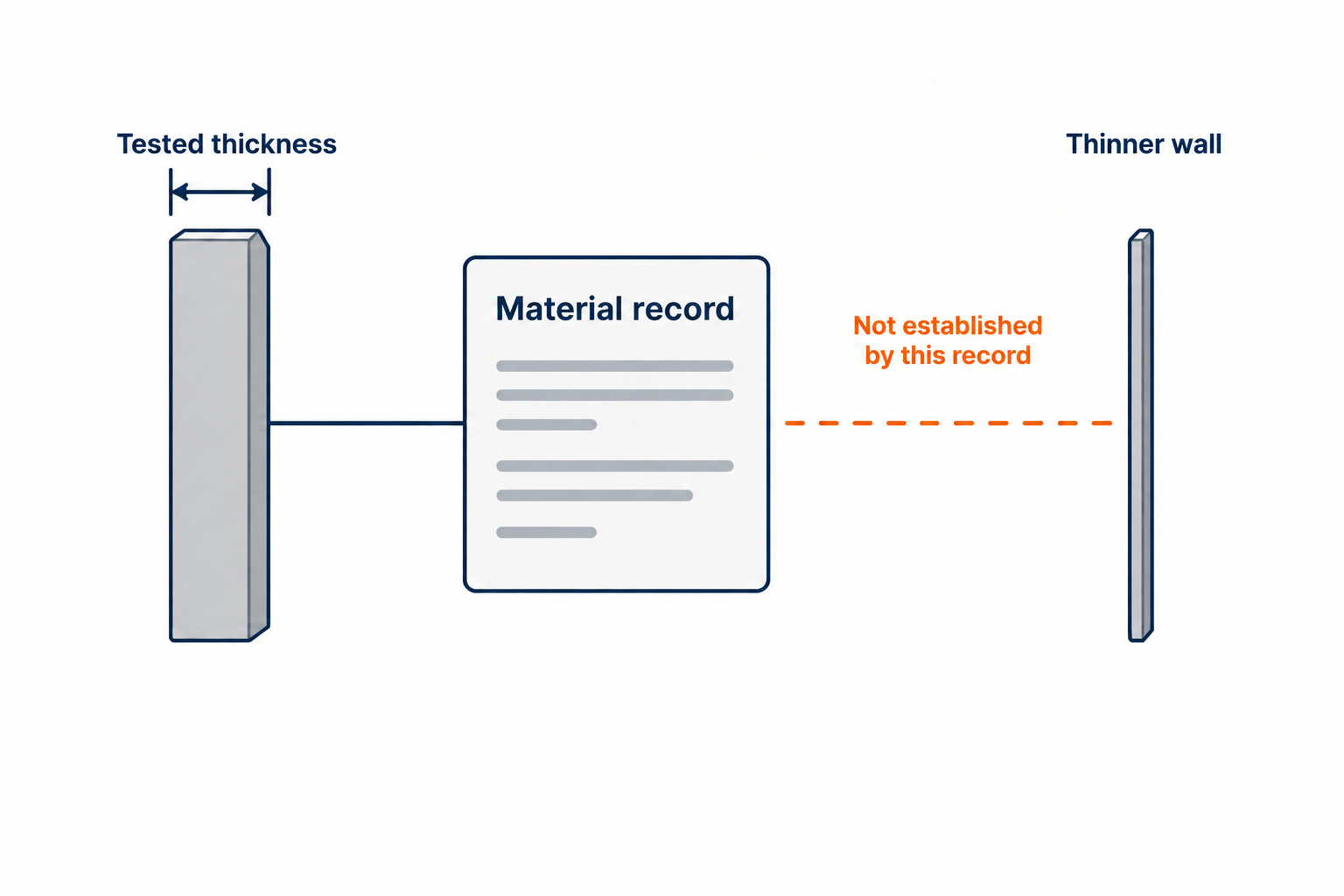
The correct response is a supported construction or additional applicable evidence, rather than assuming the material name covers the change. [164]
Color is part of formulation control too. Protolabs notes that colorants can affect flame-retardant characteristics. A new color should therefore remain within the material record’s scope or be evaluated through the appropriate process. [38]
RTP Company’s Pomona electronic-probe case makes the component boundary concrete. The inner polypropylene compound is reported as V-2 at 1/32 inch, or 0.79 mm, while a separate thermoplastic-elastomer overmold provides the grip. The stated classification belongs to the identified inner compound at the stated thickness; it is not evidence for the outer layer or certification of the complete probe. Although this is a test accessory rather than an enclosure, the same reading discipline applies to a box with a separate cover, window or gasket. [289]
Separate outdoor suitability from flammability evidence
A flame classification does not establish resistance to sunlight, moisture or a chemical cleaner. Those exposures involve different mechanisms and evaluations. An outdoor enclosure can require both appropriate flammability evidence and evidence that its materials and joints remain suitable in the installed environment.
UL’s service description for environmentally rated enclosure accessories illustrates the separation. It discusses corrosion resistance, UV degradation and the ability to maintain an environmental seal. It also identifies gaskets and seals as components that can be evaluated within the applicable program. Those are distinct questions from how a plastic specimen reacts to a test flame. [306]
For a gray enclosure with a transparent cover, outdoor suitability should address the offered cover as well as the body. A flame-rated body resin does not answer whether the window becomes difficult to read after exposure or whether the sealing construction remains suitable. The practical comparison is between complete proposed constructions with the evidence relevant to each requirement.
Avoid turning every material property into a certification demand. Establish the required performance and the accepted form of evidence for the project, then judge whether the supplied documents actually cover it. A named test result and a certification record should be described according to what each is.
Check UL 50/50E and IP/NEMA enclosure evidence separately
UL 50 and UL 50E address electrical enclosures at a different level from a material flammability classification. The published scope of UL 50 covers non-environmental construction and performance requirements, including protection against incidental contact with enclosed equipment. UL 50E provides additional environmental construction and performance requirements and is used with the applicable general or end-product requirements. [304][305]
These scope descriptions do not mean that any enclosure displaying the words “UL 50E” has been certified. A claim still needs the identifiable model, certification record and applicable construction.
An IP Code classifies protection against access, solids and water ingress. A North American enclosure Type rating may also include other environmental requirements, such as corrosion resistance for Type 4X; the scope varies with the Type. These NEMA and IP rating differences are why IP66 alone does not demonstrate Type 4X compliance. UL’s accessory program can evaluate Type ratings, IP Codes or both, so a project naming both needs evidence for both designations. [306]
Environmental protection has limits that matter in use. UL 50E’s published scope excludes protection against conditions such as condensation or contamination occurring inside the enclosure or entering through conduit or unsealed openings. The environmental rating therefore does not remove the need to design the actual cable entries and moisture-control arrangement. [305]
Request documents for the exact finished configuration
A useful document package traces the order through three levels: material, enclosure and final installation. Record the manufacturer and grade of the relevant plastic, its applicable thickness and color, and the supporting report or recognition reference. Match those records to the offered enclosure model and drawing revision.
Then describe the configuration that will be delivered. A changed cover, added window, cooling accessory or cable entry may introduce a new material or sealing interface. A component’s own rating does not automatically demonstrate how it performs when installed in a different wall or joint. UL’s accessory guidance expressly relates environmental sealing to the surface on which the accessory is installed. [306]
Adding a gland, window or vent creates a new interface in the enclosure’s protective boundary. A rated accessory can still leak if its hole is oversized, its gasket is unevenly compressed or the enclosure wall is outside the accessory’s permitted thickness range. For a modified box, the finished enclosure rating rests on the documented combination of shell, cutout, accessory and installation. When a modification falls outside that configuration, the existing evidence does not establish the rating of the new assembly.
If two suppliers offer similar boxes, compare the evidence against the same requirements. A material claim may be entirely adequate for one requirement while leaving another unanswered. State the gap specifically: an unlinked resin grade, an unsupported wall thickness, an unidentified enclosure model or an uncovered accessory arrangement.
Once the material and construction are linked to the applicable documents, the purchasing decision becomes clearer. You can select a supported configuration or identify the exact change needed, without treating a V-0 label as a substitute for every other product requirement.
FAQ
Does UL 94 V-0 mean an enclosure is UL certified?
A UL 94 V-0 classification describes flame behavior for a specified plastic material under defined test conditions. It does not establish certification of the finished enclosure or the equipment inside it. The material record must match the relevant grade, thickness and formulation; a finished-product certification must identify the enclosure model and the scope it covers. [48][164][172]
Does the same UL 94 classification cover every wall thickness and color?
The classification applies within the material record’s stated scope. A thinner wall, a different blend or an added colorant can fall outside that scope. A supplier offering another thickness or color therefore needs an applicable material record; the polymer name alone does not establish equivalent flame behavior. [164][38]
Is a flame-rated plastic enclosure suitable for outdoor use?
A flame classification does not establish resistance to sunlight, moisture or chemical cleaners. Outdoor suitability also involves the body, cover and sealing interfaces under the intended exposure. UL’s environmental-accessory guidance addresses UV degradation, corrosion and sealing separately, so a flame-rated body resin cannot stand in for evidence covering the complete outdoor construction. [306]
Sources
[38] Finding a Balance with Resin Colorants
[48] Flammability 101 for Plastic Electronic Enclosures
[164] UL 94 Classification and Flame-Retardant Materials
[172] The UL Component Recognition Classification
[173] UL 94 flammability tests explained
[289] Electronic Probe
[304] UL 50: Enclosures for Electrical Equipment, Non-Environmental Considerations — official scope
[305] UL 50E: Enclosures for Electrical Equipment, Environmental Considerations — official scope
[306] Environmental-Rated Accessories for Enclosures
[SMC36] YONGTONG SMC supplier catalog, photographed page 36, supplied for this project. Edition and publication date were not provided. This is catalog evidence, not an FN test report.
[SMC37] YONGTONG SMC supplier catalog, photographed page 37, supplied for this project. Edition and publication date were not provided. This is catalog evidence, not an FN test report.