


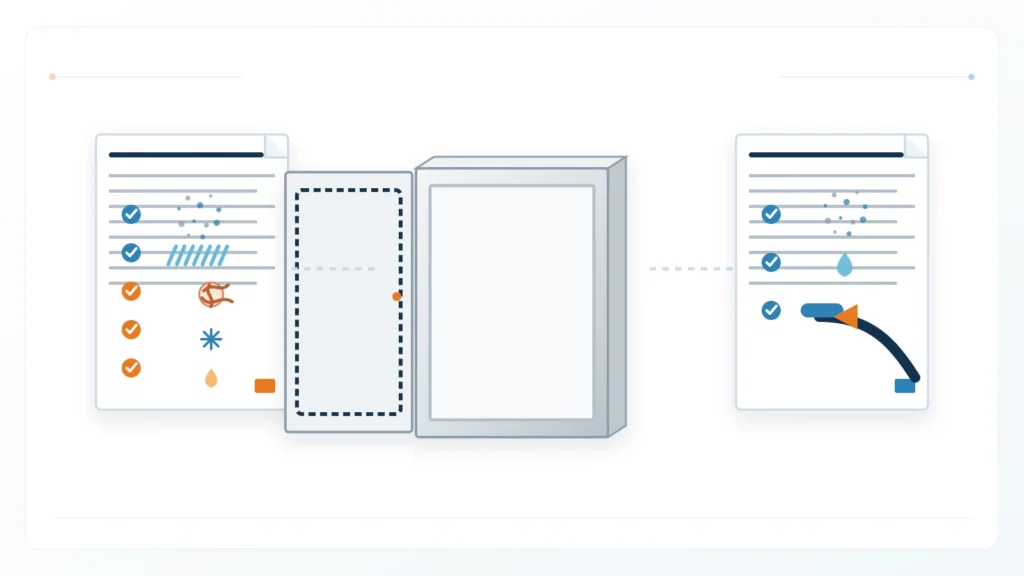
If a drawing specifies NEMA 4X but a supplier quotes IP66, do not approve the substitution by comparing the numbers. Ask three questions first:
- What standard does the project require?
- What exposure must the finished enclosure withstand?
- What evidence covers the exact enclosure, openings, hardware, and accessories?
That is the practical answer to NEMA vs IP ratings: the systems overlap, but they are not interchangeable labels.
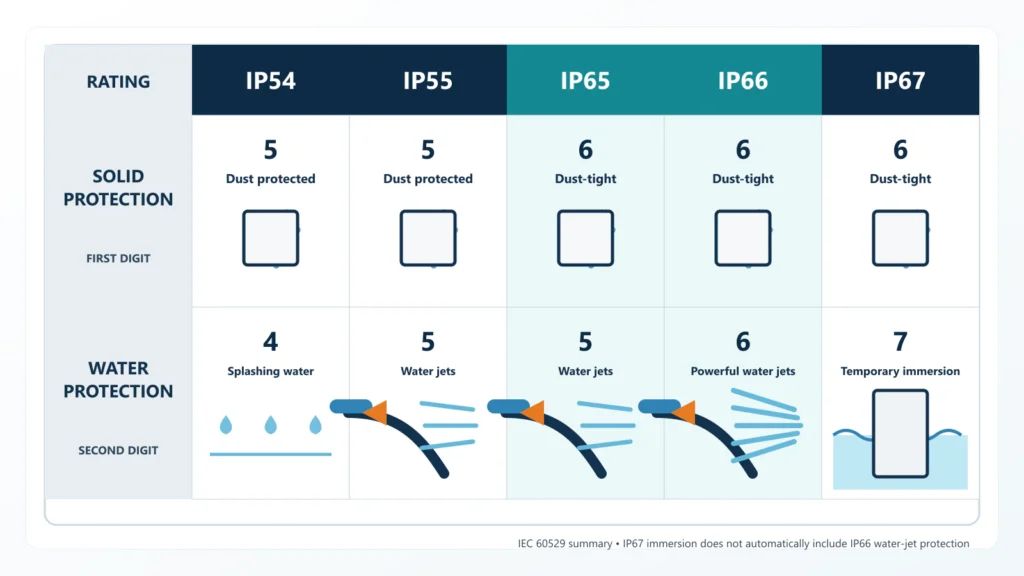
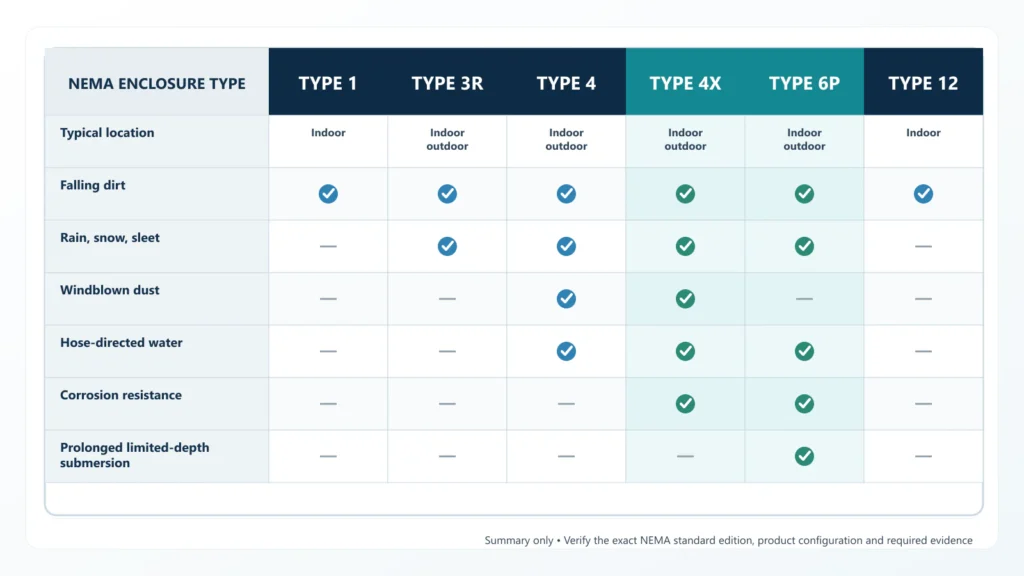
An IP code describes protection against access, solid objects, and water ingress under IEC 60529. A NEMA Type covers a broader set of enclosure requirements under the applicable NEMA standard. Depending on the Type, the requirements may also address conditions such as corrosion, icing, oil, or coolant exposure.
Do not use an IP number to erase a NEMA requirement, or a NEMA Type to guess an IP code. If the project names both, specify and verify both.

NEMA vs IP Ratings: The Short Answer
| Question | NEMA enclosure Types | IEC IP codes |
|---|---|---|
| What do they classify? | Type-specific enclosure protection and environmental performance | Protection against access, solids, and water ingress |
| Typical notation | Type 1, 3R, 4, 4X, 6P, 12 | IP54, IP65, IP66, IP67, IP68 |
| Do the systems cover the same conditions? | No. The scope depends on the Type. | No. The two digits do not describe every NEMA requirement. |
| Can one label prove the other? | No. A NEMA Type does not automatically prove an IP code. | No. An IP code does not automatically prove a NEMA Type. |
| What should appear in the purchase documents? | The exact Type, configuration, and required evidence | The exact IP code, configuration, and required evidence |
Neither system is automatically better. The project specification decides which one governs. If you searched for IP rating vs NEMA, the same rule applies: start with the designation named in the project documents.
Start With the Requirement on the Drawing
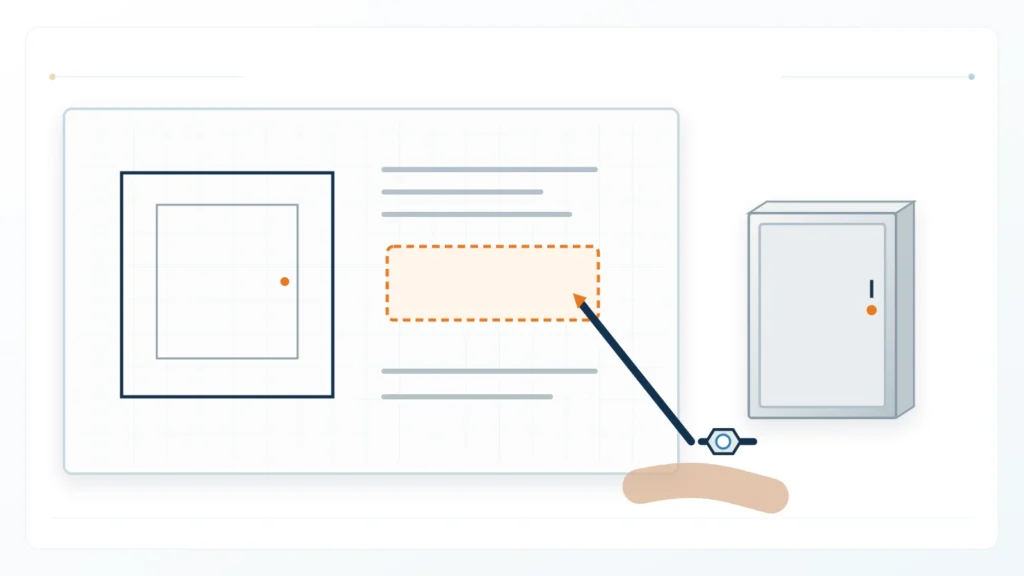
Before selecting an enclosure, look for the exact designation in the drawing, customer specification, purchase order, authority requirement, or certification file.
The wording matters. This is the practical answer to NEMA rating vs IP rating: keep the designation the project actually requires.
- IP65 required: verify IP65 for the configuration being supplied.
- NEMA Type 4 required: verify Type 4; do not replace it with IP65 because the numbers appear similar.
- NEMA Type 4X required: verify Type 4X, including the requirements that matter for corrosion and the project environment.
- Both required: list the NEMA Type and IP code as separate acceptance requirements.
This prevents a common quotation mistake: treating “waterproof enclosure” as if it were a complete technical specification. It is not. The specification still needs the exposure, configuration, openings, and evidence.
Can NEMA and IP Ratings Be Converted?
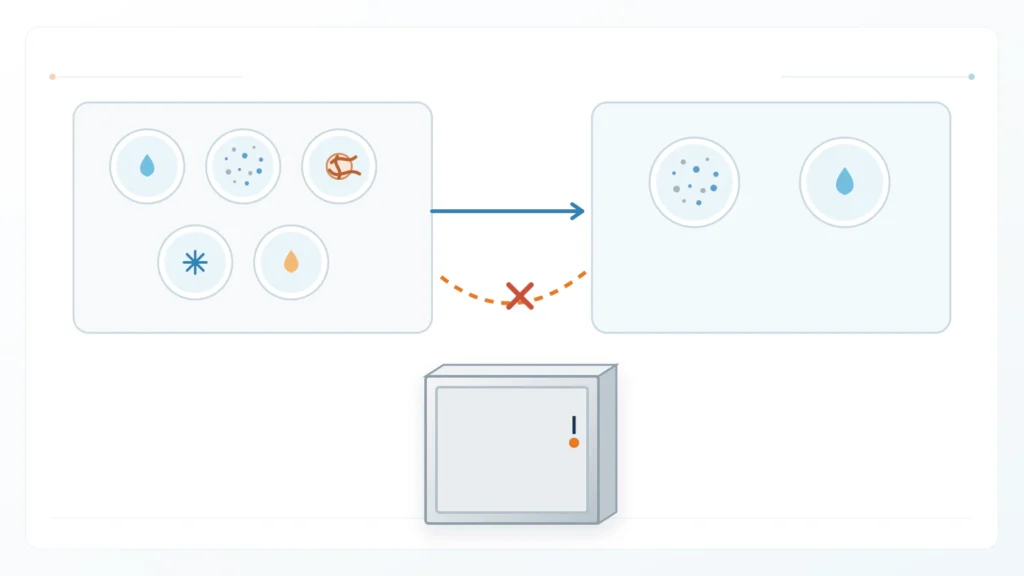
You can compare them. You cannot safely convert them like inches to millimeters.
NEMA publishes a NEMA enclosure Type and IEC IP comparison table. Use that table to identify overlapping ingress performance, not to approve a reverse substitution.
The direction matters. A NEMA Type may meet a stated IP ingress classification, while the IP classification may not address every condition required by that NEMA Type. That is why a NEMA to IP conversion chart cannot serve as a universal certificate of equivalence.
Before using an IP to NEMA conversion or NEMA to IP conversion chart, check:
- Which standard edition does the chart use?
- Is the comparison one-way or being treated as reversible?
- Does it cover the exact model and completed configuration?
- Does the project require a declaration, test report, certification, or marked product?
- Are the door, gasket, glands, windows, vents, fans, drains, and field modifications included?
For U.S. work, check the edition named in the project documents. ANSI lists ANSI/NEMA EN 10250-2024 as the current standard reference and ANSI/NEMA 250-2020 as historical. An undated chart should not decide a compliance question.
Is IP65 Equivalent to a NEMA Rating?
No. IP65 alone does not identify one NEMA Type.
That is the answer to IP65 NEMA equivalent, IP65 equivalent to NEMA, and what is the NEMA equivalent to IP65.
IP65 tells you that the product has an IP ingress classification. It does not, by itself, establish the additional conditions covered by a particular NEMA Type. So:
- If the project requires IP65, request IP65 evidence for the supplied assembly.
- If it requires NEMA Type 4 or Type 4X, request evidence for that Type.
- If it requires both, keep both designations in the specification.
- If someone proposes IP65 as a substitute for a NEMA Type, obtain written approval from the responsible engineer or customer before changing the requirement.
A product may have evidence for both IP65 and a NEMA Type. That is a product-specific result, not a universal conversion rule.
For the separate question IP65 vs IP66, use the IP65 vs IP66 enclosure comparison. Do not combine that water-ingress comparison with an assumed NEMA equivalence.

NEMA 4X vs IP66: What Is the Difference?
The difference is not the size of the number. It is the scope of the designation.
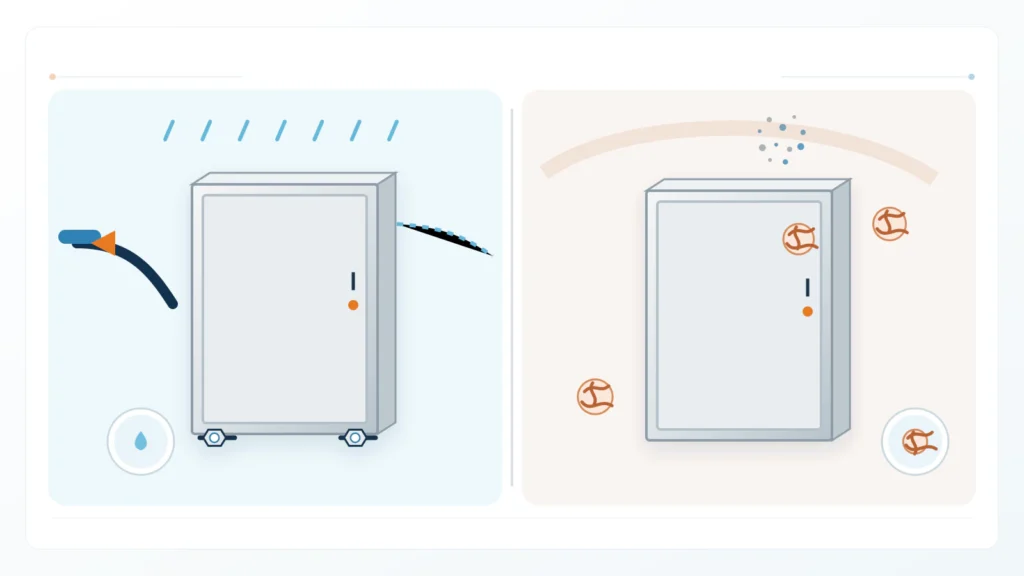
IP66 is an IP ingress classification. NEMA Type 4X includes ingress-related requirements plus Type-specific environmental requirements, including corrosion resistance. The IP66 digits do not communicate all of that information.
So the statement “NEMA 4X equals IP66” is not safe specification language.
A specific enclosure may carry evidence for both designations. The evidence must cover the actual product and configuration. If the enclosure will face salt, washdown chemicals, or a corrosive process, also state:
- material and finish;
- chemical or salt exposure;
- concentration and temperature where relevant;
- cleaning method and frequency;
- gasket and hardware requirements; and
- the evidence required for acceptance.
Do not use IP66 as a substitute for a corrosion specification.
NEMA 4 vs IP65 vs IP66
These are common comparison searches, but the answer should not be an equality table.
| Search question | Safe conclusion | What to do in the RFQ |
|---|---|---|
| NEMA 4 vs IP65 | The designations overlap in some ingress concerns but are not interchangeable. | Keep the designation named in the project specification. |
| NEMA 4 vs IP66 | IP66 does not establish every Type 4 requirement. | Request evidence for the required designation. |
| NEMA 4X vs IP65 | IP65 alone does not prove Type 4X requirements. | Specify Type 4X separately where required. |
| NEMA 4X vs IP66 | A useful comparison question, not a universal equivalence. | Verify each designation against the finished assembly. |
| IP65 vs NEMA 4X | Reversing the wording does not make the conversion reversible. | Do not infer Type 4X from IP65. |
| IP66 vs NEMA 4X | IP66 does not communicate the full Type 4X scope. | Review corrosion, materials, hardware, and evidence separately. |
If the project is choosing between NEMA types, compare NEMA Type 1 and Type 4X by exposure and failure mode—not by assuming that the largest number is always the right choice.
NEMA and IP Cross-Reference: Use It as a Question List
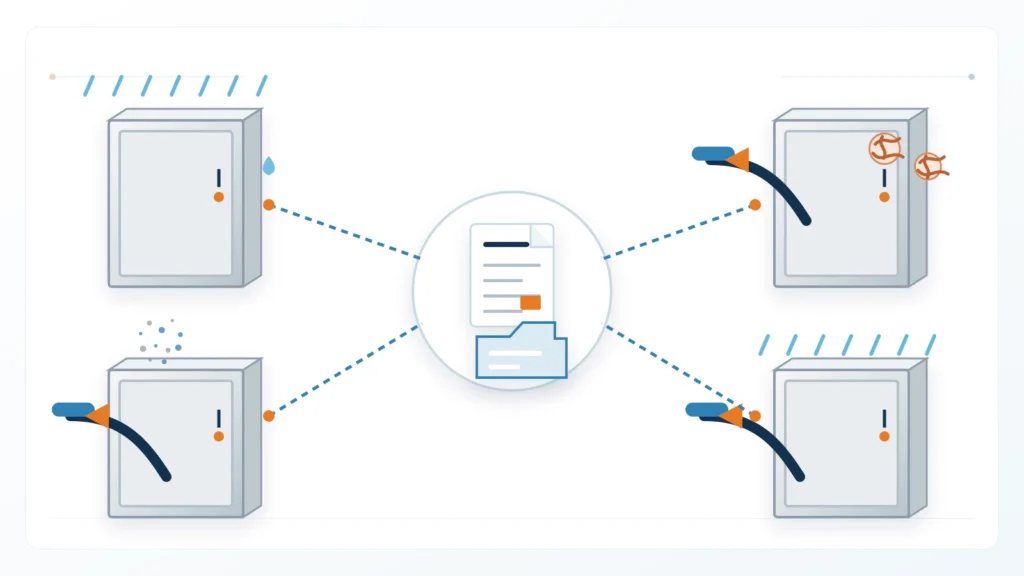
A NEMA IP cross reference is useful when it tells you what needs checking. It becomes risky when it hides the differences between the standards.
| Search question | What the label does not prove |
|---|---|
| IP54 NEMA equivalent | It does not uniquely identify a NEMA Type. |
| IP65 NEMA equivalent | It does not prove NEMA 4 or NEMA 4X. |
| IP66 NEMA equivalent | It does not prove NEMA 4X corrosion requirements. |
| IP67 NEMA equivalent | It does not automatically establish a NEMA Type or project-specific immersion condition. |
| IP68 NEMA equivalent | It does not define depth, duration, installation, or the required NEMA Type. |
| NEMA 1 IP equivalent | It does not establish an IP code without product documentation. |
| NEMA 3R IP equivalent | It does not justify replacing Type 3R with an assumed IP code. |
| NEMA 4 IP equivalent | It does not authorize reverse substitution. |
| NEMA 4X IP equivalent | It does not remove the corrosion and other Type-specific requirements. |
| NEMA 12 IP equivalent | It does not establish protection against every dust, drip, oil, or coolant condition. |
Use this table to find missing information. Do not paste a guessed equivalence into a drawing or purchase order.
The Finished Configuration Matters More Than the Empty Shell
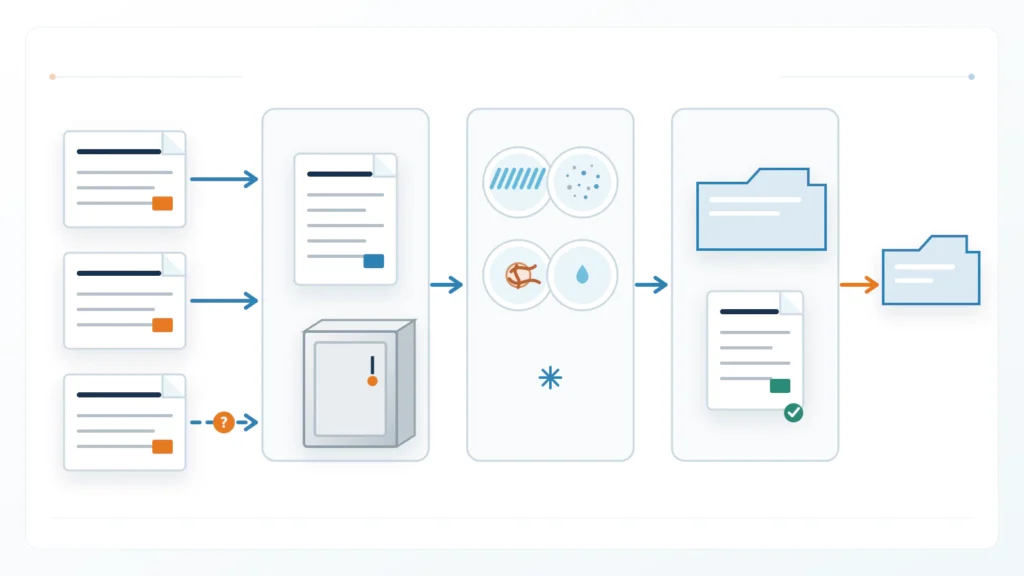
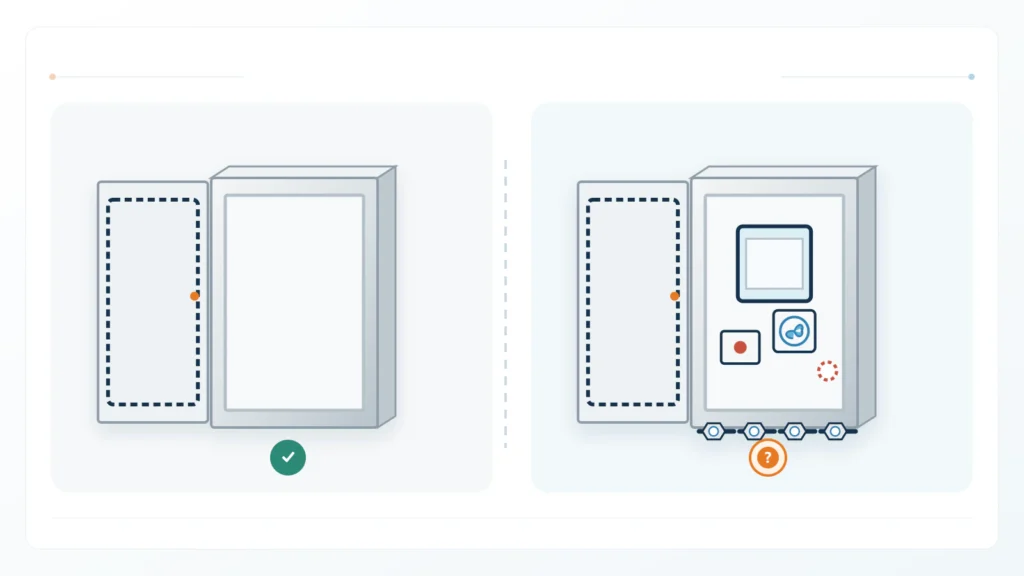
A bare enclosure and a completed enclosure are not the same evidence object.
Picture the difference between these two configurations:
- an empty box with an intact door gasket; and
- the same box with a viewing window, four cable glands, a filter fan, a door-mounted control, a drain, and one unused field hole.
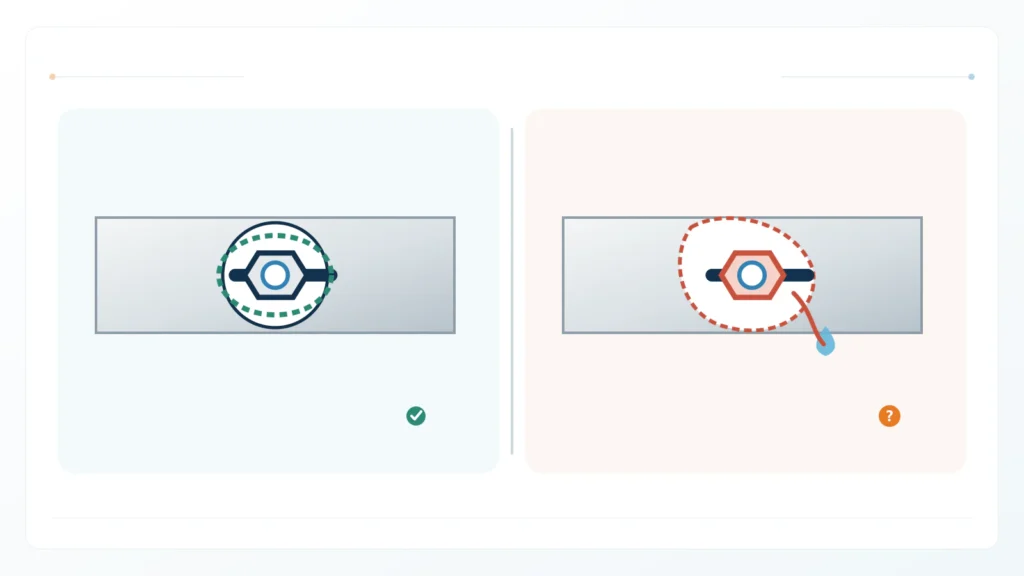
The protection boundary now depends on more than the box body. It depends on the cut-outs, sealing surfaces, component installation, torque, spacing, mounting orientation, and instructions supplied with the assembly. This is where the enclosure cutout rating and cable-entry design need a separate review. A cable entry failure can leave the box body unchanged while the finished assembly no longer meets the intended requirement.
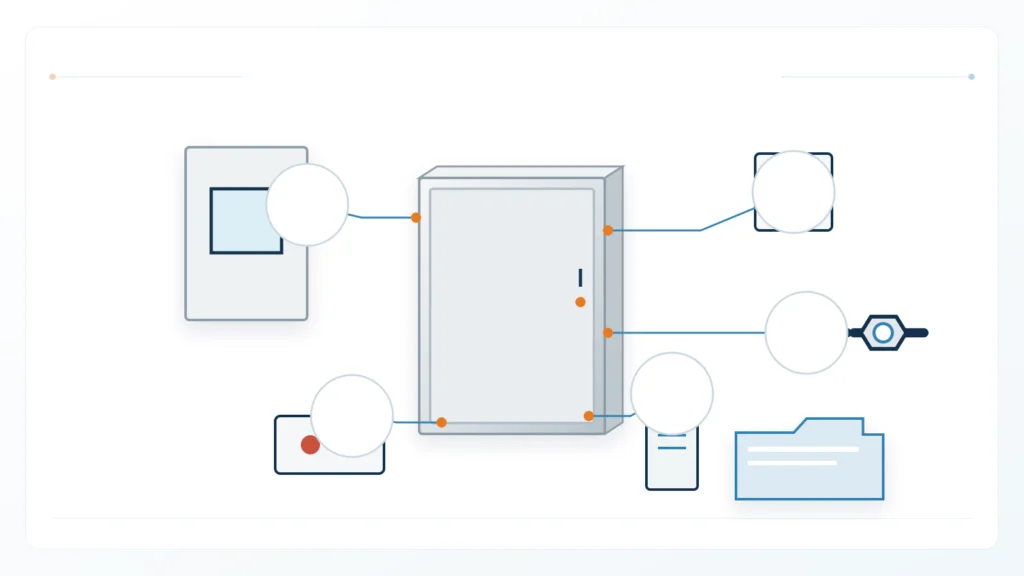
Review these items before accepting a rating:
- cable glands and cable entries;
- windows and door-mounted components;
- filter fans, vents, air conditioners, and heat exchangers;
- drains and breather devices;
- hinges, latches, and gasket compression;
- field-drilled holes and unused openings;
- mounting orientation and installation instructions.
An IP66 cable gland does not automatically make the enclosure IP66. A component marked for Type 4X does not automatically make the completed assembly Type 4X.
NEMA’s enclosure FAQ also treats modifications and installation details as relevant to enclosure performance. Approve the final configuration, not the strongest label on one component.
How to Choose the Right Rating
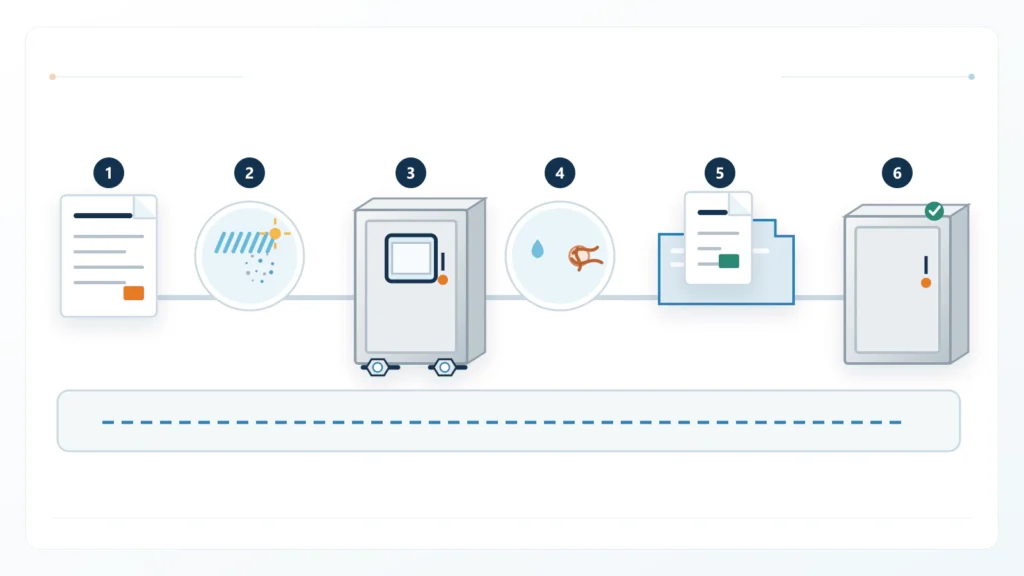
Use this sequence during design review and quotation:
1. Copy the exact requirement
Write down the full designation: NEMA Type, IP code, or both. Do not shorten “NEMA Type 4X” to “waterproof.”
2. Describe the exposure
Record indoor or outdoor use, rain, hose-directed water, washdown chemicals, dust, oil, coolant, salt, temporary immersion, UV, impact, temperature cycling, and condensation risk.
3. Draw the complete boundary
Include the door, gasket, hinges, locks, windows, glands, vents, fans, cooling units, drains, mounting orientation, and every cut-out.
4. Separate different failure modes
Ingress, corrosion, heat, condensation, UV, impact, and chemical resistance are not the same requirement. If each matters, specify each one.
5. Define the acceptance evidence
State whether the project needs a manufacturer declaration, test report, third-party certification, marked product, inspection plan, or testing of the customized final assembly.
6. Freeze the approved configuration
The evidence should match the supplied material, hardware, openings, seals, accessories, and installation instructions. If those change, ask whether the rating evidence still applies.
What to Include in an Enclosure RFQ

A useful RFQ gives the supplier enough information to quote the right enclosure rather than guess the rating.
Send:
- drawing or 3D model;
- external dimensions and usable internal space;
- material, thickness, finish, and corrosion exposure;
- door, hinge, latch, and gasket requirements;
- cable-entry locations and gland details;
- windows, fans, filters, cooling units, drains, or other accessories;
- heat load, ambient temperature, and condensation concerns;
- required NEMA Type, IP code, or both;
- test, certification, marking, inspection, and documentation requirements;
- quantity, packaging, and change-control expectations.
For custom electrical enclosures from drawings, include the exposure and evidence requirement with the drawing. “Waterproof outdoor box” is a starting description, not an acceptance specification.
Ask the supplier to identify which rating applies to which model and configuration, which accessories are included, what evidence will be delivered, and which modifications require re-evaluation.
Common Specification Mistakes
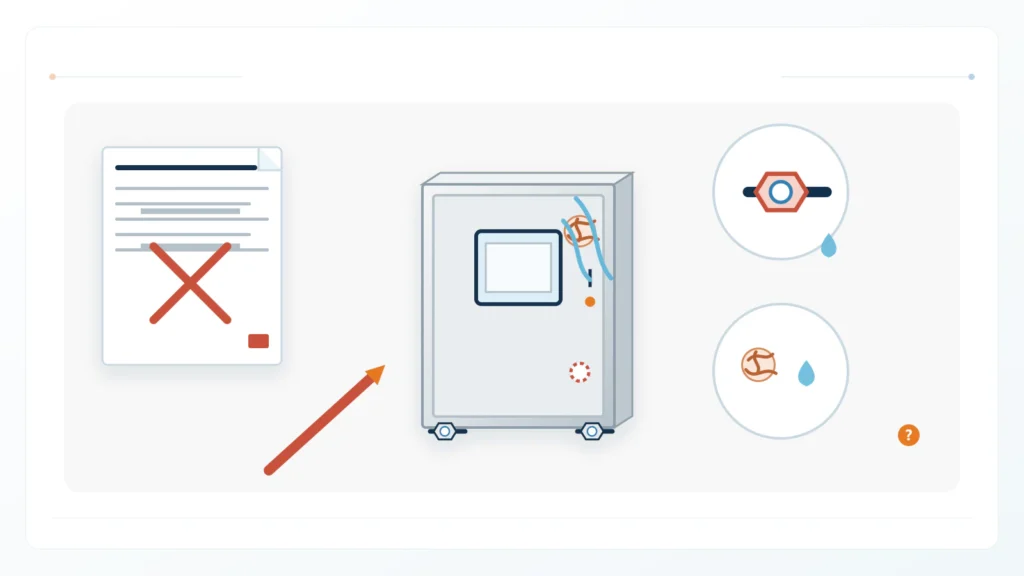
- Writing NEMA 4X = IP66 as a universal rule.
- Treating a conversion chart as a certificate.
- Choosing the largest number without defining the exposure.
- Using “waterproof” without naming the test or acceptance requirement.
- Assuming an accessory rating proves the complete enclosure rating.
- Ignoring corrosion because the IP code is high.
- Assuming a NEMA Type or IP code prevents condensation.
- Requesting certification without identifying the exact model and configuration.
FAQ
Is a NEMA rating the same as an IP rating?
No. They are different classification systems with overlapping ingress concepts and different scopes.
What is the NEMA equivalent of IP65?
IP65 does not identify one NEMA Type. Specify and verify the NEMA Type separately if the project requires one.
Is IP65 equivalent to NEMA 4X?
Not as a universal rule. A specific product may have evidence for both, but IP65 alone does not prove Type 4X.
Is NEMA 4X the same as IP66?
No. Type 4X includes requirements that the IP66 digits do not communicate. Verify both designations when both appear in the project documents.
Can I use an IP-to-NEMA conversion chart?
Use it for screening. Before approval, check the standard edition, comparison direction, completed configuration, and required evidence.
Does IP66 mean corrosion-resistant?
No. State the material, finish, chemicals, salt exposure, cleaning conditions, and corrosion requirements separately.
Do NEMA or IP ratings prevent condensation?
No. Condensation requires a separate review of humidity, temperature cycling, internal heat, drainage, ventilation, and thermal design.
What should I send with an enclosure RFQ?
Send the drawing, dimensions, material, environment, openings, accessories, heat load, required designation, and acceptance evidence.
Conclusion: Keep the Requirement That the Project Actually Names
When comparing NEMA vs IP ratings, do not ask only, “Which number is higher?” Ask:
- Which designation does the project require?
- What must the finished configuration withstand?
- What evidence will prove it at acceptance?
Use a comparison chart to identify overlap. Do not use it to delete requirements.
If the project names a NEMA Type, keep the NEMA Type. If it names an IP code, keep the IP code. If it names both, verify both on the finished build.
To request an enclosure configuration review, send FN Enclosure the drawing, environment, openings, accessories, required rating language, and evidence requirements. The quotation should show exactly what is included and what remains project-specific.
Sources and Further Reading
- ANSI/NEMA EN 10250-2024 — Current U.S. enclosure standard reference listed by ANSI.
- IEC 60529 — Official IEC publication page for the IP Code.
- NEMA enclosure Types and IEC IP comparison table — Directional comparison aid.
- NEMA Enclosure FAQ — Enclosure selection and modification guidance.
- NEMA Bulletin 123: NEMA and IP Ratings — Background on differences between rating frameworks.
- UL Electrical Enclosure and Related Component Certification — Certification scope overview.