

Polycarbonate is a natural first candidate for an instrument enclosure that needs a transparent cover and good impact performance. A fiberglass enclosure deserves priority when a suitable resin system or reinforced cabinet structure solves the installation’s main problem. Both choices still have to meet the actual exposure and equipment layout; the material name alone cannot decide outdoor durability, chemical compatibility or the weight of the installed assembly.[53][31][63]
A useful comparison starts with two proposed models. Give them the same internal space, cover function, mounting hardware and exposure, then examine the differences that remain. This avoids paying for an attractive material property that the installation does not use.
Define the application before comparing materials
First, define the fiberglass material and construction in the quotation. FRP is a fiber-reinforced polymer; for fiberglass, the reinforcement is glass, while the polymer matrix still needs to be identified.[53] A thermosetting glass-reinforced polyester body is a different material from glass-filled PC. Bud’s PTQ description uses “fiberglass” for a product made from fiber-filled polycarbonate, illustrating the overlap in commercial names.[47]
An FRP body with a PC viewing cover is a mixed-material assembly. It should not be compared with an opaque PC box as if only the body resin differed. If viewing is part of the requirement, both quotations need to provide a usable view of the same instruments.
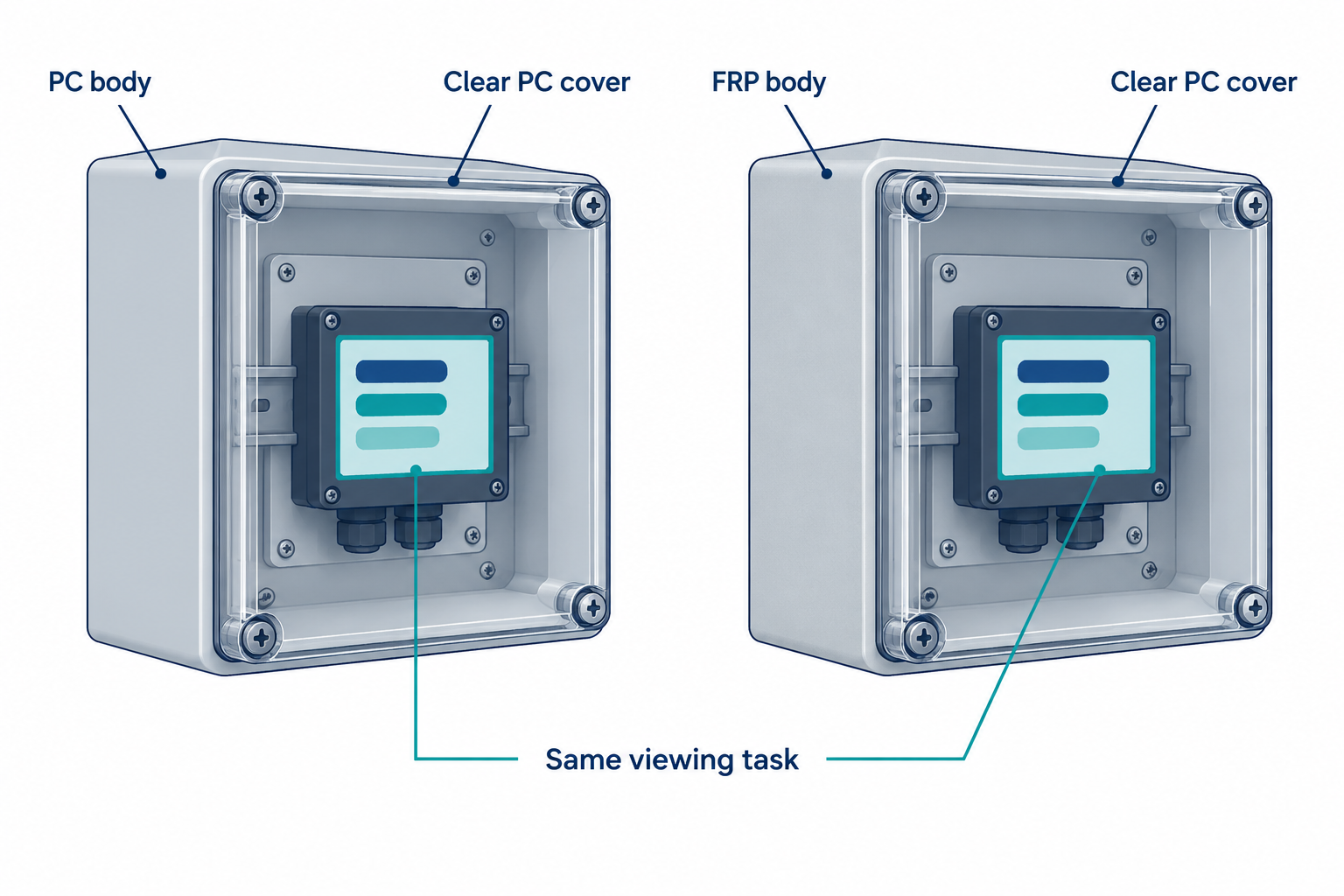
Write down the constraints that could reject a model before comparing convenience features:
| Application constraint | What makes the comparison meaningful |
|---|---|
| A display must be read while the box stays closed | Compare clear covers or windows with enough usable viewing area. |
| Cleaning fluid reaches the enclosure | Compare compatibility for the body, viewing area and seals under that contact. |
| Equipment is mounted to a removable plate | Include the plate, supports, clearance and attachment load in both candidates. |
| The box is outdoors | Compare evidence for the supplied materials and colors, plus the installed water-entry arrangement. |
| A narrow installation route limits handling | Compare actual outside dimensions, opening movement and complete assembly weight. |
When the enclosure wall must conduct significant heat outward or help provide electromagnetic shielding, metal and non-metallic options deserve comparison before choosing between polycarbonate (PC) and fiberglass-reinforced polymer (FRP). Changing between ordinary insulating PC and FRP housings does not create a conductive shielding shell. A metal enclosure can provide that shell and a useful heat-transfer path, but shielding still relies on the doors, seams and cable entries, and thermal performance still reflects the heat load and environment. These requirements can change the material shortlist before cover or mounting preferences decide between the two plastics.
Compare outdoor exposure and chemical compatibility
Neither ordinary PC nor a product described only as fiberglass should receive an automatic outdoor pass. UV resistance is affected by the polymer formulation and any protection built into it; additives can change the behavior of plastics that would otherwise be vulnerable.[32] For a buyer, the useful distinction is a product with relevant weathering evidence versus a generic material claim.
Surface appearance and continued function are also different outcomes. A cover that has become difficult to see through may no longer serve an instrument-reading task even if it still closes. Conversely, a cosmetic change on an opaque housing does not by itself establish a loss of sealing or impact performance. The reported test endpoint should match the function that matters on site.
Chemical exposure can make the choice more decisive. A specified FRP resin may be suitable for an exposure that excludes a proposed PC cover, but “fiberglass resists chemicals” is too broad to settle the issue. ROLEC’s GRP guidance ties compatibility to the resin, concentration and contact duration.[63] The answer can change when the same liquid is hotter, more concentrated or left on the surface for longer.
The assembly deserves particular attention in mixed-material designs. If an FRP body is acceptable but its clear PC cover is not, the body data does not solve the viewing problem. An opaque cover, a protected viewing position or a different compatible cover system may be a better route than rejecting the entire material family.
Compare real applications without turning them into a contest. Fibox describes PC enclosures customized for Birtes’ photovoltaic project, where outdoor exposure and project-specific interfaces shaped the choice.[277] Openchannelflow’s Pillar Point case describes a custom fiberglass sampler enclosure where coastal weather, restricted access and a small footprint mattered.[280] These cases show two workable application routes. They were not tested against each other at the same site.
Compare machining, mounting and enclosure weight
The supplied geometry often determines how easily a box can be modified. A flat cable-entry area gives fittings a different interface from a ribbed or curved wall. Supports, corner radii and sealing lands reduce the space available for cutouts even when the outside dimensions look generous.
FRP machining needs to account for the reinforcement. Stahlin identifies chipping and delamination as possible drilling defects, particularly when tools or methods are unsuitable.[51] A damaged surface near a gasket can create an assembly problem after the hole has been cut to the nominal diameter. Agreeing the edge condition and sealing area matters as much as agreeing the hole size.
Molded dimensions also matter when a cutout has to align with internal hardware. Bud notes dimensional variation as a consideration in PC enclosure modification.[49] The practical response is to locate openings from the relevant part features and use the actual enclosure drawing, rather than assume that outside dimensions alone define every mounting position. This issue does not justify a universal claim that PC is inaccurate or FRP is dimensionally perfect.
For component mounting, follow the load from the equipment to the supporting structure. An internal plate, its attachment points and the external brackets are all part of that route. The enclosure wall’s material strength cannot establish how much load an individual insert or molded boss will carry. Drilled mounting holes also need to preserve the sealing arrangement where they enter the protected space.[45]
Finally, compare complete weights. A thin shell and a shell supplied with a steel plate, hinges and brackets are different products.
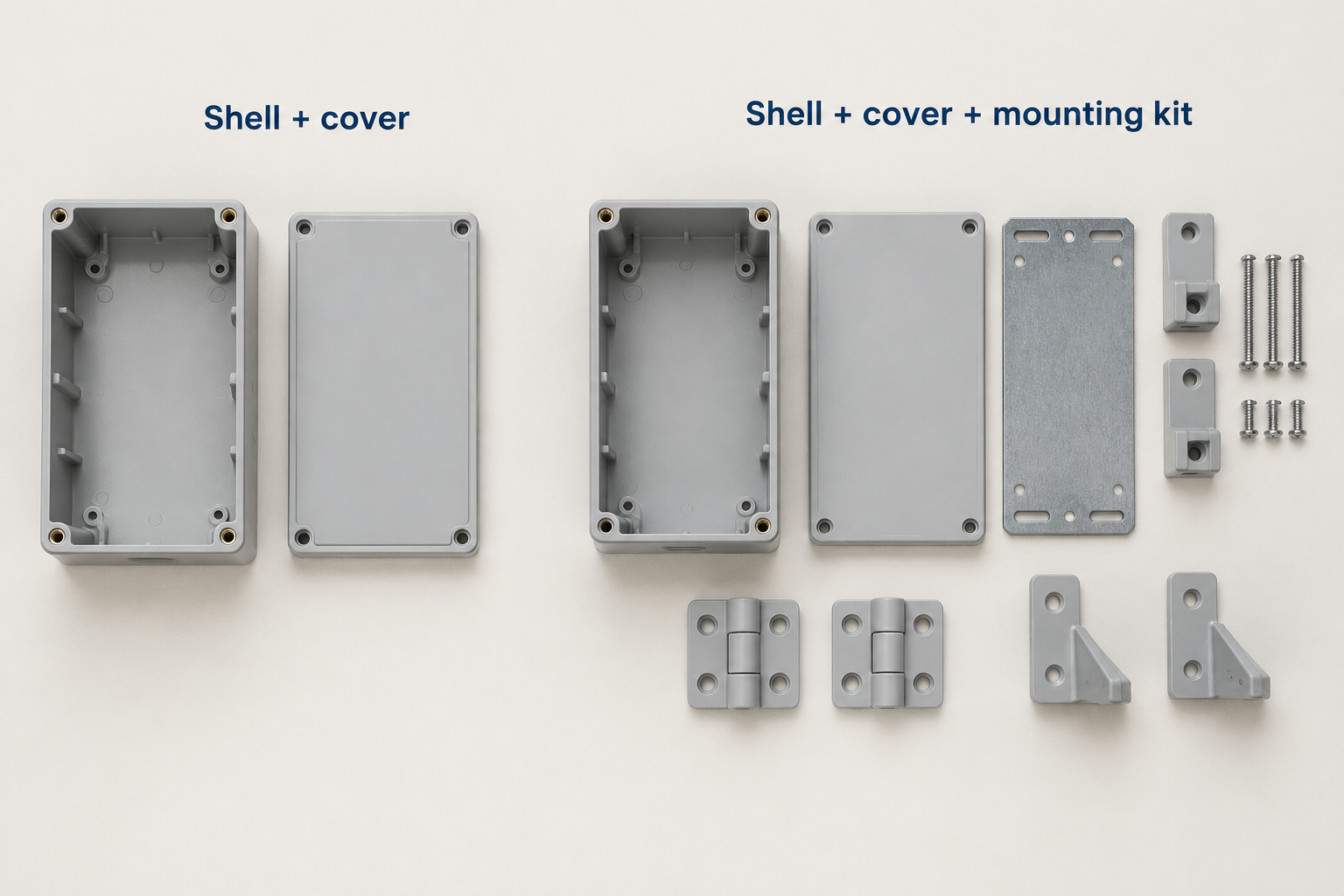
Weight matters when carrying the box through a restricted access route or loading a pole bracket, so the useful figure is the assembled configuration you intend to install. A generic density comparison is not enough to size that support.
Check temperature limits, covers and maintenance
A material temperature value must identify the property it describes. Glass-transition temperature describes a change in polymer behavior; it is not the same as an allowable continuous temperature for a loaded enclosure.[33] A heat-deflection result, a short exposure limit and a finished product’s service-temperature range should therefore remain separate entries in a comparison.
The part exposed to the highest temperature may decide the configuration. A component near a sidewall can heat that wall locally, while a door seal or plastic mounting support has a different exposure. Moving a heat-producing component or changing the cooling arrangement can solve a problem that a body-material substitution would leave in place.
A transparent cover has its own service requirement: the instrument must remain readable. Protolabs’ clear-molding guidance explains why material quality, surface finish and processing affect optical results.[41] In an enclosure, the viewing angle, internal obstructions and the surface’s condition during maintenance matter too. Select a clear cover for a defined observation task, not simply because it is available.
Access can be more important than a small difference in shell weight. A removable lid is workable when servicing is infrequent and there is space to handle it. A hinged cover may be easier where repeated access is part of the operating routine. For either arrangement, the proposed installation should allow the cover to open without straining wires or trapping the gasket against nearby equipment.
When a cover, hinge or seal must eventually be replaced, a clearly identified model and configuration make the replacement specific. A purchase record that says only “PC enclosure” or “fiberglass cabinet” leaves maintenance to reconstruct the original choice.
Make the selection using model-specific evidence
Use the requirement that can exclude a candidate first. If a proposed material cannot tolerate the cleaning exposure, its weight or finish cannot compensate. If the equipment cannot be installed through the opening, a favorable wall-strength figure is irrelevant. Once both candidates meet those constraints, compare access, modifications and the total supplied configuration.
| If the main requirement is… | Start with… | The evidence or design feature that can change that choice |
|---|---|---|
| Reading indicators through the closed cover | A PC enclosure or a suitable clear-cover assembly | Optical area, chemical exposure and the cover’s outdoor conditions |
| Direct contact with a defined chemical | The model with documented material compatibility | Concentration, temperature, duration and compatibility of the seals and fittings |
| A custom reinforced cabinet around awkward equipment | An FRP supplier and construction route that can meet the geometry | Actual drawings, openings, mounting design and the final environmental configuration |
| Resistance to accidental impacts | A model with relevant finished-enclosure impact evidence | Test temperature, mounting, cover version and other conditions that match the application |
| Easier installation and servicing | The complete model with the more workable interfaces | Assembly weight, mounting-plate access, cable-entry space and cover movement |
The result should be a short explanation of why one configuration fits better. For example, “The PC option provides the required viewing area and mounting layout, and both candidates meet the stated exposure” is a useful decision. “PC is more durable” leaves the next engineer unable to reproduce it.
Once the proposed polycarbonate and fiberglass enclosures meet the environmental and mechanical requirements, compare quotations using the same usable size, cover, plate, hardware, cutouts, inspection scope and quantity. For a supplier discussion, send FN the proposed configurations and layout. If compatibility with a cleaning fluid remains unresolved, name the fluid and its contact conditions in the inquiry so the reply addresses that exposure rather than an undefined request for “chemical resistance.”
FAQ
Does “fiberglass” always mean glass-reinforced polyester?
No. The glass identifies the reinforcement, but the polymer still needs a name. Bud’s PTQ range, for example, uses fiber-filled polycarbonate and is marketed as fiberglass. Glass-filled PC and thermosetting glass-reinforced polyester are different material systems, so their manufacturing instructions and supporting data should not be treated as interchangeable.[47]
Is a fiberglass enclosure always heavier than a polycarbonate enclosure?
The material names alone cannot establish the installed weight. A shell supplied with a steel mounting plate, hinges and brackets is a different assembly from a bare housing. For handling or support design, compare the weights of the complete proposed configurations, with the same usable space and included hardware.
Can a suitable fiberglass body make an incompatible clear cover acceptable?
A fiberglass body cannot resolve chemical damage to a separate polycarbonate viewing cover. If the specified cleaner is incompatible with that cover, the viewing arrangement must change. An opaque lid, a protected viewing position or another compatible cover system may preserve the enclosure choice while addressing the exposed part.[63]
Should polycarbonate always win when impact resistance matters?
Choose the proposed enclosure with impact evidence relevant to the application. A generic material reputation cannot establish the performance of a particular cover, mounting arrangement or modified wall. The tested configuration and conditions should match the installation; once both candidates satisfy the impact duty, access, usable space and other exposures can decide the choice.
Sources
[31] Common Impact-Resistant Plastics
[32] Evaluating UV-Resistant Plastic Options
[33] Glass Transition Temperature of Polymers
[41] Translucent and Clear Plastic Injection-Molded Parts
[45] Five Easy Suggestions for Selecting the Best NEMA or IP Rated Plastic Electronic Enclosure
[47] New Sizes of Bud’s Fiberglass IP67 rated boxes
[49] Why Select a Fiberglass Reinforced Polycarbonate NEMA Enclosure?
[51] Cutting & Drilling
[53] FRP vs. Fiberglass
[63] WHICH GRP ENCLOSURES ARE BEST FOR YOUR INDUSTRIAL ELECTRONICS?