

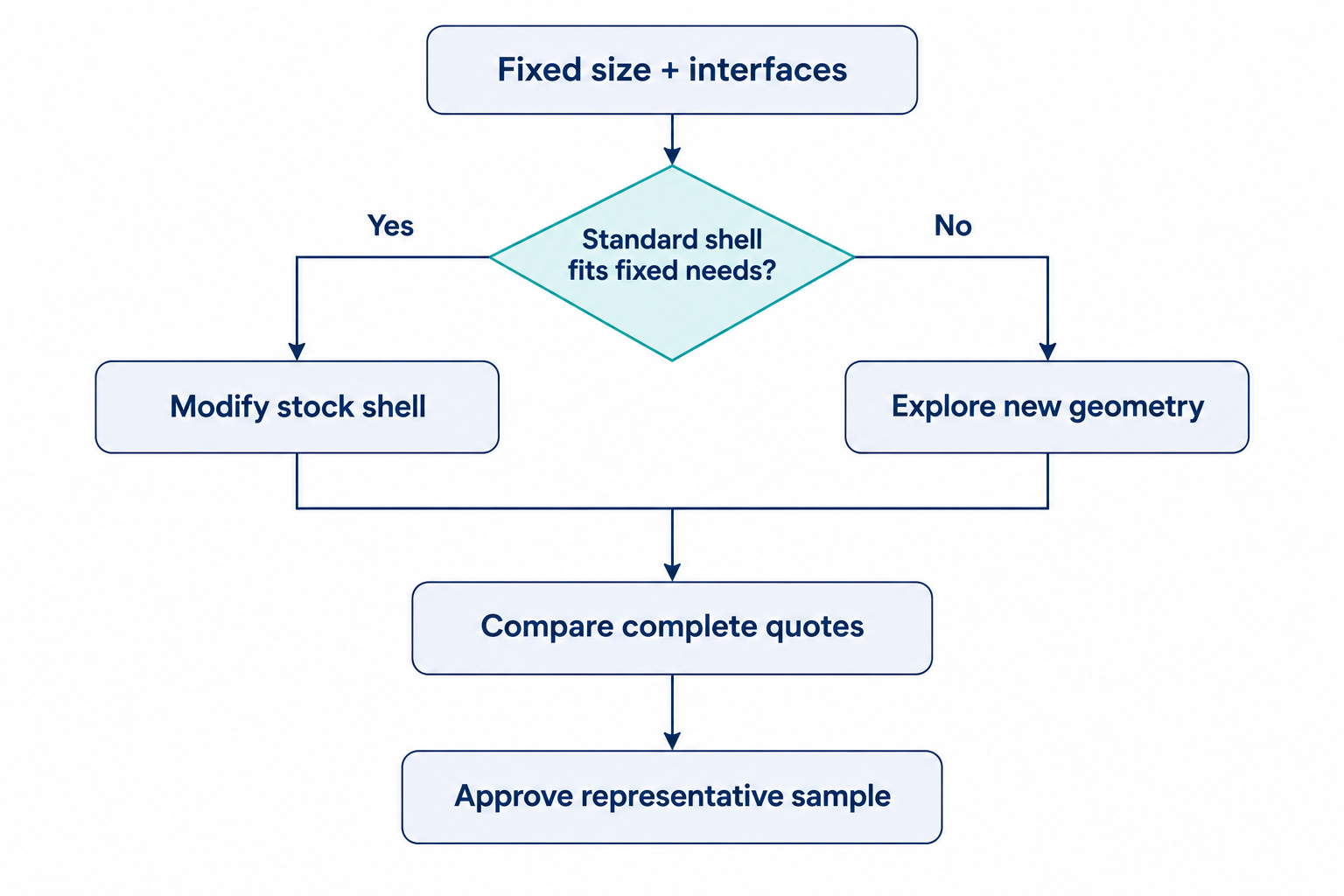
Start with a standard enclosure when its size, closure, material and mounting arrangement already fit the product. Machining connector holes, adding a display opening or fitting an internal bracket can turn that housing into a product-specific assembly. A new design becomes worth investigating when the standard shell forces you to compromise the installation footprint, usable space or essential interfaces. Manufacturers distinguish these two routes because modifying an existing housing and creating its underlying shape involve different work and cost. [25][124]
Order quantity matters, but it cannot choose the route by itself. A production forecast does not solve an enclosure that will not fit the installation. Equally, a distinctive front panel does not necessarily justify a new mold.
Decide whether a standard enclosure can meet the specification
Select the shell while the PCB layout and connector positions can still move. OKW recommends choosing the enclosure before finalizing the PCB size; its standard range includes different mounting arrangements and accessory options. This gives the electronics and housing a chance to fit each other before either becomes expensive to change. [25]
The useful comparison is between the complete assembly and the space available. Outside dimensions describe where the box fits. Inside, molded pillars, wall features, the lid and the connector bodies reduce the usable volume. A display that fits the front face may still collide with a PCB connector behind it. Lay the parts into the enclosure model, including the plugs and tools needed during assembly.
For an initial decision, separate fixed requirements from adjustable ones:
| Requirement | A standard enclosure remains a good candidate when… | A new design deserves attention when… |
|---|---|---|
| Installation space | The shell and opening lid fit the available envelope | Its basic shape or footprint conflicts with the installation |
| Internal assembly | Existing pillars or a bracket can support the electronics | Essential components cannot be positioned without removing structural features |
| External interfaces | Cutouts fit on suitable faces with room for their fixings | Connectors or displays require a different wall or closure geometry |
| Appearance | Printing, a panel or a finish provides the required identity | Product operation depends on a different grip, contour or molded feature |
These are route-selection questions, rather than evidence that a proposed modification is acceptable.
FN’s plastic enclosure product page distinguishes modifications to an existing body from requests for a new shape or size. The actual drawing still needs review before quotation.
Two published projects show why the distinction helps. SKILLQUBE used OKW’s CARRYTEC housings for medical-training simulators, with machined openings and, on a later variant, an iPad mounting plate. The standard housing could accommodate the functional changes. At Pillar Point Air Force Station, a sampler installation had restricted access and a small footprint; Openchannelflow describes developing a custom fiberglass enclosure after available products failed to fit. The first case supports adapting an existing platform. The second supports changing the shell when the site dictates its geometry. Neither establishes a universal cost advantage or a particular molding process. [286][280]
Define holes, cutouts, inserts and finishing operations
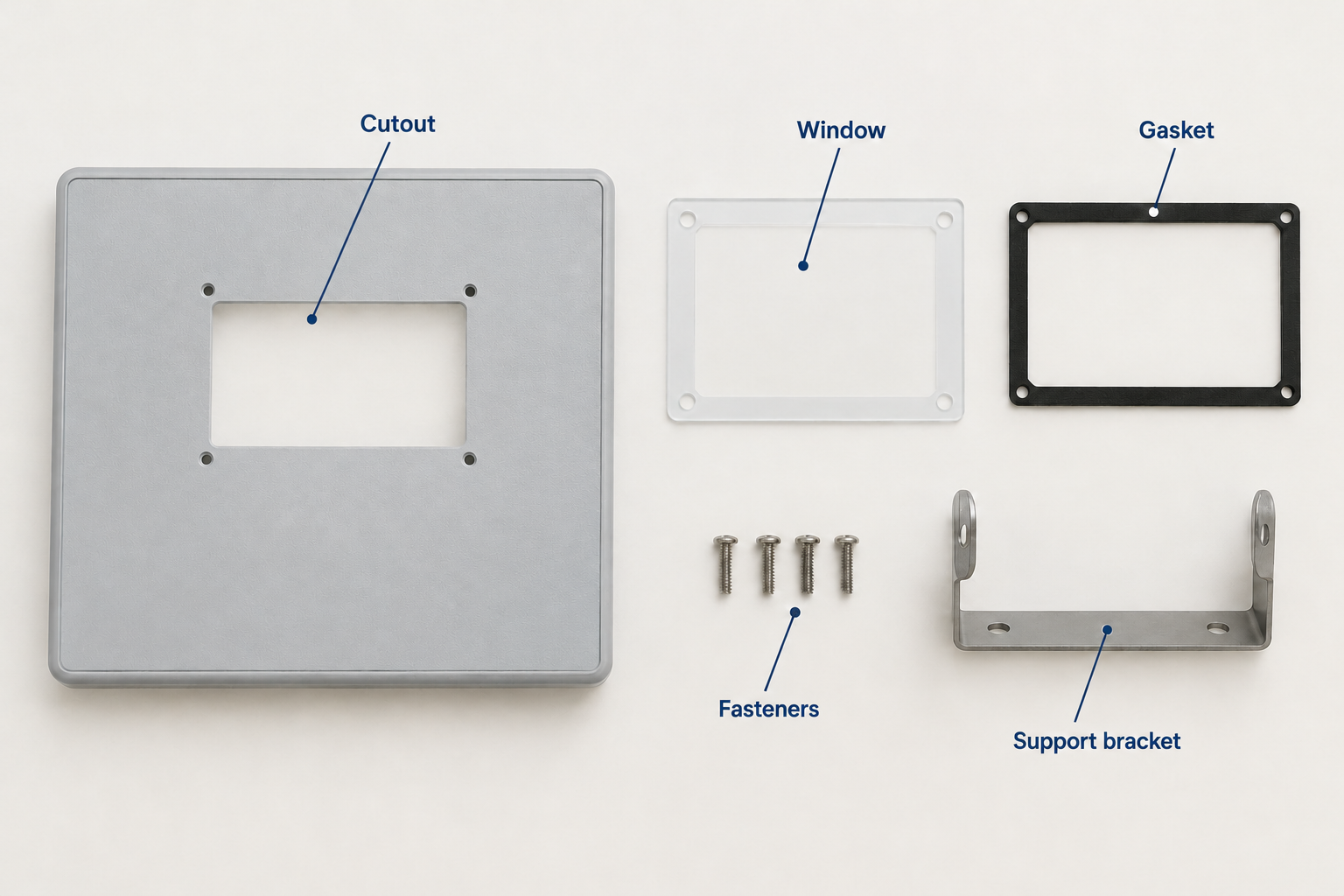
“Custom enclosure” is too broad for a comparable quotation. A useful modification drawing shows which faces receive work, the reference surfaces for each dimension, the interface tolerances and the finished appearance. Separate material removal from the parts that will be added: a display cutout is one operation; its window, gasket, fasteners and support bracket are separate items.
Location tolerances should follow function. A panel switch connected by flexible wires may tolerate a modest position variation. A USB connector soldered to a PCB has to align with both the PCB supports and the wall opening. Bud Industries uses this distinction to explain why individually acceptable holes can still produce an assembly that does not fit. Dimension related features from a common reference, rather than allowing their errors to accumulate independently. [122]
Corner shapes also affect the route. A rotating cutter leaves an internal radius. If the mating component needs a sharper opening, the drawing must resolve that interface with a different operation or a suitable clearance. Specifying an unnecessarily small radius can add machining work without improving fit. OKW’s machining guidance also notes that excessive cutting heat can deform or smear thermoplastics, so a material label alone does not define an acceptable machining process. [68]
Finishing belongs in the same quotation. Molded-in color, a coating, a printed legend and an applied graphic are different specifications. Their registration to a cutout can matter as much as the artwork itself. OKW documents these as distinct customization options; their availability, minimum quantities and compatibility are supplier-specific. [25]
Compare modification with tooling and molding
A modified stock enclosure retains the existing shell and adds secondary operations. A newly molded enclosure brings the required features into the part design, but creates a tooling project as well as a parts order. Protolabs identifies geometry, undercuts, surface finishes and part size among the drivers of injection-mold and part cost. A difficult feature can therefore outweigh the apparent simplicity of the outside shape. [88]
| Route | What it helps you establish | What remains to be demonstrated |
|---|---|---|
| Modified standard shell | Fit and function using an available enclosure geometry | Machining quality, assembly interfaces and the finished configuration’s requirements |
| Machined or printed prototype | Layout, handling and access before committing to production tooling | Whether the production material and process reproduce the necessary behavior |
| Dedicated molded shell | Product-specific geometry and features designed for repeat production | Moldability, actual production variation and final product performance |
A prototype is useful only when its construction suits the question. A visual model can settle control placement without representing service strength. A functional prototype needs closer correspondence to the intended material and interfaces. Protolabs explicitly separates concept models from functional prototypes for this reason. Treat a successful fit trial as evidence of fit, then use suitable production-representative parts for material-dependent validation. [75]
An enclosure’s material and manufacturing route need to be specified separately. Openchannelflow’s Pillar Point project identifies a custom fiberglass enclosure without disclosing its resin system or manufacturing process. A quotation for an SMC part therefore cannot simply reuse the process assumptions for a thermoplastic injection-molded part. [280]
When the comparison also includes sheet metal, standard, modified, modular and fully custom enclosures offer different degrees of change. A standard shell suits a layout that already fits; factory modification adds specified openings and mounting details to that shell. Modular construction accommodates planned expansion within a system’s limits. Full custom fabrication becomes the stronger candidate when fixed equipment, cable entry or service access cannot be accommodated by those options.
Assess quantities, changes and tooling ownership
Compare the two routes at the same delivered specification. For a modified box, include the base shell, setup, machining, finishes, accessories and inspection. For a new molded shell, separate tooling and development from the recurring part, finishing and inspection costs. The break-even quantity can then be calculated from the quotations. A generic threshold would ignore the geometry, material and amount of secondary work. [25][88]
Demand uncertainty changes the decision. If connector positions are likely to move during the next design revision, a lower recurring piece price may not offset another tooling change. Protolabs explains that some revisions can be made by removing material from an existing mold, while others require new tooling or substantial rework. It also warns that changing resin shrinkage can alter dimensions throughout the part. A later resin substitution is therefore an engineering change, even when the new material sounds similar. [93]
Before paying for tooling, put its commercial treatment in writing. The agreement should distinguish ownership of the physical tool from access to CAD data, permission to transfer the tool, maintenance obligations and the cost of alterations. These are proposed purchasing terms, not benefits automatically included in a tooling charge. Without them, two apparently similar mold quotations may purchase different long-term arrangements.
Keep the forecast realistic: separate prototype quantity, first production order and expected repeat demand. Quote an alternative route against those quantities when the design is still moving. That comparison is more useful than asking for the lowest possible unit price at a volume the project has not committed to.
Prepare a manufacturing-route RFQ
If you are deciding how to get a custom plastic enclosure made, send a brief that allows the supplier to challenge the route. Include the proposed shell or installation envelope, an assembly model, the material requirements, quantities by stage and the features that cannot change.
Ask for two responses where both routes remain plausible: a modified-standard proposal and a dedicated-design proposal. Each should identify the chosen material and process, drawing exceptions, one-time charges, recurring scope and the sample needed before production. A supplier who proposes a different enclosure size should explain which constraint it resolves.
The first sample should answer the remaining decision. For a modified box, that may be whether the connector, fixing nut and cable bend fit together. For a new shell, it may include assembly fit and production-process effects that a visual prototype could not represent. Record the sample’s drawing revision and material so that an approved shape does not become approval for an unspecified production substitute. [75][93]
Use the chosen route to finalize the manufacturing drawing and compare quotations on the same delivered scope.
FAQ
When is modifying a standard enclosure the better starting point?
A standard enclosure is a useful starting point when its size, closure, material and mounting arrangement already fit the product. Specified openings, graphics or internal brackets can adapt that shell to the equipment. A new enclosure design deserves attention when the basic shape or footprint prevents essential components, interfaces or service access from fitting. [25][124]
At what order quantity does a new enclosure mold become cheaper?
There is no useful universal quantity. Compare quotations for the same delivered assembly: the modified shell plus machining and finishing against tooling and development plus the molded part’s recurring cost. Geometry, material and secondary operations change the break-even point. Expected design revisions also matter because some mold changes require substantial rework or new tooling. [25][88][93]
Can a printed prototype approve a production enclosure?
A printed prototype can demonstrate the layout, handling or access that its construction represents. A successful fit trial does not establish the production material’s strength or other material-dependent performance. Use production-representative parts for those questions, and record the material and drawing revision so approval of the shape is not mistaken for approval of an unspecified production substitute. [75][93]
Sources
[25] How To Specify Customized Plastic Enclosures For Your Electronics
[75] Manufacturing Considerations for Plastic Prototyping
[88] Understanding Injection Mold Cost for Parts and Tooling
[93] 6 Ways to Simplify Mold Modifications
[122] How to Modify Enclosures to Get the Design You Need for Less Time and Cost
[124] Modified Enclosures Or Custom Enclosures – What is the Difference?