

Choose a chemical-resistant enclosure by matching its actual materials to the substances that will reach it. Polycarbonate and fiberglass can both suit corrosive environments, but neither material name guarantees compatibility with every cleaner, solvent or process chemical. Concentration, temperature, contact time and mechanical loading can change the answer. An enclosure also needs compatible seals and fittings; a suitable body alone does not establish the performance of the assembled box. [181][6]
The first decision is whether the proposed material can tolerate the exposure. Size, appearance and ease of modification become useful comparisons after that screen. A convenient enclosure is a poor choice if the normal cleaning process attacks its cover or sealing joint.
Specify the chemical, concentration and contact conditions
“Chemical environment” is too broad to guide a material choice. A control box beside a dosing pump may encounter occasional droplets, cleaning spray and vapors, while a box in another part of the same plant stays dry. The material comparison should describe the substances that reach each location, including maintenance products, rather than assigning one chemical-resistance requirement to the entire facility.
Concentration and temperature belong beside the chemical name. Piedmont Plastics explains that resistance can change with concentration, exposure duration and test temperature. A chart entry for a diluted substance at room temperature does not establish performance with the concentrated product during a warm cleaning cycle. [184]
Consider a hypothetical pair of installations using the same cleaning product. In the first, a housing receives brief splashes followed by rinsing. In the second, liquid repeatedly collects around a recessed fastener and remains there after the visible surfaces dry. The product name is identical, but the retained liquid creates a different local exposure.
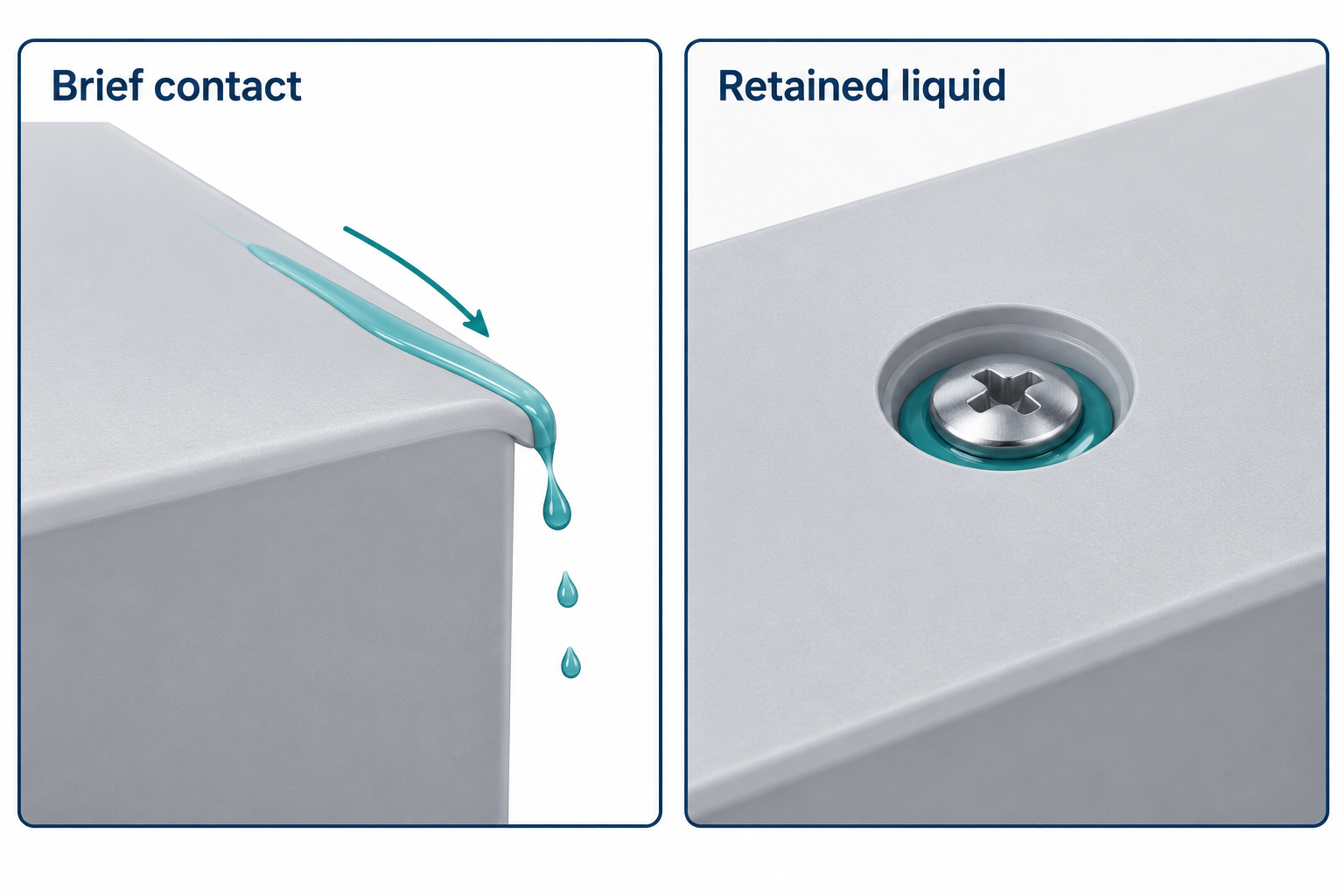
That is why drainage and the shape of the installed parts belong in the assessment.
A compact exposure description makes these differences usable:
| Information | How it changes the selection |
|---|---|
| Product name and actual composition | Distinguishes a trade-name mixture from a single chemical in a compatibility chart |
| Concentration at the enclosure | Separates diluted use from storage concentrate or an accidental spill |
| Contact temperature | Reveals whether the available room-temperature data address the application |
| Spray, vapor, splash or immersion | Defines which surfaces and joints are exposed, and how continuously |
| Cleaning, rinsing and drying sequence | Shows whether liquid remains or exposure repeats during normal service |
For coastal service, a nonmetallic enclosure body avoids red rust, but metal hinges, latches and brackets still face salt exposure. Deposits and retained moisture around a washer or hinge can create a more aggressive local environment than the open face of the enclosure. Coastal corrosion-resistant enclosure selection therefore covers the body, coatings, hardware and mixed-metal contacts as one system. That is a different comparison from deciding whether a particular resin withstands a named process chemical.
Compare resin-grade data for polycarbonate and fiberglass
Polycarbonate is available in different formulations. Protolabs notes chemical vulnerabilities including alkalis and aromatic and halogenated hydrocarbons, while also describing resistance to other groups of substances. Those broad groups help reject an unsuitable starting point; the exact formulation and exposure still determine whether a particular enclosure is appropriate. A transparent cover should have its own material identification if it differs from the body. [195]
Fiberglass is a composite, so “FRP” or “SMC” alone is an incomplete material specification. The resin system, reinforcement and exposed surface form the material that contacts the chemical. Allied Moulded itself notes that some chemicals threaten fiberglass more than polycarbonate and others reverse that comparison. There is no useful universal winner without the medium and conditions. [6]
The YONGTONG SMC catalog illustrates the difference between a material description and compatibility data. Its general claims cover acids, alkalis, salts, oils and organic solvents. The photographed material description does not provide a concentration-temperature-exposure matrix for individual substances. It therefore cannot be turned into a table stating that a finished SMC cabinet resists every chemical in those groups. [SMC36]
When comparing polycarbonate and fiberglass enclosures, prefer grade-specific information over a longer list of chemical families. If the PC enclosure has applicable evidence for the actual cleaner and the fiberglass offer has only a general catalog statement, the evidence favors the PC candidate. Reverse the evidence and the preferred candidate may reverse too. That is a decision about the offered construction, not a ranking of all PC against all fiberglass.
Allied Moulded’s water-filtration case shows a practical use of fiberglass without proving universal chemical resistance. The manufacturer describes an unnamed customer’s need for corrosion-resistant enclosures in several sizes for indoor and outdoor filtration controls. It supplied two fiberglass enclosure models and specifically identifies stainless steel hardware on the larger model. The case supports fiberglass as a candidate for that kind of installation, but it does not disclose the chemical concentrations or a resin compatibility report. It also shows why the hardware specification remains separate from the enclosure body. [293]
Account for temperature, time and assembly stress
Chemical attack can be less obvious than a dissolved or visibly damaged surface. Ensinger describes swelling and softening as consequences of chemicals entering a polymer, with possible loss of mechanical properties. It also warns that mechanical stress can promote crack development in susceptible thermoplastics. [181]
For an enclosure, that makes a tightened screw boss, a clamped cable-entry hole and a loaded hinge area more informative than an unstressed flat coupon alone. A coupon can establish whether the material is a plausible candidate.
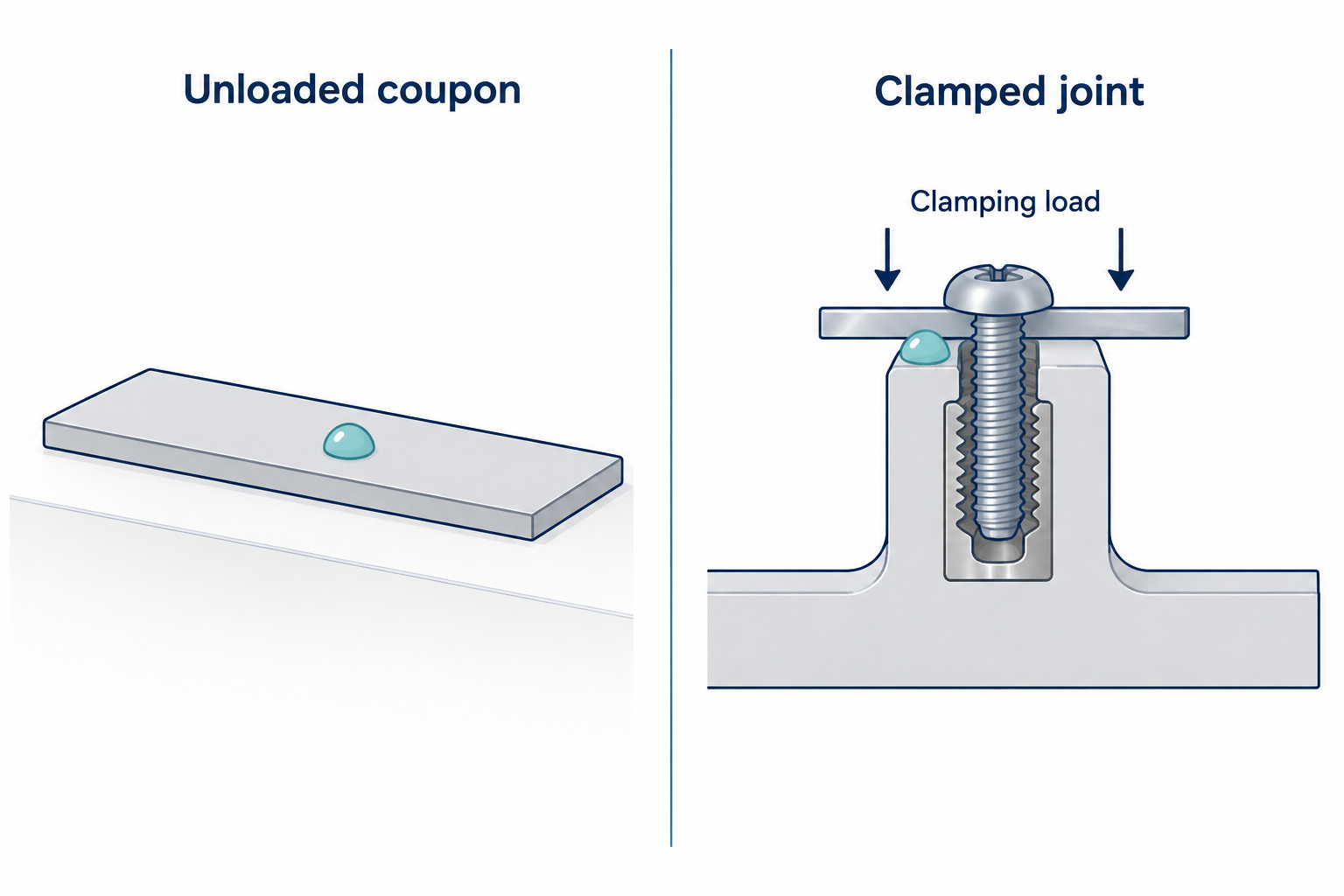
An assembled sample can reveal whether the material remains suitable around the actual joint geometry and preload. The test object should follow the failure you need to exclude.
Temperature and time affect the interpretation in different ways. A short exposure can be useful for an accidental-splash requirement, but it cannot establish performance under continuous wetting. A result below the enclosure’s local operating temperature may also miss changes that develop faster in warmer service. Piedmont’s selection guidance treats both duration and temperature as necessary parts of chemical-resistance data. [184]
Do not assume that a mixture behaves like each ingredient in isolation. Ensinger specifically recommends application testing when mixtures or unlisted concentrations and temperatures are involved. The useful input is the product as used at the enclosure, including dilution and cleaning sequence. [181]
A related lesson comes from Ensinger’s sterilization data. The company explicitly states that its cited specimen tests did not include cleaning cycles and that cleaning can materially affect resistance. These are medical-material tests, not enclosure qualification, but they demonstrate why a successful heat or sterilization result cannot cover an omitted chemical-cleaning step. [182]
Check seals, covers, fittings and fasteners separately
Map the materials along the path an external liquid could take: cover surface, gasket joint, cable gland and mounting or operating hardware. A fiberglass body with a separate transparent window is a mixed-material construction. So is a PC box fitted with an elastomer seal and metal latches. A compatibility record for the body says nothing by itself about those other materials.
The functional consequence determines what to assess. A gasket that changes dimensions may no longer sit correctly in its groove. A cover that distorts may alter closure pressure. Corrosion at a latch or hinge can affect operation even if the body remains intact. Allied Moulded’s guidance on corrosive environments includes attention to gaskets and seals, and its filtration case separately identifies stainless steel hardware. [189][293]
Water-ingress evidence should also stay in its proper place. It does not supply the missing compatibility result for a cleaner or solvent. If chemical exposure changes the joint, the relevant follow-up is whether that joint still performs its sealing function under the specified conditions.
A chemically compatible gasket can still leak if the closed door does not compress it within its working range. Too little compression can leave a gap; excessive compression can deform the door or damage the foam. Aging can also reduce the force the gasket applies even while it appears to touch the frame. Those gasket compression and aging effects explain why chemical compatibility alone cannot establish the sealing performance of an enclosure joint.
Validate the proposed configuration before purchase
Use the available data to decide how much further work is needed. Applicable material data may be enough to eliminate an unsuitable option. Where the exposure is aggressive, prolonged or poorly represented in existing records, the proposed assembled configuration needs a more direct evaluation.
An agreed test should name the actual chemical, its concentration, exposure temperature and contact sequence. It should also define the specimen: material coupon, molded component or assembled enclosure. These choices determine what the result can support. Ensinger recommends testing under realistic application conditions when the published information does not cover the proposed exposure. [181]
Choose acceptance criteria that reflect use. Color change may matter for an inspection window; cracking, dimensional change and loss of joint function matter elsewhere. Where sealing is a required function, include a suitable post-exposure sealing assessment rather than stopping at an undamaged-looking surface.
A comparable enclosure quotation can then identify the proposed body, cover, seal, gland and hardware materials against the exposure description. If one component lacks applicable evidence, resolve that component rather than declaring the whole enclosure suitable on the strength of its main material. The result is a purchasing decision with a defined construction and an understandable basis for using it. FN’s fiberglass enclosure page sets out the body layouts and material, entry and mounting details used to define a quotation.
FAQ
Is fiberglass more chemical-resistant than polycarbonate?
Neither material is more resistant to every chemical. A cleaner or solvent that is compatible with a particular fiberglass resin may attack a polycarbonate grade, while another substance can reverse that comparison. Choose between the offered formulations using evidence for the actual chemical, concentration, temperature and contact time. [6][181][184]
Does a chemical-resistance chart cover the complete enclosure?
A chart for the enclosure body does not establish compatibility for a separate window, gasket, cable gland or metal latch. Those parts use different materials and perform different functions. A chemically resistant body is still an unsuitable assembly if its gasket changes shape or its closure stops maintaining the sealing joint. [181][189][293]
Can an unstressed material sample predict cracking around a fastener?
An unstressed sample can help screen the material, but it does not represent the load around a tightened screw boss or clamped cable entry. Mechanical stress can promote cracking in susceptible thermoplastics exposed to chemicals. When that failure matters, an assembled sample under the proposed fastening load gives more relevant evidence than an unloaded flat coupon alone. [181]
Sources
[6] How to Optimize Electrical Enclosure Choices According to Materials
[181] Chemical resistant plastics
[182] Sterilisable and autoclavable plastics
[184] Guide To Chemical-Resistant Plastics
[189] Best Practices for Sourcing and Using Electrical Enclosures in Highly Corrosive Environments
[195] Know Your Materials: Polycarbonate (PC)
[293] Fiberglass Enclosures for Water Filtration Success Story
[SMC36] YONGTONG SMC supplier catalog, photographed page 36, supplied for this project. Edition and publication date were not provided. This is catalog evidence, not an FN test report.