

To choose a plastic electrical enclosure, start with what could damage the equipment: sunlight, cleaning chemicals, heat, impact or water entering at a cable connection. ABS is a useful starting point for protected indoor equipment with modest heat and impact demands. Polycarbonate becomes attractive when impact resistance or a clear cover matters. PVC deserves a place in the comparison for junction boxes integrated with a conduit system, while fiberglass offers reinforced enclosure structures with resin formulations selected for the exposure. Use these differences to build a shortlist of materials.[18][52][279]
The actual model then has to provide enough depth for cable glands, a practical mounting surface and a cover compatible with the cleaning process.
Start with the installation environment and equipment
A junction box is an electrical enclosure used mainly for cable joins, branches or terminations. Its usable space is driven by conductors, terminals and cover access. A control enclosure may also hold a mounting plate, power supplies, contactors or displays, adding equipment weight, heat and service clearances to the layout. For a plastic housing, those differences determine what must fit and how it will be supported before outside dimensions can settle the choice.
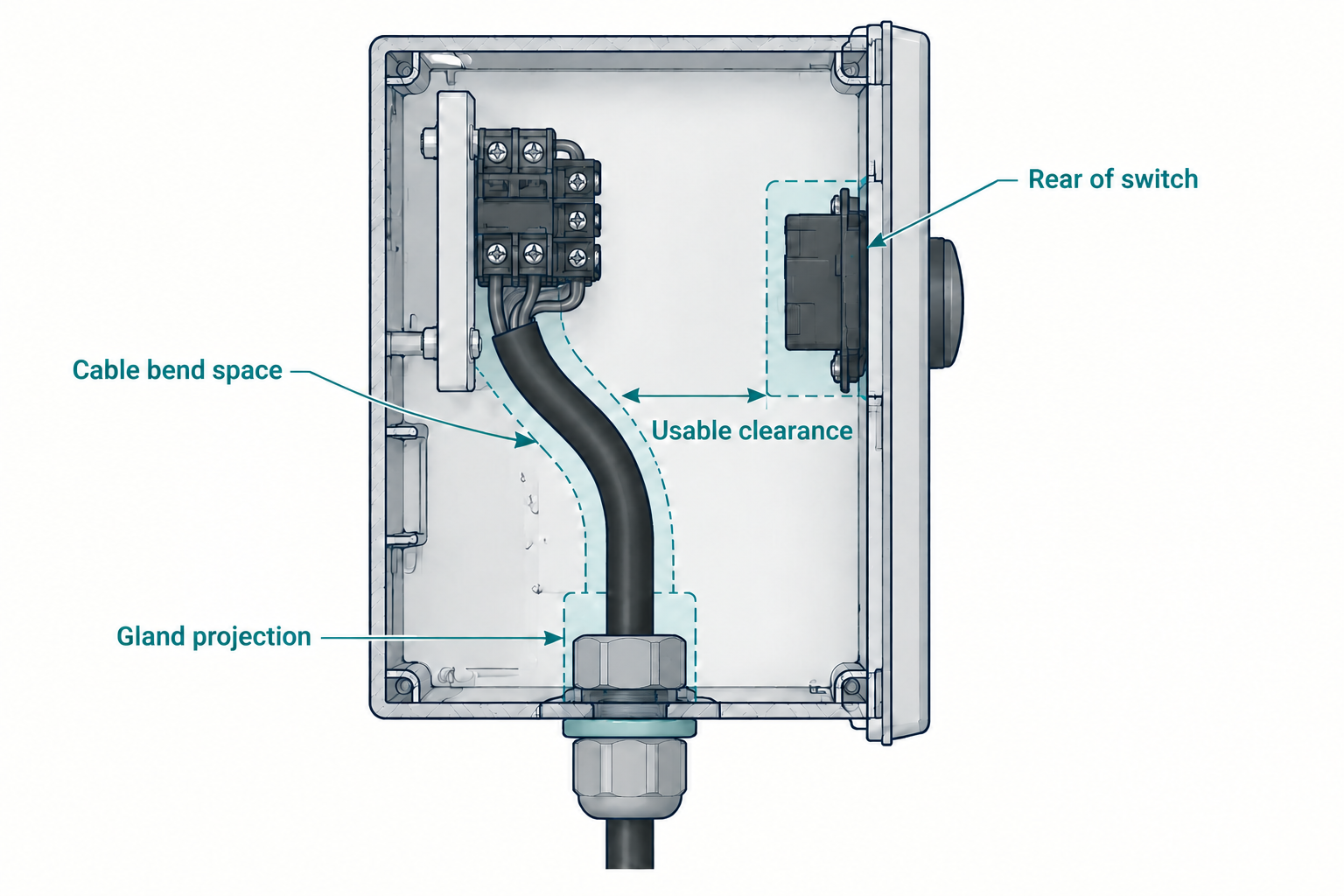
Work from the installed arrangement. Cable glands occupy space on both sides of the wall. Terminal positions determine where cables must bend. A door-mounted switch needs clearance behind the door, and a removable lid needs somewhere to go during servicing. A box can have enough total volume and still be unusable because its usable depth is in the wrong place.
Exposure then narrows the material choices. A shaded indoor cabinet, a box beside a washdown line and a box in direct sun present different problems. “Outdoor” alone does not explain whether the enclosure will see salt spray, occasional rain, hot cleaning liquid or standing water. Record the exposure that can actually reach the box, including cleaners used during maintenance.[45]
Compare metal and non-metallic enclosures before committing to plastic if the wall must transfer significant heat outward or form part of an electromagnetic shield. A metal wall can provide a heat-conduction path, but heat must first reach the wall and then pass into the surroundings. An ordinary insulating plastic housing does not provide a conductive shielding shell. With a metal enclosure, the doors, seams and cable entries still need to maintain the electrical continuity required by the shielding design.
Compare ABS, polycarbonate, PVC and fiberglass
A material comparison is most useful when it explains why a candidate belongs on the shortlist and what would remove it. Comparing generic maximum temperatures or assigning each plastic a “durability” score hides those decisions.
| Material | A sensible starting application | The limitation that can change the choice |
|---|---|---|
| ABS | Protected indoor instruments, controls and electronic housings | Ordinary ABS is a weak starting point for sustained sunlight. Heat, solvents and the required impact performance may also rule out a particular grade. |
| Polycarbonate, or PC | Housings where impact performance or a transparent cover is useful | Outdoor suitability still requires an appropriate grade. A cleaner that attacks PC or a surface that becomes difficult to read can outweigh the benefit of transparency. |
| PVC | Electrical junction boxes where conduit connections and non-metallic fittings shape the installation | A PVC conduit-compatible box still needs the correct usable space, temperature conditions, closure and entry arrangement. |
| Fiberglass-reinforced polymer, or FRP | Enclosures selected around a reinforced structure and a resin system suited to the environment | “Fiberglass” does not identify the resin, surface protection, mounting structure or finished enclosure rating. |
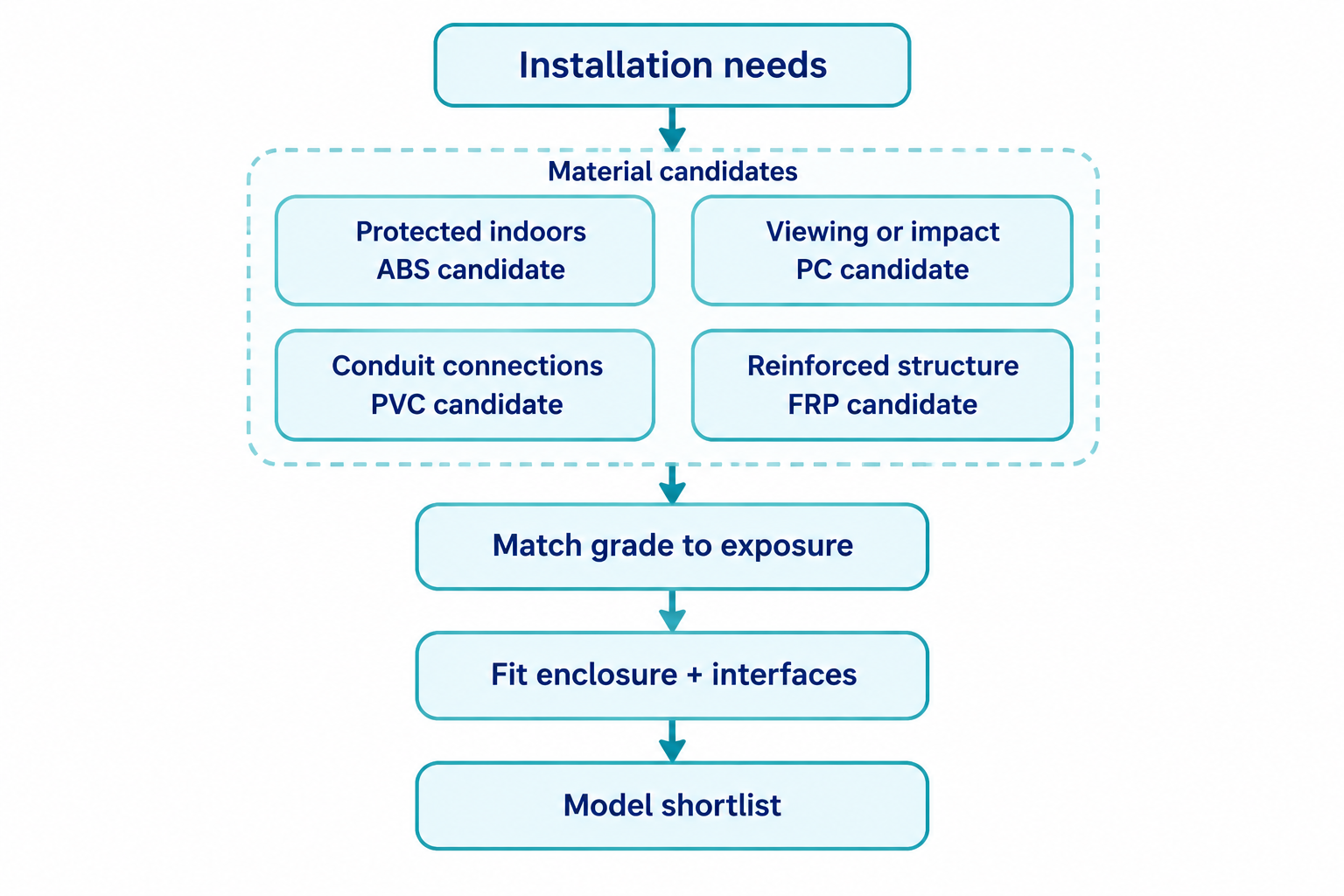
The ABS and PC distinctions reflect their usual material roles, not a guarantee for every formulation.[18][31] For PVC, the enclosure system is often as important as the material. IPEX’s Scepter JBox example combines a PVC body with conduit compatibility, a hinged cover, a fixed cover seal and molded mounting feet. The manufacturer also describes its use in a wiring and panel upgrade at the Pelletier dairy operation in Québec.[279] That example explains why an installer might choose a particular PVC box; it does not establish that all PVC enclosures tolerate every dairy-cleaning chemical.
A fiberglass enclosure specification needs a more precise material description. The reinforced body may be paired with a different cover material. Allied Moulded’s ULTRALINE discussion, for example, describes fiberglass-reinforced polyester enclosures with viewing options.[1] The body material cannot stand in for the whole assembly when a clear cover or window is added.
Check UV exposure, chemicals and operating temperature
Sunlight affects the material as well as the temperature inside the enclosure. UV exposure can change a polymer’s appearance and mechanical behavior; stabilizers can improve resistance, but their presence and performance belong to the selected formulation.[32] An opaque box that stays watertight when new has not, for that reason alone, demonstrated outdoor durability.
For an exposed installation, the useful comparison is between the outdoor versions of the candidate models. Evidence for an indoor ABS version does not transfer to a differently colored PC version, and an outdoor rating on the base does not answer the same question for the cover or gasket. If one candidate has relevant exposure data and another only says “weatherproof,” the documented candidate is the more defensible starting point.
Chemical exposure can reverse a preference based on impact strength. PC may be attractive for a clear, tough cover, yet particular solvents or cleaners can damage it.[18] Name the fluid rather than the industry: “food processing” could mean condensation, detergent mist or direct contact with a concentrated cleaner. The same material decision should not be made for all three. Where a clear cover would receive an incompatible cleaner, changing the cleaning process, shielding the cover or choosing another enclosure configuration is more useful than simply specifying a stronger plastic.
For enclosure temperature, distinguish the surrounding air from local heating inside the box. A power supply or resistor can create a hotter region next to a wall or mounting point. Glass-transition temperature describes a material change, not a ready-to-use enclosure operating limit.[33] Compare the finished model’s stated service conditions with the temperatures expected at its walls, mounting points, cover and seals. If internal heat dominates the problem, changing ABS to PC without reviewing heat loss and component layout leaves the cause untouched.
Separate material properties from enclosure ratings
Material tests and enclosure tests answer different questions. A resin’s flammability classification describes its behavior in a specified test. An ingress-protection result concerns the assembled barrier to solids or water. A component recognition record has its own permitted conditions of use. None of those documents automatically proves the other claims.
UL explicitly distinguishes Recognized Components from complete, standalone end products. Plastics can be recognized components, and their use is subject to conditions such as application or temperature limitations.[172] A supplier showing a material recognition record has therefore answered a material question. The enclosure model and the equipment built into it still need the evidence relevant to their own scope.
The practical consequence appears at the interfaces. A molded wall may be appropriate for the environment, while a poorly sealed cable opening provides a direct path for water. Bud’s selection guidance calls out mounting and drilled openings because the installed hardware must preserve the enclosure’s sealing arrangement.[45] When comparing two boxes, compare the versions you will actually install, including the cover, entries, blanking plugs and mounting method.
Choose the cover, mounting and customization route
A transparent cover is worthwhile when someone needs to read a display, indicator or instrument without opening the enclosure. It is less useful when the components are hidden behind an opaque internal panel or the viewing surface will be coated with residue. Transparency also introduces an optical requirement: scratches, haze and molding quality matter even if the cover remains structurally intact.[41]
An opaque lid is appropriate when no direct viewing task is required. A window can provide a smaller viewing area while retaining a different main door construction. Each option changes the cover assembly, so its material and environmental conditions belong in the specification alongside those of the body.
Mounting has two separate interfaces. One holds the equipment inside; the other holds the enclosure to a wall, frame or pole. A heavier internal assembly may need a mounting plate rather than individual screws into plastic features. External mounting brackets may avoid penetrations through the protected space. The useful question is where each load goes and whether the chosen model provides that attachment, rather than whether the resin is described as “strong.”[45]
For customization, begin with a stock model that already provides enough usable space and the right closure. Adding defined holes, cutouts or markings can be a practical next step. A new mold becomes relevant when the required geometry, integrated features or repeated production cannot be served by a standard housing. OKW’s customization guidance treats machining, printing and related finishing as distinct operations; the word “custom” does not by itself describe a new molded design.[25]
Prepare the material and enclosure specification
A useful specification allows another person to select the same configuration without guessing. It identifies the body and cover materials separately, then connects them to a drawing and the exposure they must withstand. FN’s plastic enclosure product page sets out the body, cover and mounting details used for quotation.
For example, a hypothetical indoor pump-monitoring box might need a clear cover to read status indicators, sealed cable entries below the terminals and space for a removable mounting plate. If there is no direct sunlight and no incompatible cleaner, those needs may keep several material families in the running. If the same box moves beside a sunny exterior pipe rack, the UV and temperature evidence becomes part of the selection. If a solvent wipe is added to the maintenance procedure, cover compatibility becomes a deciding issue. The application has changed even if the electronics have not.
Carry the result into a short material-and-model record:
- The actual environment and cleaning exposure, including the conditions that rule out a candidate.
- Usable internal dimensions, component arrangement, mounting load and cable-entry positions.
- Body, cover and gasket materials, with the proposed model and configuration.
- The required enclosure ratings and the documents that apply to that configuration.
- The supply scope: enclosure only, mounting plate, hardware, machining or other agreed work.
For a plastic-enclosure inquiry, send FN the layout and operating conditions and state whether the order is for a blank housing or also includes a mounting plate, hardware and machining. The reply should identify the proposed material and configuration, along with any unmet requirements, so you can compare actual products rather than prices attached only to “ABS” or “PC.”
FAQ
Do custom plastic enclosures always need a new mold?
A new mold is unnecessary when a standard enclosure already provides the required space, cover and mounting features. Defined holes, cutouts and markings can be added as separate customization operations. A new molded design becomes relevant when the required geometry or integrated features cannot be achieved with a suitable standard housing.[25]
Does a UL-recognized plastic make the enclosure UL certified?
A UL material recognition record applies to the identified material and its permitted conditions of use. It does not certify a complete enclosure or the equipment installed inside it. The enclosure model, cover and fitted components still need the evidence relevant to the finished product and its intended application.[172]
Are outside dimensions enough to choose the enclosure size?
Outside dimensions cannot show whether cables will bend into the terminals or whether equipment will clear the closed cover. Cable glands occupy space on both sides of a wall, and switches may project behind the door. Compare the usable internal layout, including the mounting arrangement and service access, before choosing between otherwise suitable boxes.[45]
When is a transparent enclosure cover worth choosing?
A transparent cover is useful when a display or indicator must be read without opening the enclosure. It adds little when an internal panel hides the equipment or residue obscures the viewing surface. The clear material also needs suitable cleaning compatibility and surface quality; an intact but cloudy or scratched cover may no longer serve its viewing task.[41]
Sources
[1] How ULTRALINE Enclosures Help Protect Electrical Components
[18] QUICK AND EASY GUIDE TO THE BEST PLASTICS FOR ELECTRONIC ENCLOSURES
[25] How To Specify Customized Plastic Enclosures For Your Electronics
[31] Common Impact-Resistant Plastics
[32] Evaluating UV-Resistant Plastic Options
[33] Glass Transition Temperature of Polymers
[41] Translucent and Clear Plastic Injection-Molded Parts
[45] Five Easy Suggestions for Selecting the Best NEMA or IP Rated Plastic Electronic Enclosure
[52] Non-Metallic Enclosure Material Types