

Aluminum is usually the better starting point when enclosure weight and a conductive heat path are major design constraints. Stainless steel is often the stronger candidate when the design needs a stiff fabricated cabinet and an unpainted surface suited to the specified exposure. The final choice must name an alloy and finish: a formed 5052 aluminum enclosure and a 316 stainless cabinet have different fabrication and corrosion behavior that the words aluminum and stainless cannot capture.[270][257][262]
Compare complete designs, including doors, mounting plates, hardware and surface treatment. Keeping the same wall thickness while swapping metals can change panel deflection, fastener behavior and installed weight.[255][270] Paying for a more corrosion-resistant grade also has limited value if the vulnerable joint or an incompatible fitting remains unchanged.
Define the enclosure duty and compare specific alloys
The first useful distinction is the manufacturing route. A folded sheet-metal cabinet, a die-cast instrument box and an extruded electronics housing solve different geometric problems. A material comparison that mixes those forms can accidentally attribute the benefits of a design to the metal alone.[264][270]
For formed aluminum sheet, 5052 is a common candidate because of its formability. Protocase contrasts it with 6061, which is readily machined but more susceptible to cracking at tight bends.[270] If the drawing has narrow returns and tight bend radii, substituting an alloy used for a machined part can create a fabrication problem before the enclosure reaches service.
For stainless steel, 304 is a practical starting point for a controlled, low-chloride environment; 316 offers greater chloride corrosion resistance than 304.[257] Salt aerosol, road salt or chloride-bearing cleaning chemicals therefore strengthen the case for 316, without making it immune to attack. For a welded enclosure, the 304-versus-316 choice also includes weld cleanup, surface restoration and joints that retain moisture. The grade choice does not remove moisture-trapping joints or establish that the welded surface has been properly restored.
| Design priority | Direction to investigate first | What could change the choice |
|---|---|---|
| Lower enclosure mass | An aluminum design | Extra thickness, reinforcement or heavy internal equipment may reduce the system-level saving |
| Tight bends in a fabricated aluminum shell | A suitable formable sheet alloy, such as 5052 | Machining, extrusion or casting may be a more suitable route for the geometry |
| A stiff, unpainted fabricated cabinet | Stainless steel | Handling limits, mounting loads or the service environment may favor another design |
| Chloride exposure in a stainless design | 316 rather than assuming 304 | Concentration, temperature, retained moisture and joint design still affect the result |
| Conducting component heat into the enclosure | An aluminum wall or base with a designed thermal interface | Poor contact or a hot external environment can defeat the proposed heat path |
The table combines material guidance with design consequences; it is not a ranking of finished enclosure models.[270][257][262]
Compare corrosion exposure, coatings and mixed-metal contact
Both materials rely on protective surface behavior. Aluminum forms an oxide film; stainless steel derives its corrosion resistance from a chromium-rich protective film. Alloy composition and surface treatment influence how those surfaces perform in the actual environment.[266]
Neither material is corrosion-proof. Bud’s coating guidance specifically notes that aluminum can corrode in salty or chemical-rich environments.[179] A catalog statement that aluminum does not rust is therefore a poor reason to accept an untreated enclosure in a coastal installation. The relevant question is whether the alloy, finish and joints suit the chloride exposure and maintenance conditions.
For coated aluminum, specify the finish as part of the design. Powder coating, anodizing and chemical conversion coating serve different purposes. Anodizing grows a harder oxide surface, while a suitably specified conductive conversion coating can support electrical-contact requirements.[268][269] A color name alone does not describe the protection system or the contact areas that must remain functional.
Mixed-metal joints deserve particular attention. ROLEC’s die-cast enclosure guidance calls out stainless fasteners in aluminum and the need for suitable isolation or protective interface treatment. Electrical contact between dissimilar metals, together with a conductive liquid, can create a galvanic corrosion cell. That is why corrosion-resistant fasteners alone do not settle the durability of a wet mixed-metal joint.[262]
Electrical bonding in an aluminum or stainless-steel enclosure requires a defined conductive path, so insulating every mixed-metal joint is not a workable corrosion strategy. The design must distinguish isolated contacts from intended electrical connections and preserve both functions through the expected exposure.[262][269] At a wet bracket or fastener interface, coastal corrosion control may involve isolation or protective interface details, but those details still have to preserve mechanical support, sealing and the required bonding arrangement.
Compare weight, stiffness, joining and mounting needs
Aluminum reduces mass compared with a similar steel construction, but it has lower stiffness. Protocase notes that aluminum may need greater thickness to meet a design’s mechanical requirements.[270] This is why an equal-thickness comparison cannot answer whether two doors will remain equally flat or whether the same mounting points will carry the internal equipment.
The practical comparison is between designs that meet the same load and deflection requirements. A wider door may need returns or reinforcement; a heavy mounting plate may need better support close to its load. Protocase describes hems, angle bends and gussets as ways of improving sheet-metal rigidity.[276] Those features allow the designer to put stiffness where it is needed instead of increasing every panel thickness.
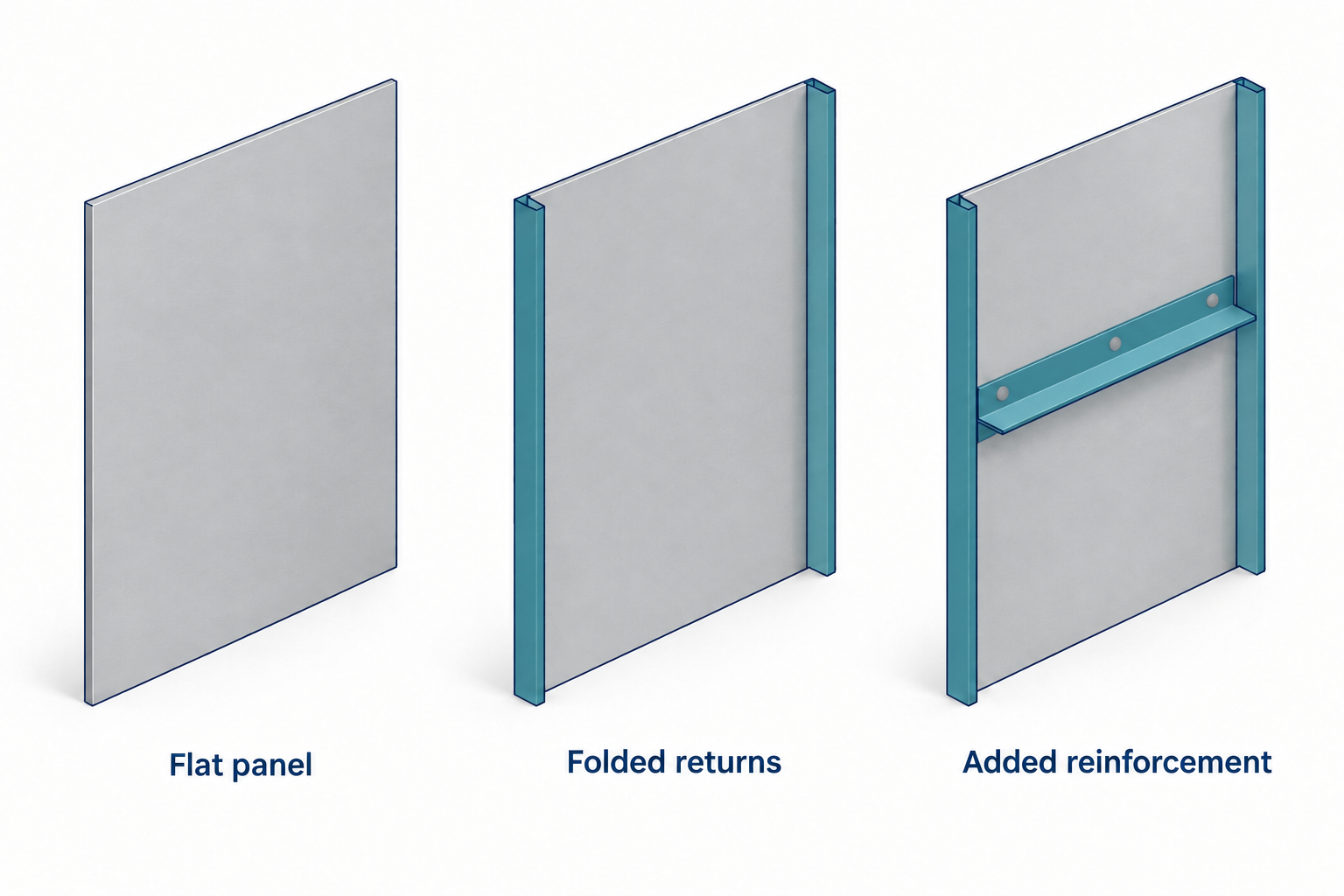
Consider a cabinet whose internal components are much heavier than its shell. Reducing shell weight will still change handling, but the wall anchors and mounting structure must carry the whole assembly. If the door supports controls, its hinges and attachment area also carry those loads. Comparing only the empty enclosure weight misses these separate load paths.
Thickness should be explicit on the quotation. Maysteel discusses the confusion that arises when gauge labels are used across different metals and contrasts them with actual dimensional thickness.[255] Specifying a nominal thickness and tolerance in millimeters or inches makes an aluminum/stainless comparison easier to audit.
Welding also belongs in the comparison. Heat can distort thin sheet, affecting the fit of adjacent parts. Protocase describes controlling heat input when welding light-gauge aluminum and stainless.[275] For a sealed enclosure, a fabrication review should therefore include the finished mating surfaces and door fit. A neat weld appearance alone does not answer that question.
Review heat transfer and fabrication requirements
Aluminum’s thermal conductivity is useful when heat has a path from the component to the shell and from the shell to the surroundings. ROLEC makes that condition explicit in its aluminum enclosure guidance.[262] Simply replacing a stainless cabinet with aluminum does not create contact between a hot device and the enclosure wall.
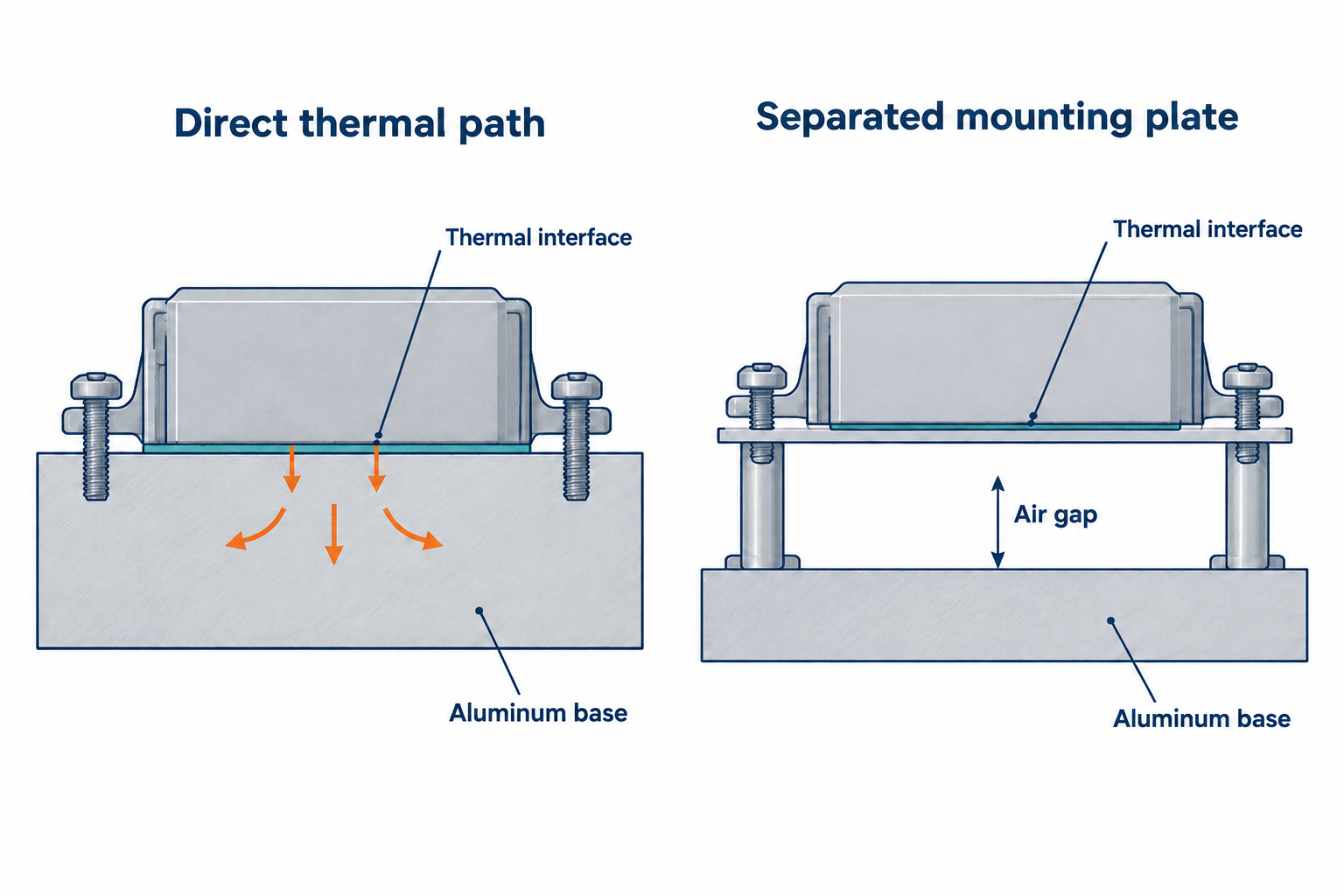
A component mounted through a suitable thermal interface to an aluminum base is a different design from the same component standing on a distant mounting plate. In the second arrangement, heat must first move through other paths before the shell material can help. The selection should follow the proposed thermal layout, including contact areas and external conditions.
Heat can also travel inward. ROLEC notes that solar loading can make the outside surface hotter than the enclosure interior.[262] In that situation, a conductive shell cannot be treated as a source of cooling. Shading, surface finish and the cooling method belong in the thermal design alongside material choice.
Finishing and electrical contact can pull in different directions. An anodized surface provides a protective oxide layer; an electrically conductive contact requires an appropriate surface specification.[268][269] The drawing should distinguish those areas rather than allowing a general finish note to cover every mating surface indiscriminately.
The same discipline helps with manufacturing cost. Compare the operations needed to produce the finished design: forming, welding, installed hardware, finishing and inspection. An alloy that is convenient for machining may create trouble at a tight sheet-metal bend, while a simpler formed design may remove machining operations entirely.[270] Raw material price cannot settle that comparison.
Choose the material using drawings and supplier evidence
Select aluminum when its weight or thermal role solves a defined problem and the alloy, stiffness and finish can meet the exposure. Select stainless when its fabricated structure and specified surface performance justify the additional mass. For a chloride-exposed stainless design, resolve the 304/316 choice before treating the offer as complete.[257][270][262]
A drawing-based comparison should make departures visible. Both offers need to identify alloy, thickness, finish, door construction, mounting interfaces and supplied hardware. If an aluminum offer adds reinforcement, or a stainless offer changes the wall thickness, those changes belong in the comparison. They may be sensible engineering decisions; they should not be hidden behind an identical outer size.
Protocase’s account of work with Stellar Power and Control Solutions illustrates this procurement step. Stellar needed enclosures and ventilation components made from design drawings, then used part numbers to support repeat ordering.[299] The case does not disclose a complete aluminum-versus-stainless comparison. Its value is the controlled definition of the fabricated parts, so a later order refers to the same design.
If electrical insulation or reduced handling weight becomes the priority, a suitable nonmetallic enclosure is an alternative to aluminum and stainless steel. The metal-versus-nonmetallic comparison then includes equipment support, heat removal and electrical function: metal backplates and fasteners still need a bonding review, and an ordinary plastic shell does not provide the same conductive shielding structure as a metal housing.
For a stainless-steel option, FN’s stainless steel enclosure page describes drawing-defined projects rather than a fixed stock-size catalog. The drawing and quotation need to identify the grade, dimensions, thickness, mounting interfaces, finish and inspection points. Those details define the enclosure being priced; “stainless steel cabinet” alone does not.
For a drawing-based metal enclosure project, FN’s custom enclosure review covers the proposed structure, cutouts, mounting parts and sealing details in relation to the installation and delivery scope. Send the drawing revision and quantity, and mark acceptable alternatives such as a change in sheet thickness or reinforcement. Electrical wiring, controls engineering and complete-system certification remain separate from this mechanical enclosure scope and need their own assigned responsibilities.
FAQ
Can I replace stainless steel with aluminum at the same wall thickness?
An equal-thickness substitution does not preserve stiffness. Aluminum has lower stiffness and may need thicker panels, formed returns or reinforcement to control deflection. Compare designs that meet the same support and door-fit requirements, then compare their finished weight rather than assuming the sheet thickness can remain unchanged. [270][276]
Does choosing 316 stainless steel solve coastal corrosion?
316 offers greater chloride corrosion resistance than 304, but the grade alone does not resolve retained moisture, vulnerable joints or the condition of welded surfaces. Chloride exposure, surface restoration and the hardware interfaces still affect the finished enclosure. A 316 specification is useful only as part of a design suited to that exposure. [257][262]
Will an aluminum enclosure automatically improve cooling?
Aluminum’s thermal conductivity helps only when heat can travel from the component into the shell and then to a cooler environment. A device mounted far from the wall may lack that effective heat path. Sun exposure can also make the exterior hotter than the interior, so shell conductivity does not replace a thermal layout and assessment of external conditions. [262]
Sources
[179] The Role of Surface Treatments and Coatings in Corrosion-Resistant Enclosures
[255] Metal Enclosure Design Tips: Metal Thickness (Gauges or Inches?)
[257] Stainless Steel Considerations
[262] Meeting Defence Standard: Specifying Reliable Diecast Enclosures For Military Applications
[264] DIECAST VS EXTRUDED ALUMINIUM ENCLOSURES FOR TOUGH HANDHELD ELECTRONICS
[266] Finding the Right Corrosion-resistant Metals
[268] 9 Things to Know About Anodizing Sheet Metal
[269] Chemical Conversion Coating in Electronics: Corrosion Protection
[270] Electronic Enclosure Design 101 – Sheet Metal Design Guide
[275] Why We Use Cold Metal Transfer (CMT) Welding