
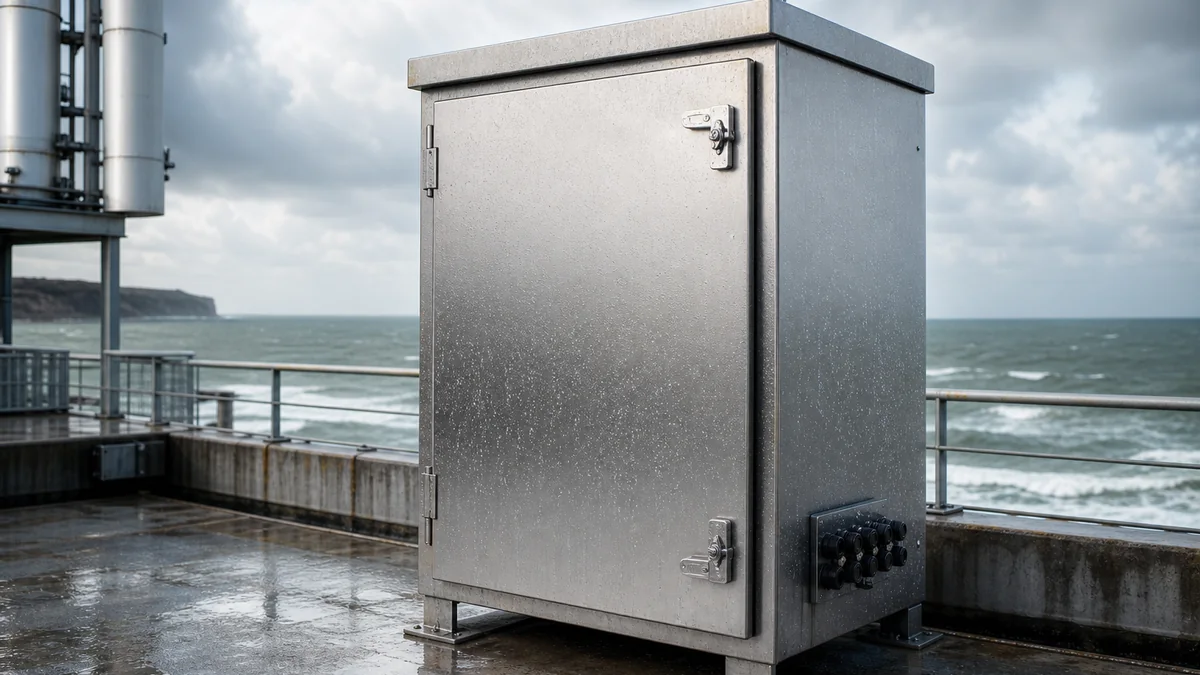

Short answer: Coastal corrosion is an enclosure-system problem, not a material-label problem. A corrosion-resistant electrical enclosure cannot be selected by material name, IP rating, or a single salt-spray number. Start with how salt and moisture reach the installation, then specify the enclosure body, surface condition, hardware, cable entries, gasket system, condensation control, evidence, and maintenance expectations as one system.
So, is 316L always the answer? Not by itself. If you are comparing 304 stainless, 316L stainless, aluminum, coated steel, fiberglass, or polycarbonate, ask: “Where can salt and moisture collect?” and “Does the complete enclosure still support the project conditions after it is cut, welded, fitted, installed, and maintained?” Before approving 316L, IP66, or NEMA 4X, review five things: exposure, material system, interfaces, completed configuration, and evidence.
The quick coastal enclosure checklist
Use the FN Coastal 5-Point Review before approving a specification or comparing quotations:
- Exposure: Define salt, wetting, shelter, chemicals, temperature cycling, condensation, cleaning, and access.
- Material system: Confirm the body and door, surface finish or coating, weld treatment, cut-edge protection, and repair.
- Interfaces: Check hardware, brackets, grounding parts, gland plates, cable glands, plugs, and gasket contact areas.
- Completed configuration: Review openings, field changes, sealing, ventilation, drainage, thermal control, and the rating after accessories are installed.
- Evidence: Match material, coating, rating, test, inspection, packaging, and maintenance records to the delivered enclosure.
Use them to expose differences behind the same quotation label.
When should you run it? Before an assumption becomes part of the project:
- Before approving 316L
- Before accepting IP66 or NEMA 4X
- Before comparing supplier quotations
- Before accepting a salt-spray report
- Before releasing the enclosure drawing
Why coastal corrosion starts at local details
A coastal site may look like an ordinary outdoor installation. The important difference is what remains on the enclosure after air, mist, rain, spray, or washdown has passed.
Salt deposits and wet-dry cycles
Salt-containing deposits can stay on roofs, door edges, horizontal hardware, gasket interfaces, fastener recesses, gland plates, and mounting brackets. When humidity rises or condensation forms, those deposits can support a thin conductive moisture film. Repeated wet and dry cycles concentrate contamination at local points, so the first visible stain may appear around a screw, hinge, weld, cut-out, or door seam rather than across the middle of a panel.
The Nickel Institute’s corrosion guidance identifies chlorine salts as important corrosive agents in marine and coastal environments. This does not make one alloy correct for every site. It makes the chloride source, wetting cycle, temperature, geometry, cleaning, and maintenance part of the selection.
Pitting and crevice corrosion
Stainless steel protects itself with a passive surface film. Chlorides can challenge that film, especially where deposits remain wet or oxygen access is restricted. A gasket edge, lap joint, washer, nameplate fixing, hinge leaf, or dirt trap can form a more aggressive local environment than the open face of the enclosure.
A clean door panel therefore does not prove that every interface is healthy. A stronger stainless grade may improve resistance, but it does not remove a narrow wet crevice or a water trap.
Galvanic contact between dissimilar metals
Picture a stainless enclosure mounted to an aluminum bracket with ordinary fasteners in a wet, salty environment. Each material may look acceptable on its own, while the electrical contact between them changes the corrosion behavior.
The Aluminum Association’s structural guidance recommends electrically insulating dissimilar metals where galvanic corrosion is possible. For an enclosure, review fasteners, mounting feet, hinges, ground connections, cable glands, gland plates, and support frames. Any isolation detail must still meet the mechanical, sealing, bonding, and grounding requirements of the project.
Coating damage at edges, welds, and cut-outs
A powder-coated steel enclosure can be practical when the exposure is controlled and the coating system is properly specified. Risk increases when pretreatment is weak, cut edges remain exposed, welded areas are not restored, scratches are left unrepaired, or hardware creates water-retention points.
“Powder coated” is not a complete specification. Buyers need the substrate, pretreatment, coating system, edge coverage, repair method, and protection through fabrication and shipment. Our guide to why pretreatment matters for powder-coated steel enclosures explains that foundation in more detail.
Condensation and internal corrosion
A sealed enclosure can still experience condensation. Temperature changes can move humid air through weak paths, cable entries, or conduit, while moisture already inside can condense when a wall, roof, or component falls below the local dew point.
Salt contamination makes that moisture more conductive and more damaging. Corrosion may then appear on internal fasteners, rails, mounting parts, or terminals even when direct rain ingress is not obvious.

From overlooked detail to project consequence
Where does corrosion start? Often at a detail treated as secondary.
| Overlooked detail | Possible failure path | Project action |
|---|---|---|
| Salt at a gasket edge or fastener | Wet-dry crevice attack | Define hardware, geometry, and cleaning |
| Bare metal at an edge, weld, or cut-out | Local loss of protection | Specify treatment and repair |
| Dissimilar metals in a wet joint | Concentrated galvanic attack | Review compatibility, isolation, and grounding |
| Gland, plug, or accessory added later | Local interface weakness | Include it in the schedule and rating review |
| Condensation or conduit moisture | Internal corrosion without rain entry | Review sealing, drainage, thermal cycling, and maintenance |
This does not predict service life. One detail can change the drawing, evidence, installation, or maintenance plan.
Define the coastal exposure before choosing a material
“Installed near the sea” is useful context, but it is not yet an engineering specification. Distance from shore alone can mislead because wind direction, shelter, elevation, surf, local pollution, cleaning practice, rainfall, temperature cycling, and maintenance change the real exposure.
Use the following categories to start the quotation discussion. They are not a universal environmental classification.
| Exposure discussion | What the enclosure may face | Questions to ask before selection |
|---|---|---|
| Humid coastal air | High humidity with limited direct salt spray | Is the installation sheltered? Can condensation form? Are chemicals or washdown also present? |
| Windborne salt | Repeated salt deposition on an outdoor enclosure | Which faces receive the prevailing wind? Are the roof, door seams, hardware, and cable entries exposed? |
| Direct spray or washdown | Frequent wetting, cleaning spray, or salt-laden water at interfaces | What pressure, direction, frequency, temperature, and cleaning chemistry apply? |
| Splash, offshore, or immersion risk | Severe wetting or temporary/continuous submersion | Is this still an empty-enclosure selection, or does the complete system require a project-specific marine or offshore review? |
Do not jump from the word “coastal” directly to a 316 stainless steel electrical enclosure. The same grade can face very different conditions in a sheltered installation, a wind-facing rooftop, a washdown zone, and an offshore splash area.
For a useful quotation, record the installation position, shelter, salt source, wetting method, temperature range, chemicals, cleaning method, internal heat load, condensation concern, and maintenance access.

Compare enclosure materials for coastal service
No material is correct for every coastal project. Corrosion resistant electrical enclosures are selected by matching the material system to a defined exposure and complete interface specification. Compare corrosion, weight, impact, UV, chemicals, heat, electrical continuity, fabrication, maintenance, and budget.
304 and 316 or 316L stainless steel
Stainless steel offers a clean finish and general corrosion resistance. As chloride exposure increases, 316 or 316L is often considered because molybdenum improves resistance to localized corrosion in many chloride-containing environments.
The certificate grade is only one part of the finished enclosure. A 316 stainless steel electrical enclosure can still have weak points at fasteners, contaminated surfaces, untreated welds, dirt traps, openings, and mixed-material mounting interfaces. Likewise, 304 should not be approved or rejected from the word “coastal” alone.
For welded work, 316L may enter the discussion because of its lower carbon content. The quotation should still define weld cleanup, passivation, finish direction, contamination control, hardware, drainage, and packaging. FN’s stainless steel electrical enclosures page treats grade as one part of that review.
Powder-coated and galvanized steel
Coated steel offers cost, stiffness, fabrication, and color options. Its coastal performance depends on the complete protective system.
For powder-coated steel, confirm the substrate, pretreatment, edge coverage, weld restoration, damage repair, hardware, water traps, and maintenance. For galvanized steel, also review cut edges, welds, appearance, chemicals, and any additional coating.
ISO 12944-2 provides a widely used framework for protective paint systems on steel structures. It can structure the environment and durability discussion, but it is not a universal certification for every completed enclosure and accessory combination.
Aluminum
Buyers consider aluminum when low weight, handling, machining, and heat transfer matter. It avoids the red rust associated with carbon steel, but it can still experience pitting or galvanic problems in a salty environment.
Confirm the alloy, surface treatment, chemical exposure, fasteners, mounting hardware, drainage, grounding, and dissimilar-metal contacts. An aluminum body with stainless hardware may require suitable isolation without compromising electrical bonding or mechanical strength.
Fiberglass, FRP, and polycarbonate
Non-metallic materials avoid red rust and can suit corrosive or electrically insulating applications. Fiberglass or FRP may be considered for chemical resistance and structural use. Polycarbonate may be attractive where impact resistance, low weight, visibility, or field modification matters.
Confirm UV grade, chemicals, temperature, internal heat, impact, stiffness at the required size, hardware loads, thread strength, machining practice, fire requirements, grounding, shielding, EMC, gasket compression, and door flatness. “Non-metallic” does not mean maintenance-free or suitable for every environment.
| Material route | Why buyers consider it | Coastal boundary to confirm |
|---|---|---|
| Powder-coated steel | Cost, stiffness, fabrication, color | Pretreatment, edge coverage, coating damage, repair, hardware |
| Galvanized steel | Sacrificial zinc protection, cost | Cut edges, welds, appearance, chemicals, coating compatibility |
| 304 stainless steel | General corrosion resistance, clean finish | Chloride exposure, crevices, cleaning, finish, hardware |
| 316 or 316L stainless steel | Common candidate for stronger chloride exposure | Fabrication, surface condition, weld treatment, local crevices, accessory materials |
| Aluminum | Low weight, machining, heat transfer | Alloy, pitting, galvanic isolation, grounding, finish |
| Fiberglass or FRP | No red rust, chemical resistance, insulation | UV, surface aging, machining, stiffness, fire and thermal requirements |
| Polycarbonate | Impact resistance, low weight, modification | UV grade, chemicals, temperature, size, hardware loads, EMC needs |

Need a material shortlist? Send the installation location, exposure description, drawing, and required rating. Those four inputs are more useful than asking for the “best coastal material” without site context.
What NEMA 4X and IP66 do—and do not—prove
NEMA 4X, IP66, and material corrosion resistance answer related but different questions.
The NEMA enclosure type comparison includes corrosion resistance in the Type 4X protection description. The IEC 60529 IP Code addresses degrees of protection provided by enclosures against access, solid objects, dust, and water.
| Selection layer | What it helps answer | What still needs review |
|---|---|---|
| IP66 | What dust and powerful-water-jet exposure the tested enclosure resists | Material, coating, chloride exposure, accessory compatibility, field installation |
| NEMA Type 4X | Enclosure-type protection including a corrosion-resistance requirement | Actual material system, site severity, complete configuration, service-life expectations |
| Material and completed configuration | How the body, finish, hardware, openings, seals, and accessories fit the project | Evidence, installation, inspection, cleaning, and maintenance |
Asking whether NEMA 4X is “better” than IP66 oversimplifies two different systems. An IP66 electrical enclosure can still corrode. A stainless enclosure can still leak through a poorly installed gland. A nominally corrosion-resistant box can still collect condensation inside.
For a focused water-ingress comparison, see IP65 vs IP66 electrical enclosures. For coastal selection, use ingress protection as one layer of the specification, not the whole decision.

Specify the enclosure interfaces that usually fail first
The enclosure body is the largest and most visible part, but smaller components often decide what happens in service. Review these interfaces after customization and accessory installation, not only on an empty box.
Hinges, latches, fasteners, mounting, and grounding
Ask for an accessory material schedule. “Stainless hardware” may not identify the grade, finish, washer, spring, pin, or internal mechanism. Check whether water can remain behind a hinge leaf, under a washer, inside a latch recess, or between the enclosure and its bracket.
A corroded latch can reduce closing force. A difficult hinge can change door alignment and make gasket compression uneven. Mounting brackets, grounding points, and mixed-metal fasteners can also create local galvanic or coating problems.
Cable glands, gland plates, and unused openings
Cable entry should not be left until installation day. The gland material, sealing ring, thread, reducer, locknut, blanking plug, gland plate, and cable diameter all affect the completed interface.
Use compatible materials, size the gland for the cable, and avoid an unsealed thread path or dissimilar-metal contact where water and salt collect. Our guide to cable glands and gland plates covers these water-ingress paths in more detail.
Gaskets and door compression
A gasket works through suitable material, continuous contact, controlled compression, door stiffness, latch spacing, and a clean sealing path. Coastal deposits can accumulate at the gasket edge, and frequent opening can move contamination onto the sealing surface.
If a hinge or latch corrodes, the door may no longer compress the gasket evenly. Gasket performance therefore belongs in the corrosion review even though the gasket itself is not metal.
Cut-outs, welds, and coating repair
If the project includes windows, displays, connectors, gland plates, louvers, fan filters, air conditioners, brackets, bases, or welded structures, define what happens to the surface after fabrication.
For stainless work, this may include weld cleanup, finish direction, contamination control, and passivation requirements. For coated steel, it may include edge coverage, coating restoration, damage criteria, and repair instructions. The drawing should define the new feature, not only the base enclosure.
Ventilation, drainage, and condensation control
Review whether the design traps water, allows drainage, or needs a heater, hygrostat, vent, drain, cooling method, or conduit-sealing strategy. Read why condensation happens inside outdoor electrical enclosures before selecting a control method. A pressure-equalization vent can help manage pressure cycling, but it does not dehumidify the enclosure.

What the test report actually proves
A test name or hour count is useful only when the buyer knows what was tested, how it was prepared, and how the result was judged.
ASTM B117 describes the apparatus, procedures, and conditions used to maintain a controlled salt-spray environment. It supports comparative testing when the specimen and evaluation criteria are defined. It does not convert a salt-spray hour count into a universal number of coastal service years.
If a supplier gives a salt-spray claim, ask whether the report identifies the standard and edition, substrate, grade, pretreatment, coating system, scribe condition, cut edges, welds, fasteners, assembled interfaces, exposure duration, evaluation criteria, laboratory, and permitted defects. Most importantly, ask whether the tested specimen represents the delivered construction.
The same logic applies to ingress testing. Evidence for an empty enclosure does not automatically cover every field-drilled opening, gland, window, vent, fan, air conditioner, handle, or accessory combination.
A practical evidence package
| Evidence | What the buyer should confirm |
|---|---|
| Material record | Grade, traceability, and relationship to the delivered enclosure |
| Hardware schedule | Grades and finishes for hinges, latches, fasteners, glands, plugs, and brackets |
| Surface specification | Substrate, pretreatment, finish, weld treatment, passivation, edge protection, and repair |
| Salt-spray or cyclic-corrosion report | Specimen, preparation, exposure, evaluation method, laboratory, and allowed defects |
| IP, NEMA, UL, or project evidence | Tested configuration and limits after customization |
| Gasket and cable-entry information | Materials, compatibility, dimensions, installation, and maintenance requirements |
| Inspection and shipment controls | Acceptance points, finish protection, packaging, cleaning, and maintenance instructions |
More documents are not automatically better. The evidence should match the project risk and the delivered configuration.
From coastal enquiry to a quote-ready specification
A useful enquiry connects the environment to the drawing. Engineering defines exposure, procurement compares material systems and documents, and quality defines inspection and acceptance. Shared inputs reduce avoidable requoting and redesign.
What FN needs to review
At FN, the quotation discussion starts with the environment and drawing, not with a promise that one grade solves every coastal problem. Use this tool to align engineering, procurement, quality, and the enclosure supplier.
A. Exposure
- ☐ Location, orientation, shelter, access
- ☐ Salt, spray, washdown, splash, chemicals
- ☐ Temperature, heat, condensation, cleaning
B. Material system
- ☐ Body, door, finish, coating
- ☐ Pretreatment, weld cleanup, passivation
- ☐ Edge, cut-out, damage repair, protection
C. Interfaces
- ☐ Hardware, mounting, gasket compression
- ☐ Glands, plate, plugs, cable layout
- ☐ Grounding, isolation, ventilation, drainage
D. Completed configuration
- ☐ Dimensions, doors, mounting, layout
- ☐ Openings, accessories, thermal control
- ☐ Required rating and documented scope
E. Evidence and delivery
- ☐ Material, surface, hardware records
- ☐ Tests, inspection, acceptance criteria
- ☐ Quantity, packaging, destination, delivery
FN can review the enclosure body, fabrication, openings, material options, hardware, sealing interfaces, inspection requirements, and shipment protection within the confirmed manufacturing scope. Complete-equipment integration, field installation, wiring, thermal validation, certification ownership, and service-life decisions remain project-specific unless separately confirmed.
If the buyer is still comparing broad options, the outdoor electrical enclosures page provides a starting point. For drawing-based manufacturing and custom openings, use the custom electrical enclosures route.

An illustrative solar-controls example
Consider a buyer requesting a 316L stainless steel, IP66 outdoor cabinet for solar control equipment near a coastline. This is an illustrative specification example, not a customer case.
At first glance, “316L and IP66” sounds quote-ready. But it does not say whether the cabinet is sheltered or faces salt-laden wind, whether deposits remain wet, whether conduit can carry moisture inside, or whether hardware, glands, brackets, vents, and cut-outs follow the same corrosion and sealing strategy. Suppliers can therefore price different completed configurations under the same labels.
The FN Coastal 5-Point Review changes the sequence. Exposure defines how salt, water, heat, and condensation reach the cabinet. Material system covers the body, finish, weld cleanup, contamination control, and repair. Interfaces cover hardware, glands, gaskets, grounding, and mixed metals. Completed configuration checks the rating after openings and accessories are installed. Evidence asks whether records and reports represent the delivered construction.
The result is a reviewable specification covering environment, material, interfaces, configuration, evidence, inspection, and maintenance. The answer may still be 304, 316L, aluminum, coated steel, or a non-metallic enclosure. The improvement is that the choice has reasons, boundaries, and an acceptance path—not that a material label has become a service-life guarantee.
For renewable-energy routing, the solar enclosures page can help define the application before the final custom specification.
A seven-step quote-ready workflow
The five-point review defines what to cover. These seven steps move the inputs into a specification that can be compared, quoted, inspected, and maintained.
Step 1: Describe the environment
Record salt source, wetting method, shelter, humidity, temperature, UV, chemicals, washdown, splash, and maintenance access. Do not write only “outdoor coastal.”
Step 2: Identify the likely failure points
Mark water traps, seams, gasket edges, hinges, locks, cut-outs, welds, cable entries, brackets, grounding points, and dissimilar-metal contacts on the drawing.
Step 3: Shortlist material systems
Compare stainless grades, coated steel, galvanized steel, aluminum, FRP, and polycarbonate against corrosion, weight, impact, heat, UV, chemicals, fabrication, grounding, appearance, and cost.
Step 4: Complete the interface specification
List hardware grades, gasket material, glands, plugs, gland plates, mounting parts, isolation details, venting, drainage, and thermal-control provisions.
Step 5: Match ratings to the completed enclosure
Confirm the required ingress or enclosure type, then check whether customization and accessories remain within the tested or documented configuration.
Step 6: Define evidence and acceptance
State which material records, coating data, test reports, inspection points, dimensional checks, finish criteria, and packaging controls are required.
Step 7: Plan inspection and maintenance
Set safe inspection and maintenance actions for the site. Look for salt deposits, staining, coating damage, difficult hardware, gasket damage, blocked drainage, damaged cable entries, and internal condensation before they become a sealing or operational problem.
FAQ
Are NEMA 4X enclosures always suitable for coastal environments?
NEMA Type 4X includes a corrosion-resistance requirement, but the project still needs a material, hardware, opening, sealing, and exposure review. A type designation should not be used as a universal service-life guarantee for every coastal or offshore condition.
Is IP66 corrosion resistant?
IP66 describes dust-tight protection and protection against powerful water jets under the IEC IP Code. It does not by itself define stainless grade, coating durability, chloride resistance, hardware compatibility, or corrosion life.
Is 316L always better than 304 for a coastal enclosure?
316 or 316L is commonly considered when chloride exposure is stronger, but “better” depends on the actual environment, fabrication, finish, crevices, hardware, cleaning, maintenance, cost, and other project requirements. Avoid selecting by grade alone.
Can powder-coated steel be used near the coast?
It can be considered when the exposure and coating system are suitable. Confirm substrate preparation, coating specification, edge and weld protection, damage repair, hardware, water traps, inspection, and maintenance. Direct severe exposure may require a different material or coating approach.
Are fiberglass and polycarbonate enclosures corrosion proof?
They avoid red rust, but they still have selection limits. Review UV resistance, chemicals, temperature, impact, stiffness, hardware loads, sealing, fire requirements, grounding, shielding, and field modification.
Does a 1,000-hour salt-spray result mean the enclosure will last a certain number of years?
No universal conversion should be used. Check the test method, specimen, preparation, scribe condition, evaluation criteria, laboratory, and whether the tested construction matches the delivered enclosure.
What should I send to request a coastal enclosure quotation?
Send the installation location and exposure description, drawing, dimensions, mounting arrangement, material preference, finish, openings, hardware, cable-entry layout, internal heat load, condensation concern, required rating, documents, quantity, packaging, and delivery destination.
Ready to review the enclosure, not just the material label?
Before approving 316L, IP66, or NEMA 4X, complete the FN Coastal 5-Point Review. If an item is unclear, send the conditions, drawing, accessories, rating, quantity, packaging, and destination.
FN can review enclosure manufacturing details within the confirmed scope; integration, field work, certification ownership, and service-life decisions remain project-specific.