

ABS is usually a sensible starting point for protected indoor electronics when the enclosure has no demanding heat, impact or sunlight exposure. Polycarbonate is worth comparing when the design needs a clear cover, greater impact capability or more thermal headroom. Outdoor equipment needs an appropriate weather-resistant grade and enclosure configuration, including outdoor evidence for the selected PC version.[40][18][32]
The useful purchasing question is whether the proposed PC model solves a requirement that the ABS model cannot meet. If both satisfy the duty, compare usable space, assembly, modifications and price on the same basis.
Start with the resin grade and enclosure configuration
ABS and PC are thermoplastic enclosure materials, but each name covers many grades. Reinforcement, flame-retardant additives, color and blends can change the material record. A specification for PC+ABS is a blend specification; it should not be treated as interchangeable with either neat ABS or neat PC. ASA+PC is another distinct blend, used where weatherability is part of the material choice.[40][18]
The finished enclosure may contain both materials. An ABS body with a transparent PC cover is a common type of configuration; Bud’s PNB description provides a named example.[50] The clear lid does not turn the body into PC. Body and cover data should remain separate when comparing temperature, flammability or outdoor exposure.
This also matters when replacing an existing housing. A new material in the same nominal shape does not automatically deliver the same part. A supplier still has to control the molded dimensions and the interfaces with the lid, screws, gasket and internal equipment. If the application is served by two standard versions of a product, compare those versions. If changing the resin requires a new molding specification, treat that as a product change rather than a purchasing substitution.
Compare indoor use and outdoor UV exposure
For a protected indoor instrument, ABS can meet the mechanical and appearance needs without selecting PC solely for a tougher-sounding name. Its suitability ends where the particular grade or model no longer meets the environment. Ordinary ABS has limited UV stability, while outdoor PC also needs the appropriate formulation rather than an assumption that all PC resists sunlight.[18][32]
Exposure is more precise than location. A housing inside a shaded electrical room has a different duty from one near sunlit glazing. A box under an outdoor canopy may avoid direct rain but still experience reflected sunlight and temperature changes.
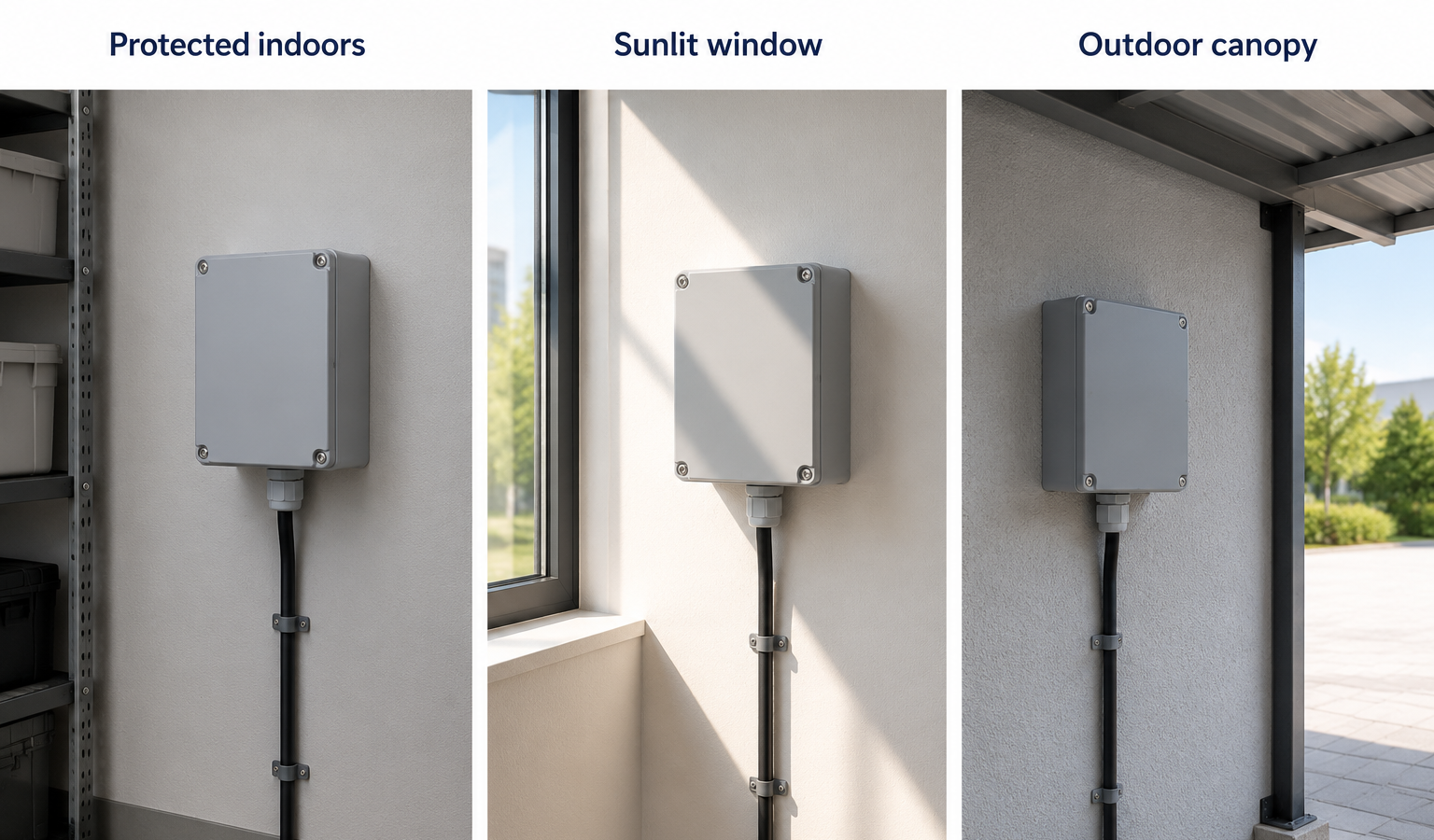
“Indoor” and “outdoor” are useful labels only after the relevant exposure has been described.
UV can affect both appearance and retained properties. If the enclosure contains an indicator that must remain visible, loss of clarity can matter before an operator notices any mechanical problem. If the enclosure protects a frequently handled sensor, retained impact performance may be the more important endpoint. Select evidence that addresses the function, rather than accepting a color-change result as proof of every outdoor property.
For a new exposed installation, a documented outdoor PC version is a stronger starting point than an ordinary ABS version with no relevant exposure evidence. If an ABS-based blend or another plastic has the required weathering record and fits the mechanical duty, the material label alone is not a reason to exclude it. This keeps the decision open to evidence without treating every candidate as equally suitable.
Check impact, temperature and mounting requirements
PC is known for impact performance, but a material specimen and an enclosure do not have the same geometry. Corners, openings, wall thickness and fastener locations affect where the assembled housing is stressed. Material data also varies by grade and manufacturing process; Protolabs explicitly distinguishes molded materials from superficially similar “ABS-like” printing resins.[31]
OKW specifies IK07 for the ABS version of its IN-BOX enclosure and IK08 for the PC version.[21] Those values describe the specified enclosure versions, not universal ratings for either resin. An enclosure’s IK rating concerns resistance to defined mechanical impacts on a particular assembled sample. The mounting arrangement, strike locations and included parts therefore matter: a report for one cover does not automatically cover a different window, mounting arrangement or later cutout. The comparison is useful only when each candidate matches the configuration covered by its impact evidence.
Temperature needs a similarly careful distinction. Glass-transition temperature describes a change in polymer behavior; it is not the finished enclosure’s continuous operating limit.[33] A box carrying equipment at its mounting features also has a different duty from an unloaded material specimen.
Bud’s PNB article illustrates the risk of selecting the largest number on a data sheet: it lists an ABS body range up to 70°C and a clear PC cover limit up to 110°C.[50] The cover figure cannot establish that the complete enclosure may operate at 110°C.
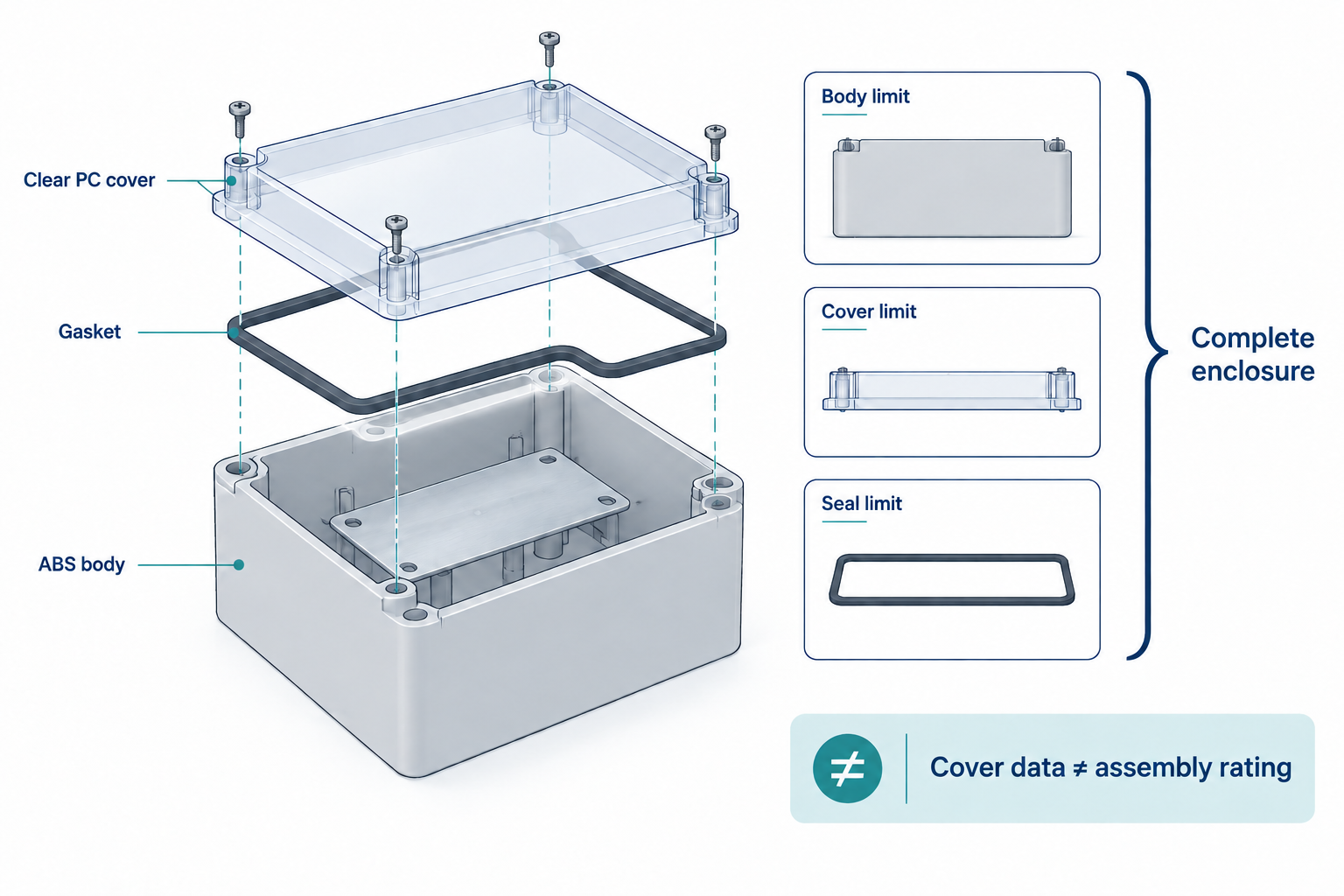
The body, seal, fasteners, component supports and the intended load all remain part of the assembly.
Internal heat can also make a material substitution less helpful than it first appears. If a power component heats a nearby wall or mounting feature, selecting PC may change that feature’s thermal margin, but it does not remove the heat source. Component spacing and the enclosure’s thermal design still determine the local temperature. Use the model’s stated service conditions to decide whether an ABS option remains viable; do not substitute a generic softening value.
Mounting requirements can decide between two otherwise suitable versions. A plate supported at several defined points is a different arrangement from a heavy component attached to a single molded boss. Repeated lid removal also places repeated demand on the fastening interface. A stronger body material does not, by itself, establish the capability of those attachments. Compare the available mounting features and their specified use along with the resin.
Compare flammability evidence and finished enclosure ratings
Neither ABS nor PC has one universal flammability classification. The relevant record belongs to a formulation under stated test conditions, including specimen thickness.[48] A flame-retardant ABS grade may therefore answer a requirement that an unspecified PC grade does not. Buying PC for its general toughness does not settle the flame requirement.
UL explains that Recognized Components, including plastics, are evaluated for use within a larger product and have conditions of acceptability. Component recognition is not certification of a complete, standalone product.[172] Where a supplier provides material evidence, read it as evidence for that material and its stated use.
Ingress protection is a separate question. A higher flammability classification does not improve the seal around a cable entry. Likewise, an enclosure that passes an ingress test has not thereby demonstrated a particular material flame classification. Keep the material record, finished enclosure documentation and installed entry configuration separate in the comparison. This avoids choosing a more expensive material while leaving the actual requirement unresolved.
Choose by requirements rather than the material name
The strongest reason to choose PC is a requirement the proposed ABS enclosure cannot satisfy. The strongest reason to retain ABS is that it already meets the duty and the PC alternative adds no useful function. Compare price only after that technical distinction is clear.
| Requirement | Selection direction | What would change the answer |
|---|---|---|
| Protected indoor controls with modest heat and handling loads | Start with the suitable ABS model | A higher actual temperature, incompatible cleaner or more demanding impact duty |
| Reading a display through the closed cover | Compare PC clear-cover options, including mixed-material assemblies | Optical area, surface damage, cleaning exposure and the separate body limits |
| Direct sunlight or repeated outdoor exposure | Prefer a version with relevant outdoor evidence | A different grade, color, cover or exposure from the documented configuration |
| Greater impact demand | Choose the model whose tested performance meets that demand | Changes to mounting, openings, cover or test temperature |
| A specified flammability classification | Select the documented grade and thickness that meet it | Material substitution or a condition outside the record’s scope |
Wireless equipment adds a question that a mechanical comparison cannot answer. In Integra’s Allterco Robotics case, the customer compared ABS, PVC and PC candidates for products using wireless communication. The supplier reports that Allterco used antenna-tuning equipment and tested several Integra enclosures before choosing its PC solution.[278] The public account does not provide a complete comparison method for every material, so it is not a universal RF ranking.
The practical implication is to test the chosen housing with the actual antenna and equipment arrangement. A successful result in one enclosure does not establish the same result after changing its wall, cover or internal layout. Electrical insulation and wireless transmission are different design requirements.
For a material replacement, keep a record of the requirement that justified the change and the model configuration that satisfies it. If the new PC housing provides necessary viewing or impact performance, that is a clear reason to use it. If the ABS version meets the environment, holds the equipment properly and supports the required interfaces, it remains a credible choice. FN’s plastic enclosure product page describes the model, material and mechanical scope used for a quotation.
FAQ
Does a PC cover raise the operating limit of an ABS enclosure?
A higher temperature limit for the PC cover does not raise the limit of the ABS body or other parts. Bud’s PNB example gives separate temperature figures for its ABS body and clear PC cover. The complete enclosure must remain within the conditions supported for its body, seal, fasteners and loaded mounting features.[50]
Can PC+ABS be substituted for either PC or ABS?
PC+ABS is a blend specification, not another name for either neat polymer. Formulation, reinforcement, flame-retardant additives and color can change the material record. A substitution needs matching material and part evidence, including the lid, gasket and mounting interfaces, rather than approval based only on the same nominal enclosure dimensions.[40][18]
Does polycarbonate always have a better flammability classification than ABS?
Neither polymer has one universal flammability classification. The result belongs to a particular formulation under stated conditions, including specimen thickness. A documented flame-retardant ABS grade may satisfy a requirement that an unspecified PC grade does not. Select the material record that meets the requirement rather than treating impact toughness as flame evidence.[48]
Is an outdoor canopy enough to make an ordinary ABS enclosure suitable?
A canopy may reduce direct rain without removing reflected sunlight or temperature changes. Ordinary ABS has limited UV stability, and an outdoor PC version also needs evidence for its actual formulation. Describe the exposure that still reaches the enclosure, then choose a model with weathering evidence for that duty rather than relying on the presence of a roof.[18][32]
Sources
[18] QUICK AND EASY GUIDE TO THE BEST PLASTICS FOR ELECTRONIC ENCLOSURES
[21] SPECIFY THE RIGHT PLASTIC ENCLOSURES FOR YOUR INDUSTRIAL ELECTRONICS
[31] Common Impact-Resistant Plastics
[32] Evaluating UV-Resistant Plastic Options
[33] Glass Transition Temperature of Polymers
[40] ABS vs. PC: Comparing Two Common Thermoplastics
[48] Flammability 101 for Plastic Electronic Enclosures
[50] New PNB Series of ABS IP67 Products
[172] The UL Component Recognition Classification
[278] Case Study: Providing IoT Solutions with Allterco Robotics