
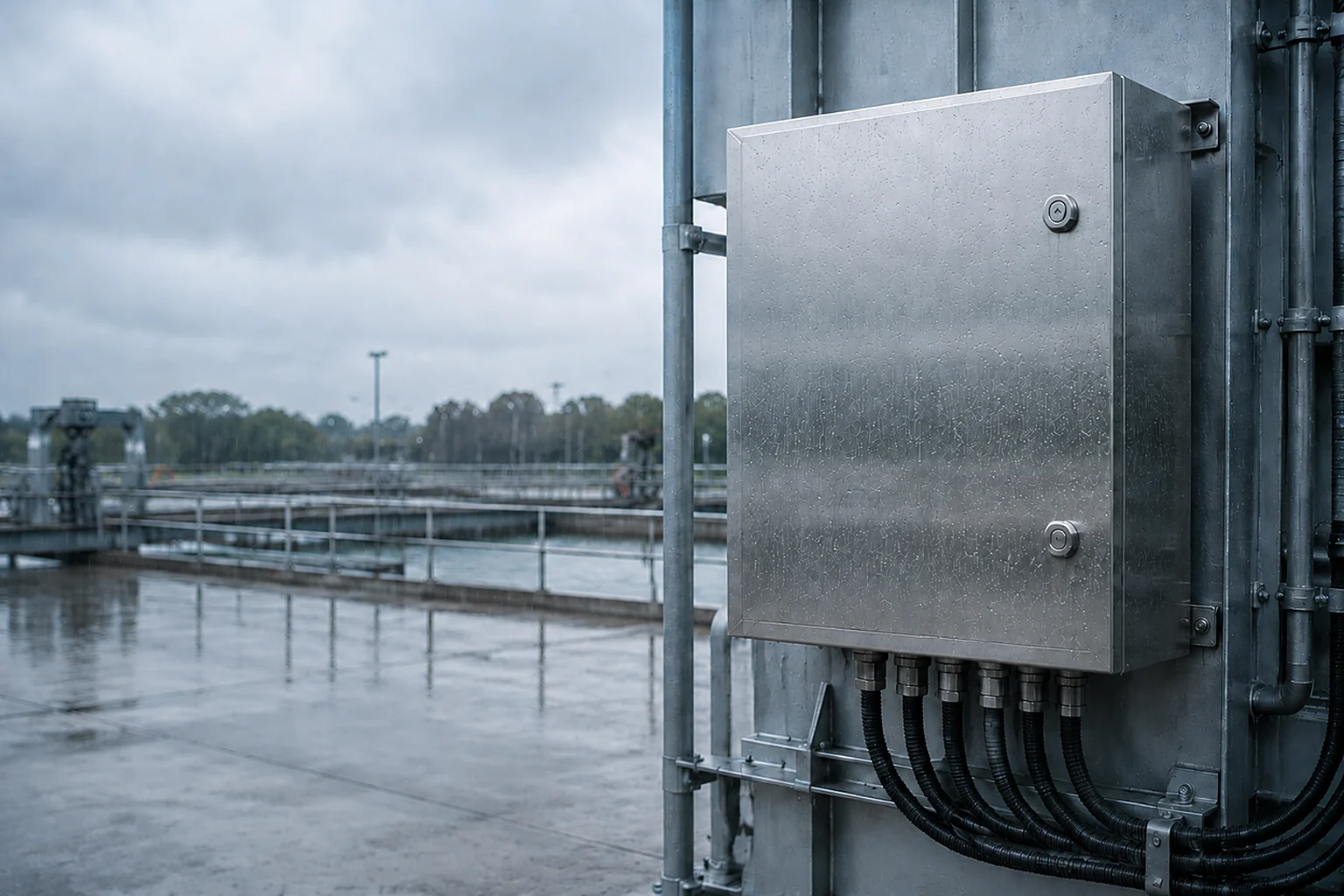

Start with the water exposure—not the word “waterproof.” Then confirm the IP or NEMA scope, material, openings, heat, mounting and supplier deliverables.
The decision that prevents most mistakes
Specify the finished enclosure configuration, not just the empty box. Door seals, hinges, locks, cable glands, connectors, windows, fans and field-drilled holes all affect the water path.
That is why a box suitable for rain may still be wrong for hose-down cleaning, salt spray or temporary submersion.
1. Start with the water exposure
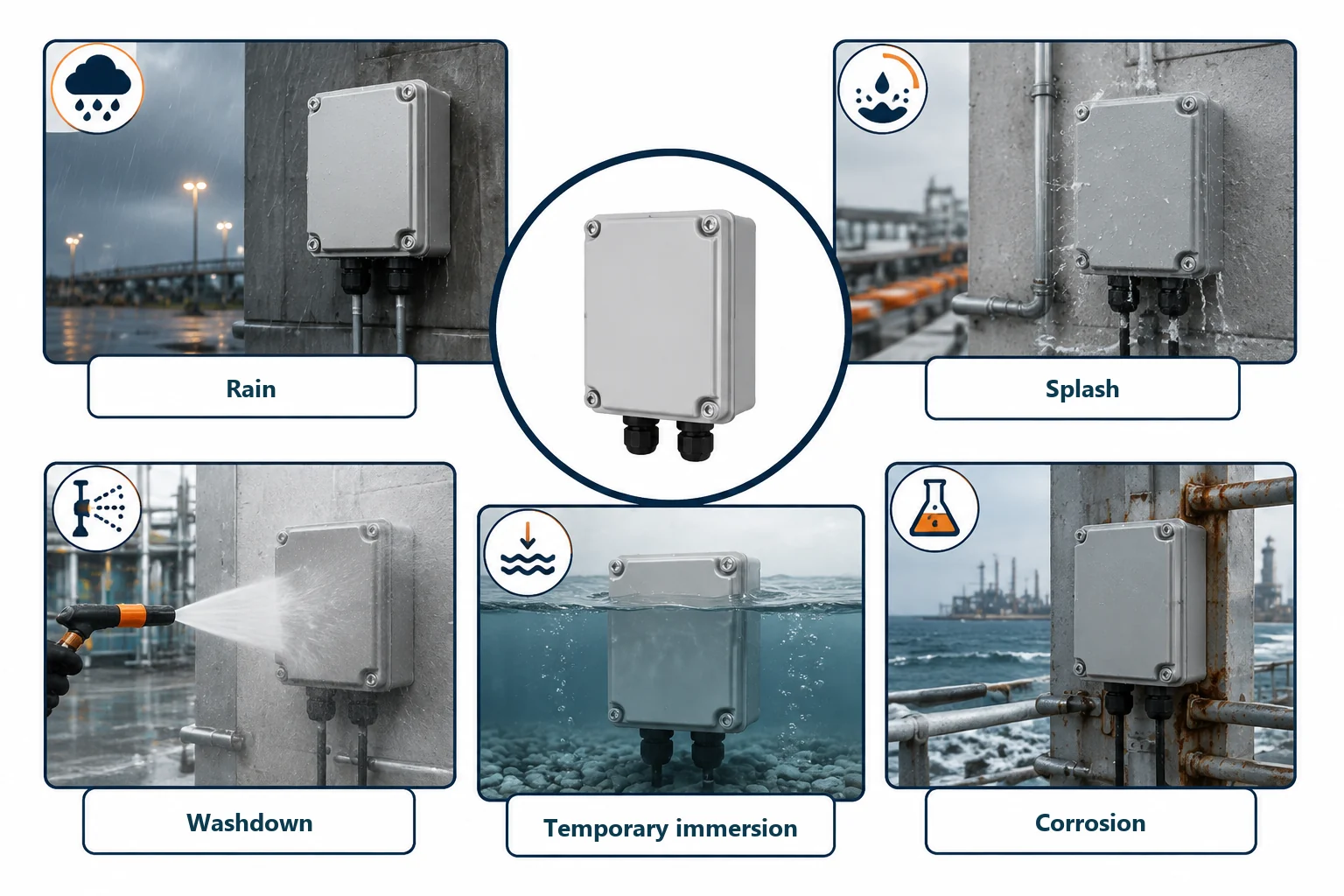
Before comparing IP65 with IP66 or NEMA 4 with NEMA 4X, answer one question: what will actually hit the enclosure?
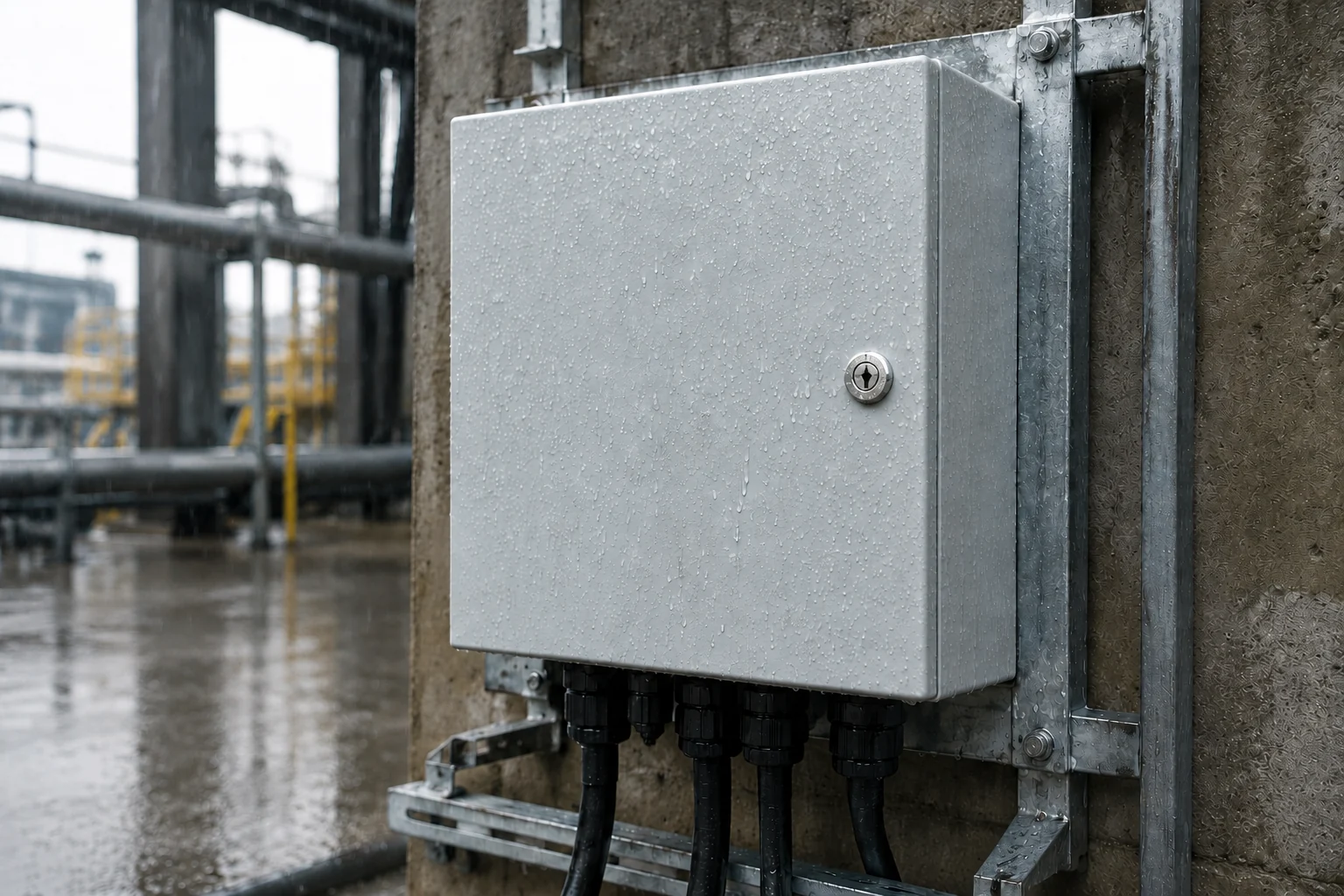
Use the closest description below as your starting point. The table does not replace a project specification; it tells you which questions need an answer first.
| Site condition | Typical exposure | What to confirm before ordering |
|---|---|---|
| Outdoor weather | Rain, snow, humidity, dust, sunlight | Outdoor installation, drainage, UV exposure, door sealing and cable entry |
| Occasional splash | Splash from nearby equipment or cleaning | Direction and frequency of splash, mounting orientation and accessory sealing |
| Hose-down or washdown | Directed water from cleaning hoses | Required NEMA/IP scope, gasket compression, latches, cable glands and external devices |
| Temporary immersion | The enclosure may be briefly under water | Immersion depth and time, cable-entry design and installed-assembly evidence |
| Corrosive outdoor site | Salt spray, chemicals, fertilizer or wastewater atmosphere | Material, finish, fasteners, hinges, locks and gasket compatibility |
| Hot sealed cabinet | Water protection combined with heat buildup | Internal heat load, ambient temperature, service access and thermal solution |
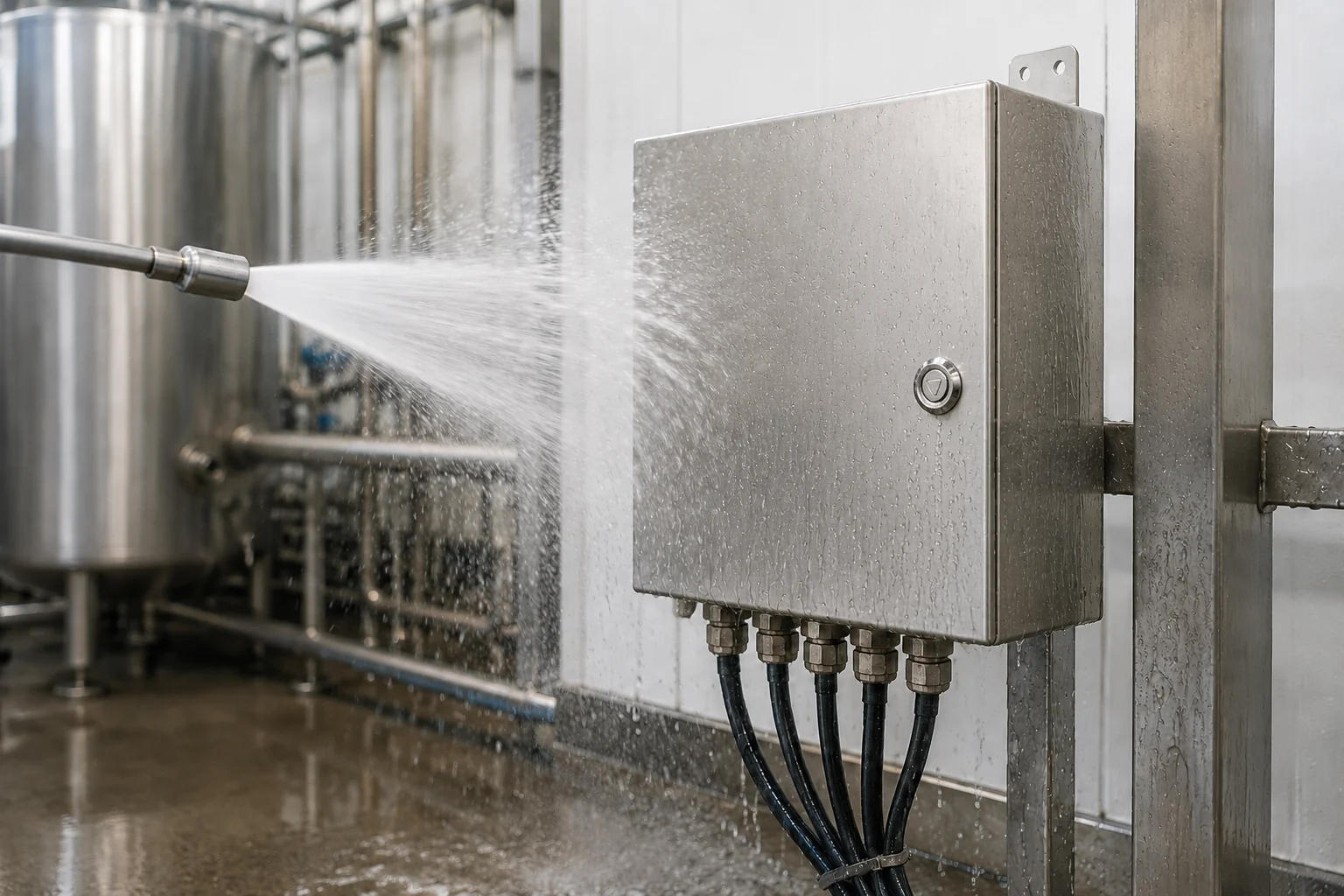
Do not choose a higher number simply because it sounds safer. A higher water rating can still be the wrong answer if the material, heat path, cable entry or installation method does not match the project.
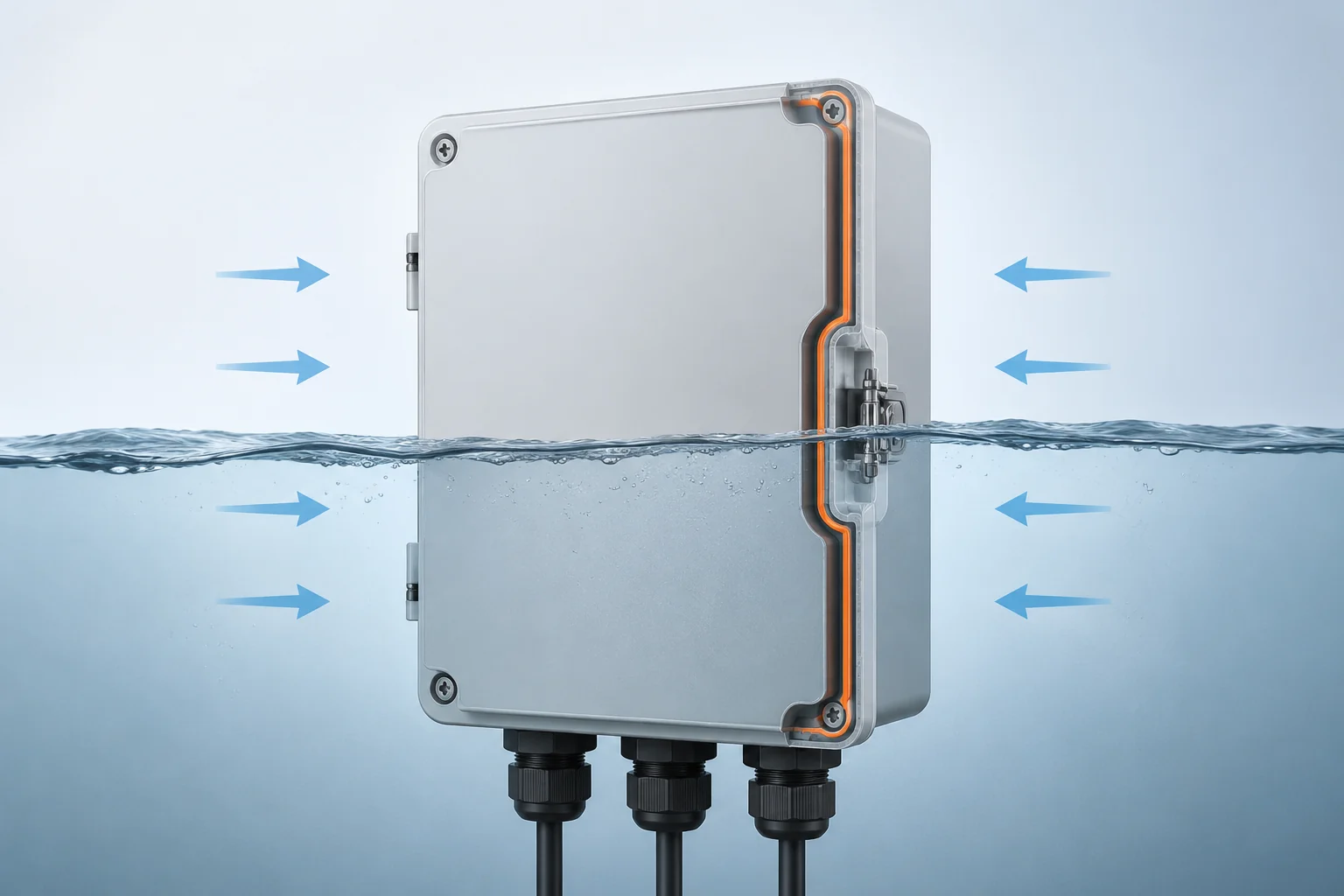
For a broader outdoor pre-check, see the outdoor electrical enclosure design checklist.
2. IP and NEMA are not interchangeable labels
The IP Code is defined through IEC 60529 and describes protection against access, solid foreign objects and water under defined test conditions IEC 60529. NEMA enclosure types cover a wider set of environmental conditions and construction expectations. NEMA’s guidance warns that an IP rating cannot be converted into a NEMA type as a universal one-to-one equivalence NEMA Enclosure Types guidance NEMA technical bulletin on IP ratings.
When a specification says “IP66/NEMA 4X,” treat it as two requirements to verify—not as a shortcut that lets you replace one with the other.
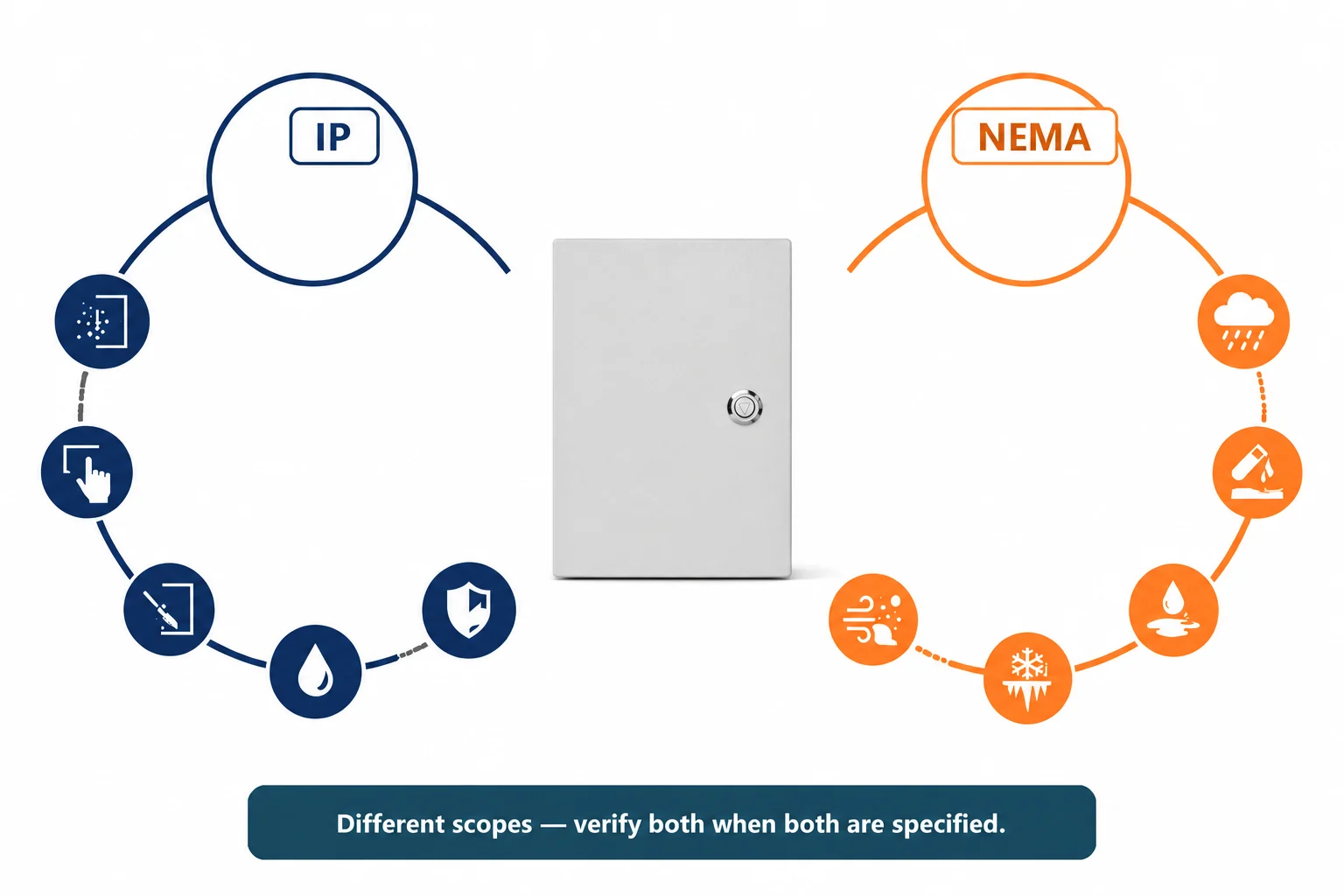
What an IP rating tells you
An IP code uses two main digits IEC 60529:
- The first digit relates to protection against solid foreign objects and dust.
- The second digit relates to protection against water under defined test conditions.
The test condition matters. “Waterproof” is not a single test. Rain, water jets, washdown, temporary immersion and continuous immersion are different exposures.
What a NEMA type adds
NEMA types are often used in North American specifications because they address more than water and dust. Depending on the type, the evaluation can also involve corrosion, oil or coolant, icing and other environmental conditions NEMA Enclosure Types guidance NEMA technical bulletin on IP ratings.
For example, corrosion may be the deciding factor between a standard outdoor enclosure and a corrosion-resistant configuration. Near the coast, in a wastewater plant or in a chemical-processing area, the rating name alone is not enough. Review the material, finish, hardware, gasket and installation details together.
A simple “NEMA 4X equals IP66” table is easy to read and easy to misuse. Use comparisons for early orientation only; verify the actual finished assembly against the project specification and the required evidence.
For a focused comparison, read IP65 vs. IP66 electrical enclosures.
3. Choose the enclosure around the components inside
Water protection is only half of the job. The enclosure also needs enough room for components to operate, cool and remain serviceable.
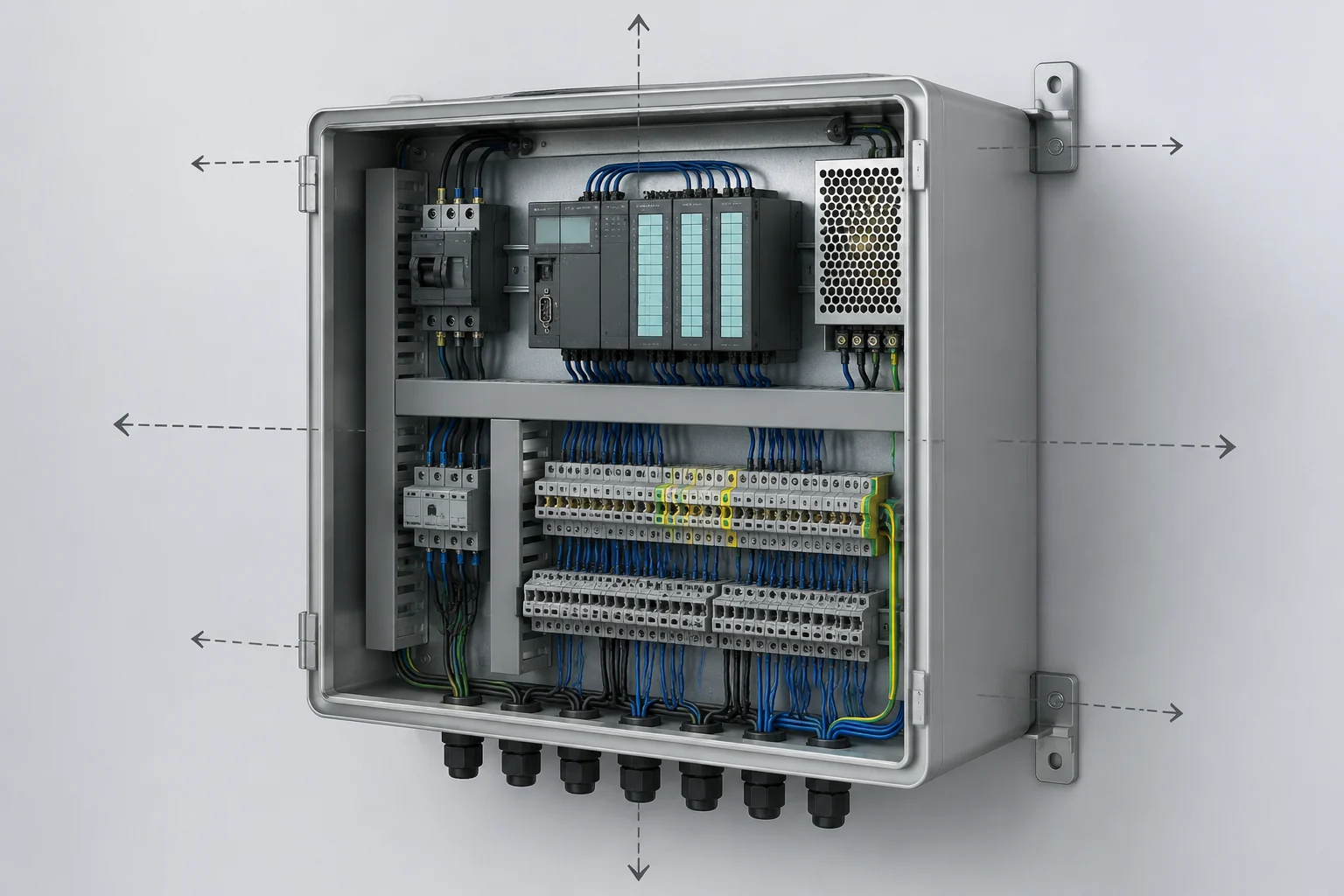
Before selecting dimensions, list the internal equipment:
- PLCs, VFDs, breakers, relays, terminals, sensors or power supplies
- Cable bend radius and terminal access
- Mounting plate, DIN rail or internal supports
- Heat-producing components
- Separation between power and signal wiring
- Clearance for tools, inspection and replacement
- Door-mounted displays, switches or indicators
A box can be large enough on paper and still be difficult to wire. The usual failure is not the outside dimension; it is the missing space around cable bends, terminals, door hardware or service access.
For larger sealed cabinets, deal with heat early. Adding a fan, filter, air conditioner, vent or pressure-equalization component adds an opening or interface that must be reviewed against the protection requirement.
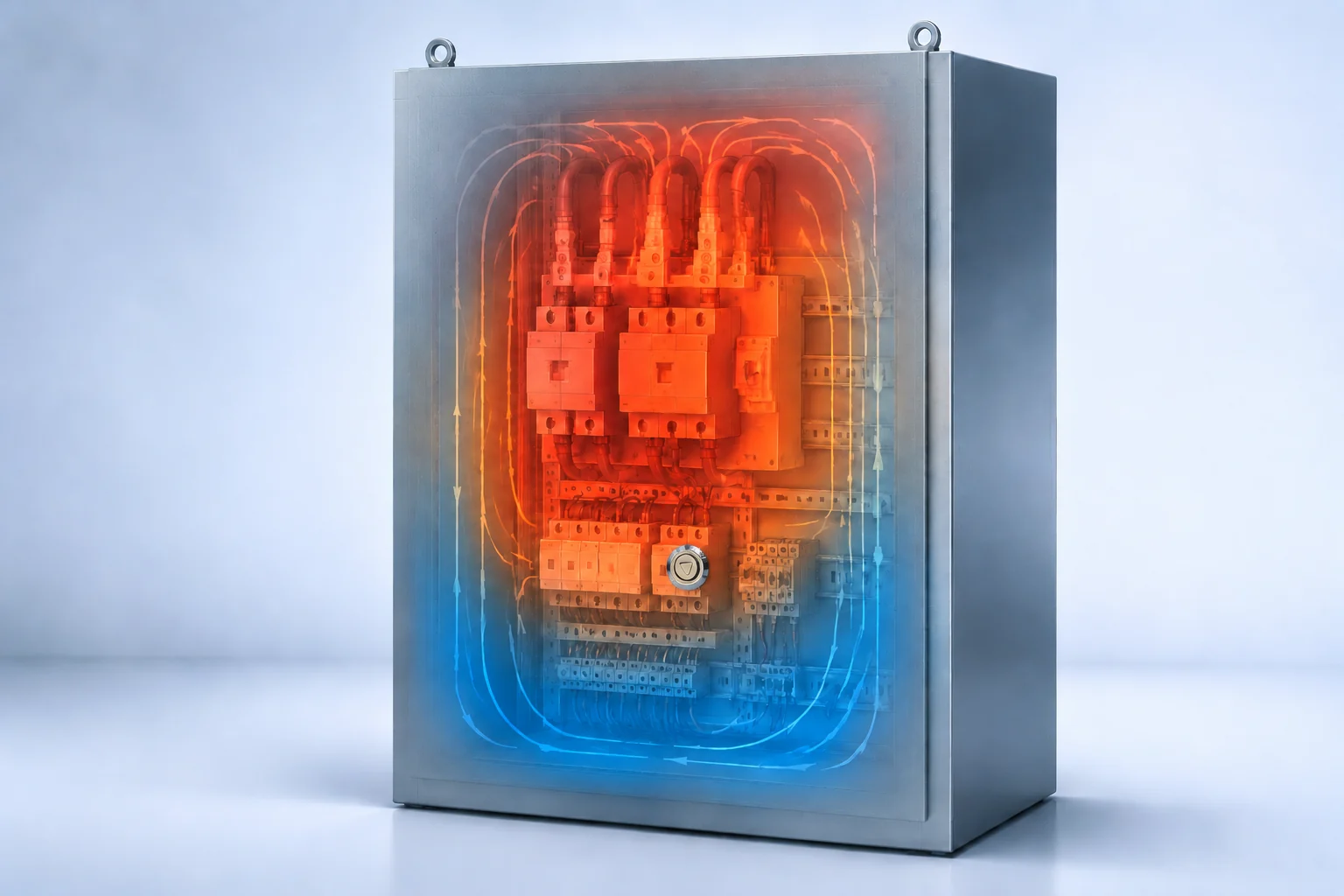
Electrical enclosure sizing guide: space, wiring and heat covers the layout questions in more detail.
4. Openings are where the design becomes real
The shell may look robust, but the water path usually starts at an opening:
- Cable glands and conduit hubs
- Door cutouts
- Viewing windows
- Fan and filter openings
- Pushbuttons, switches and displays
- Drain or breather components
- Field-drilled holes
- Gaps around mounting hardware
A component rating does not automatically prove the rating of the installed assembly. The enclosure, accessory, seal, fastener and installation method need to work as one system.
Cable entries
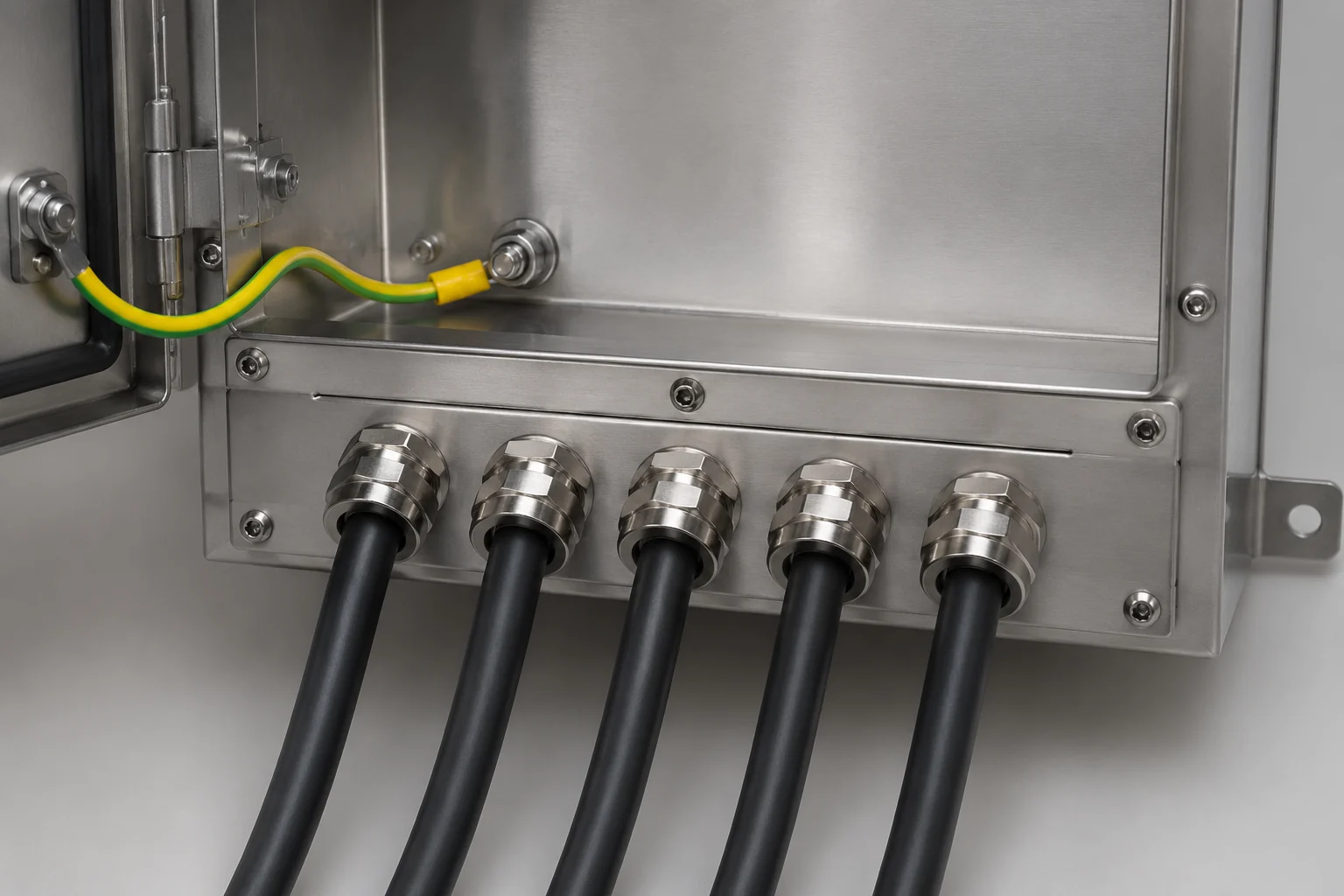
Confirm these points before fabrication:
- Cable diameter range
- Number of cables
- Entry direction and location
- Required gland or connector type
- Grounding or bonding requirements
- Spare entries for future expansion
- Whether the gland plate is removable
- Whether the installer will drill or modify the box on site
A cable entry that is technically available but placed too close to a bend, hinge or internal terminal can create both sealing and wiring problems. Put the cable schedule on the drawing instead of leaving it for installation day.
See cable glands and gland plates: preventing water ingress for a focused review.
Door seals and compression
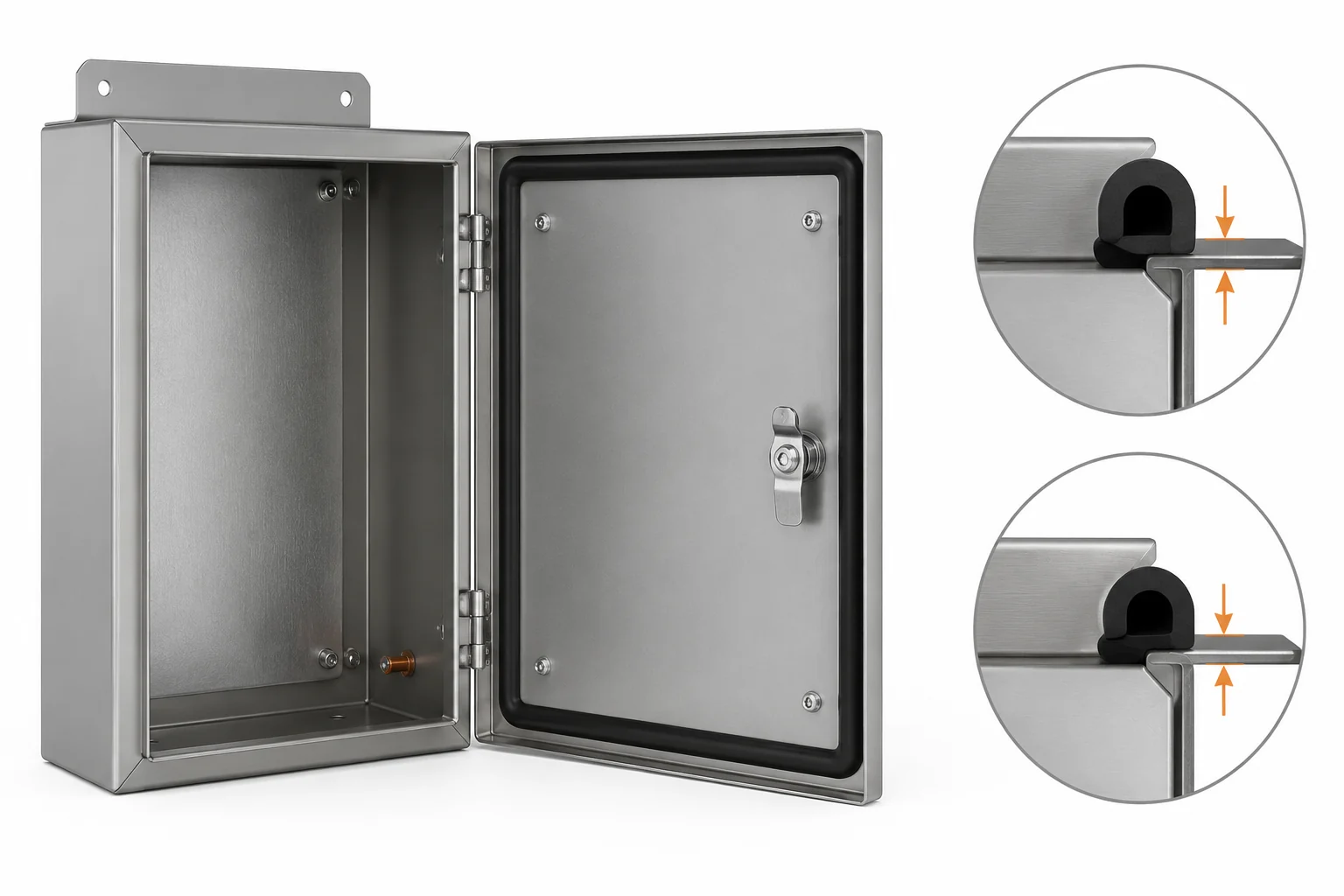
A gasket is not effective just because it is present. The design needs a continuous sealing path and enough—but not excessive—compression. Door flatness, flange width, latch position, hinge alignment and gasket joints all matter.
If the door is difficult to close, the answer is not always “use a stronger latch.” Excessive force can distort the door or create uneven compression. Check the complete door and flange geometry.
5. Select the material for the site, not the product photo
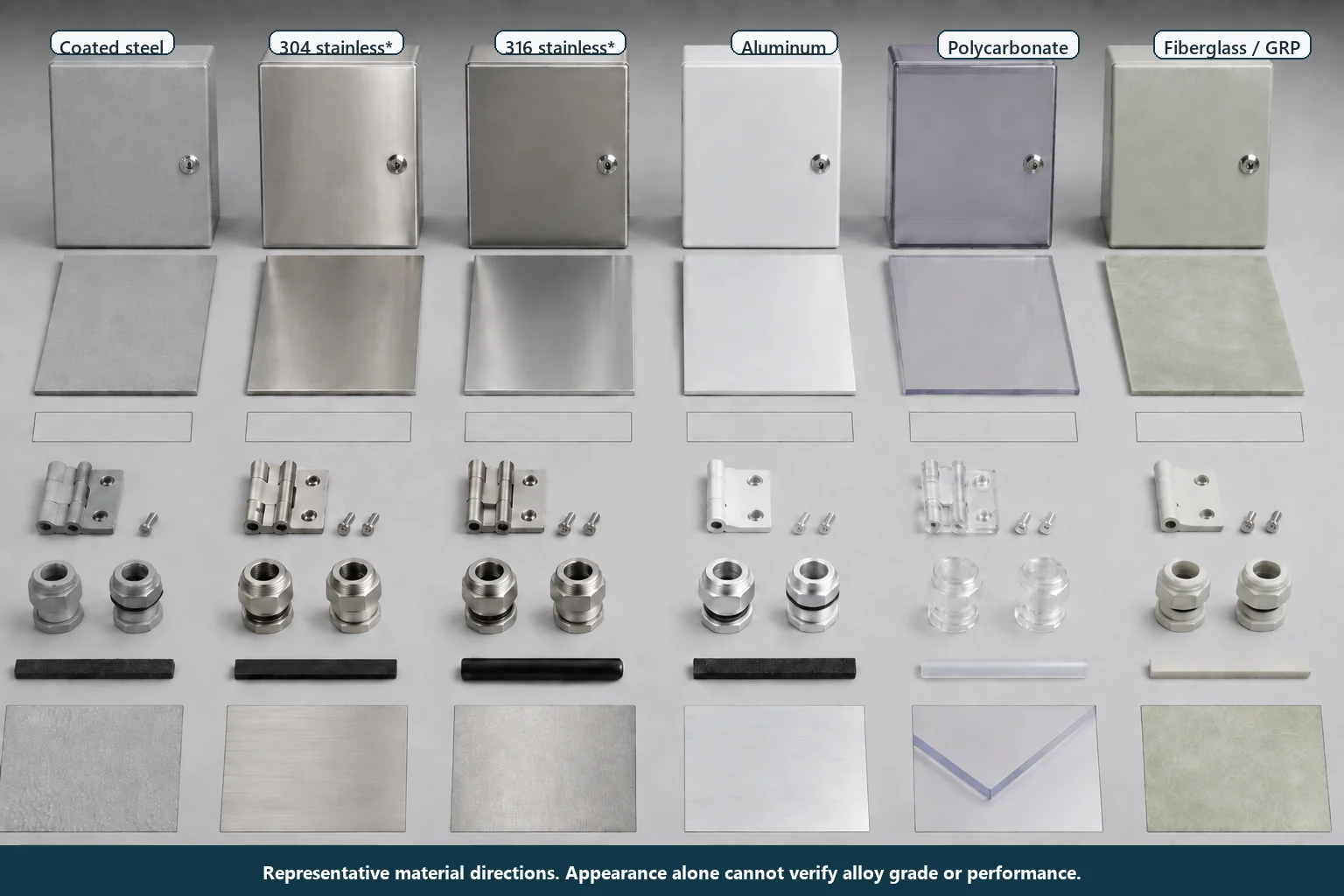
There is no universal “best” waterproof enclosure material. The right choice depends on corrosion, impact, weight, temperature, UV exposure, fabrication and budget.
| Material direction | Typical reason to consider it | Questions to ask |
|---|---|---|
| Carbon steel | Industrial strength and sheet-metal fabrication | What surface treatment is required? Is the site corrosive? |
| 304 stainless steel | General wet or outdoor environments where stainless steel is appropriate | What chemicals, salts and cleaning agents are present? |
| 316 stainless steel | Higher concern about chloride or coastal exposure | Is the extra corrosion resistance justified by the actual site? |
| Aluminum | Lower weight and corrosion considerations in some applications | What are the strength, bonding, coating and galvanic requirements? |
| Polycarbonate or ABS | Lightweight non-metallic construction for selected electronic applications | What are the UV, impact, temperature, flame and mounting requirements? |
| Fiberglass or GRP | Non-metallic option for selected harsh environments | How will it be drilled, mounted, bonded and serviced? |
Do not use “stainless steel” as a complete environmental specification. Grade, surface finish, fasteners, hinges, locks, gasket, cleaning chemicals and exposure duration still need to be considered.
For coastal projects, see corrosion-resistant electrical enclosures for coastal sites.
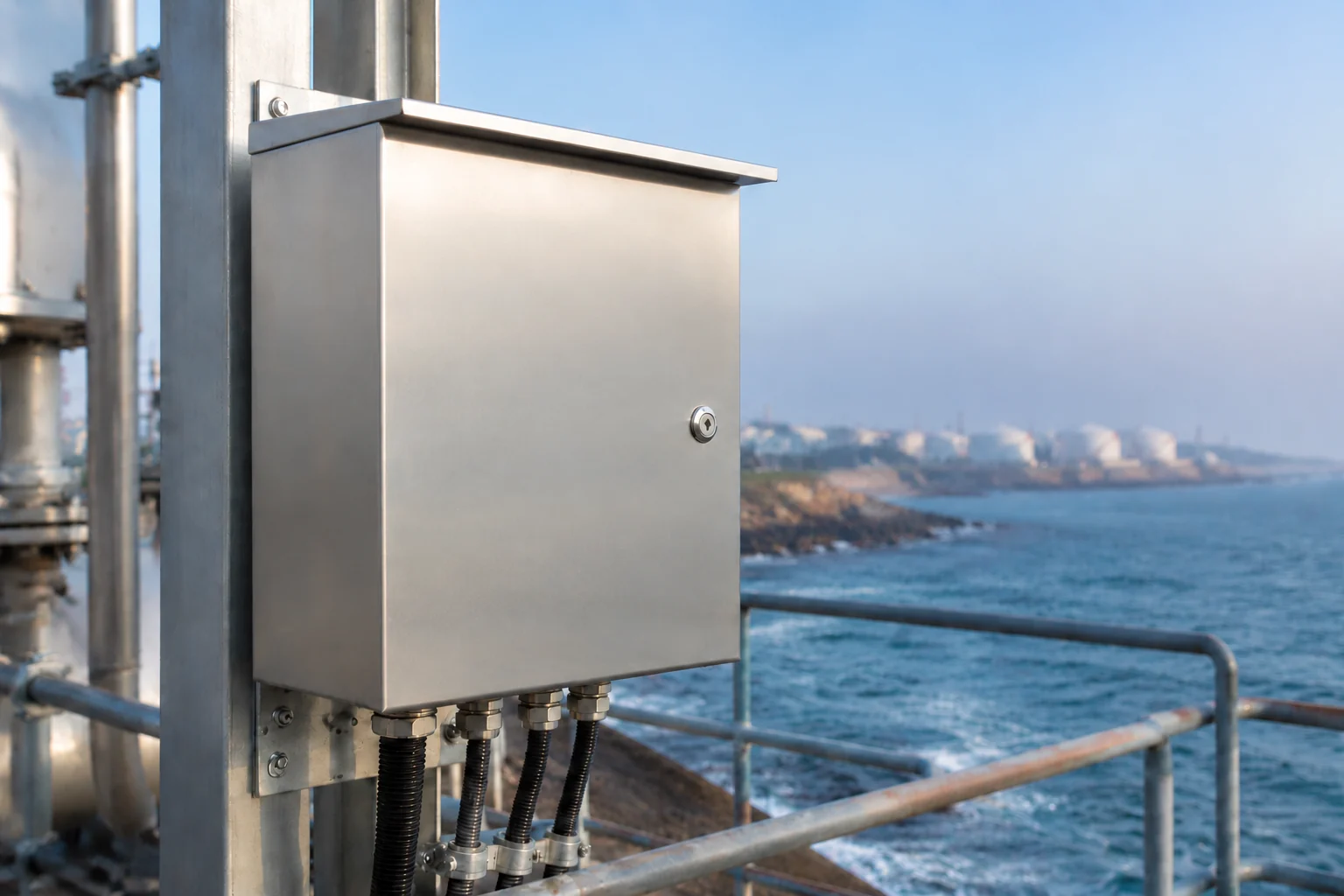
6. Decide whether you need a junction box, wall-mounted enclosure or cabinet
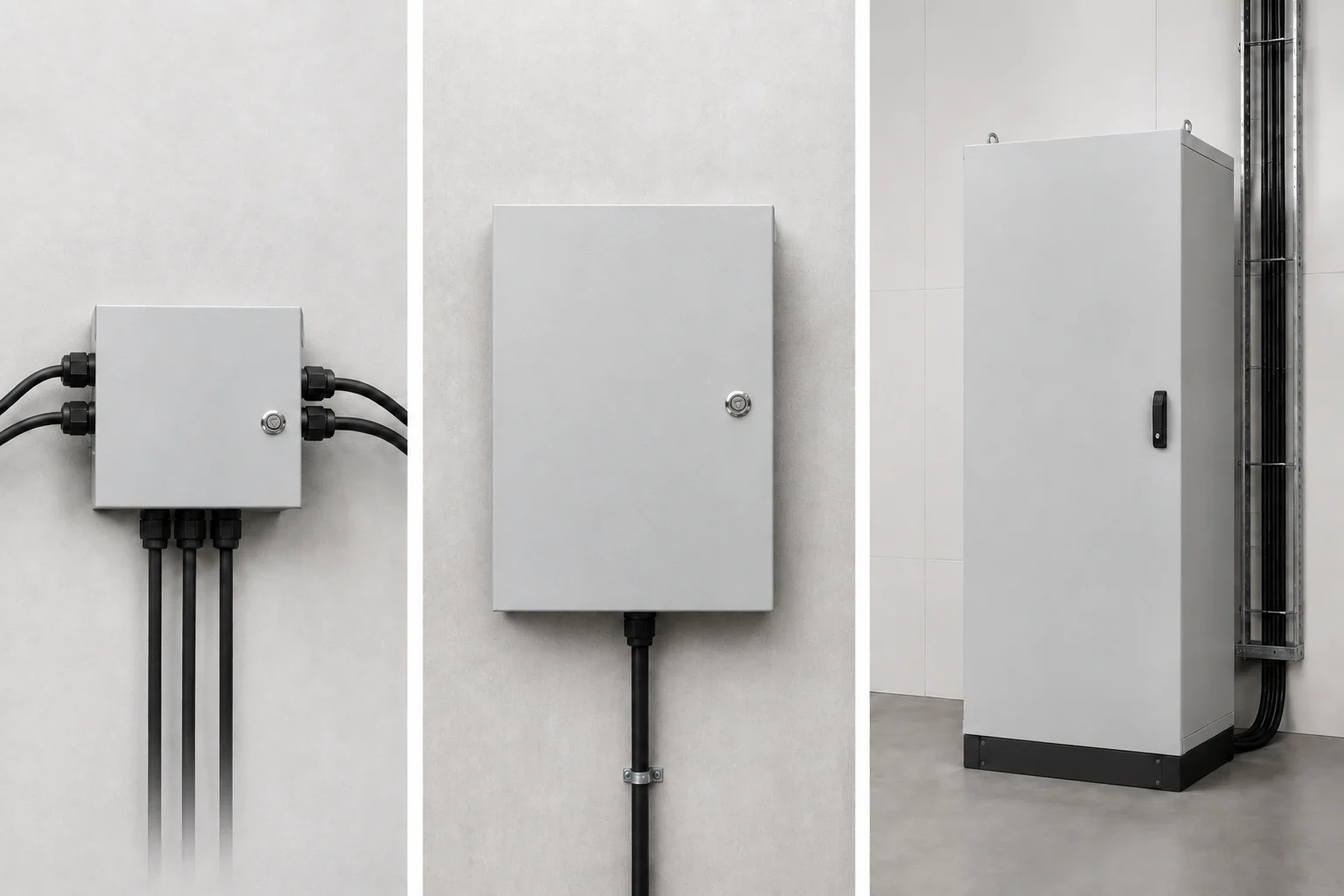
The enclosure format should follow the installation task.
Junction box
For protected connections, terminals, splices or compact electronics. Review the cable route and entry layout first.
Outdoor electrical enclosure
For outdoor equipment where weather exposure, mounting, access and cable entry need to be reviewed together.
Custom cabinet from drawings
For unusual dimensions, defined cutouts or a layout that needs engineering review before production.
Junction box
Use a junction box when the main requirement is to protect connections, terminals, splices or compact electronics. The cable route and entry layout often matter more than a large internal mounting area.
Wall-mounted enclosure
A wall-mounted enclosure works when the equipment can be serviced from the front and the wall or frame can carry the load. Check door swing, cable bend radius, mounting points and working space around the door.
Floor-standing cabinet
A floor-standing cabinet is more suitable when the installation needs more internal equipment, cable volume or service access. Check base fixing, lifting and transport, door load, internal mounting structure and the path for incoming and outgoing cables.
FN Enclosure’s confirmed OEM scope covers wall-mounted enclosures, floor-standing enclosures and junction boxes built to customer drawings. The project database does not define a fixed catalog minimum or maximum size; unusual dimensions require engineering review. That is a better starting point for a custom project than choosing a nominal size and discovering later that the internal layout does not fit.
7. A practical selection example
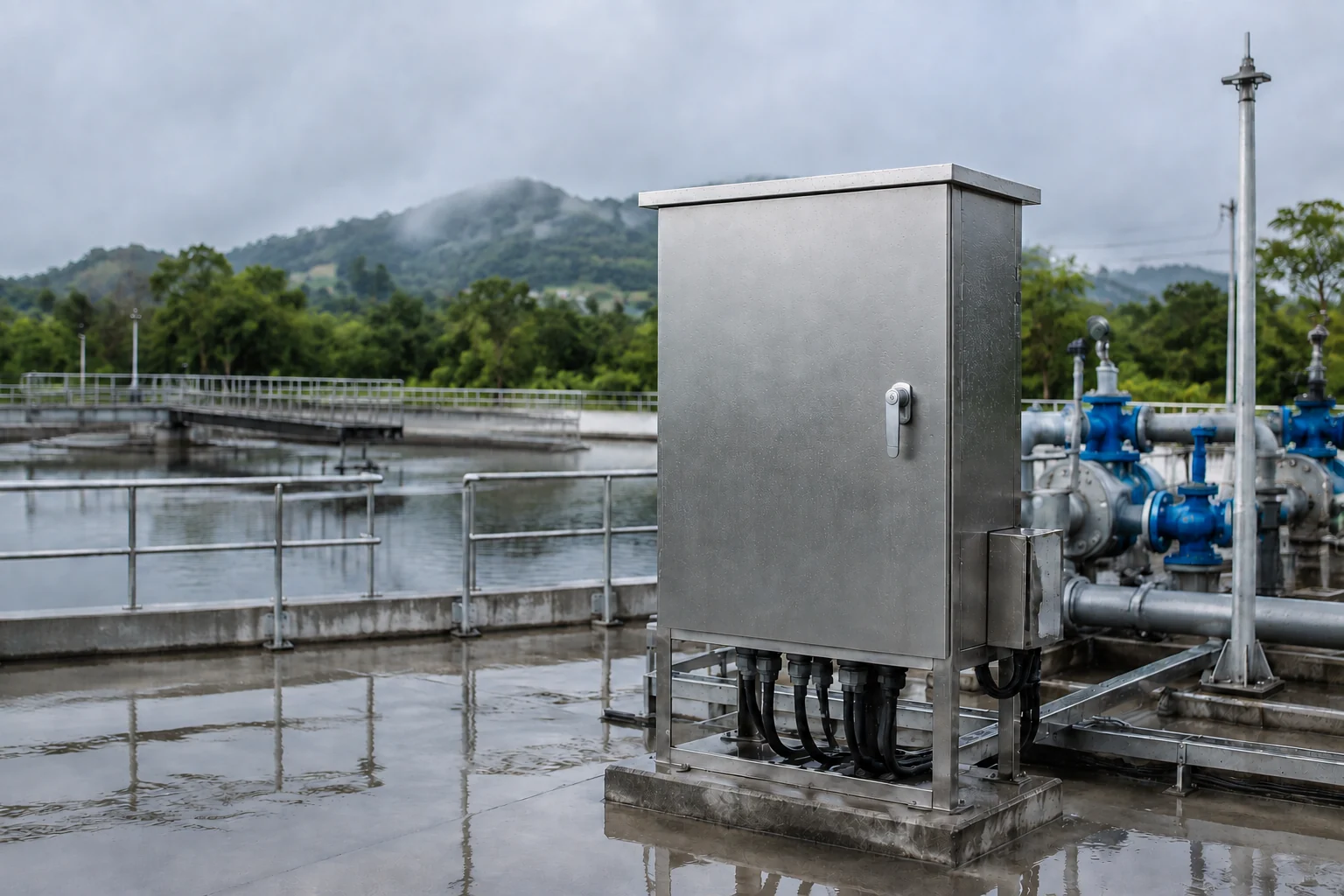
Imagine an outdoor pump-control box beside a treatment process. It sees rain, dust, periodic cleaning and a humid atmosphere. The box contains a controller, terminals and a small power supply.
Do not begin by asking for “the highest IP rating.” Begin with the project questions:
- Is the cleaning water a light splash or a directed hose stream?
- Are chemicals present in the atmosphere or cleaning process?
- Does the controller generate enough heat to require thermal management?
- Where do the cables enter, and how much bend radius is needed?
- Will the installer add holes on site?
- Does the customer specify an IP code, a NEMA type or both?
- How will the finished configuration be reviewed?
The answer may lead to a sealed metal enclosure, a corrosion-conscious material choice, a defined cable-entry plate and a documented installation method. The point is not to guess a rating from the application name; it is to turn the application into a configuration.
8. What to send when requesting a custom waterproof enclosure
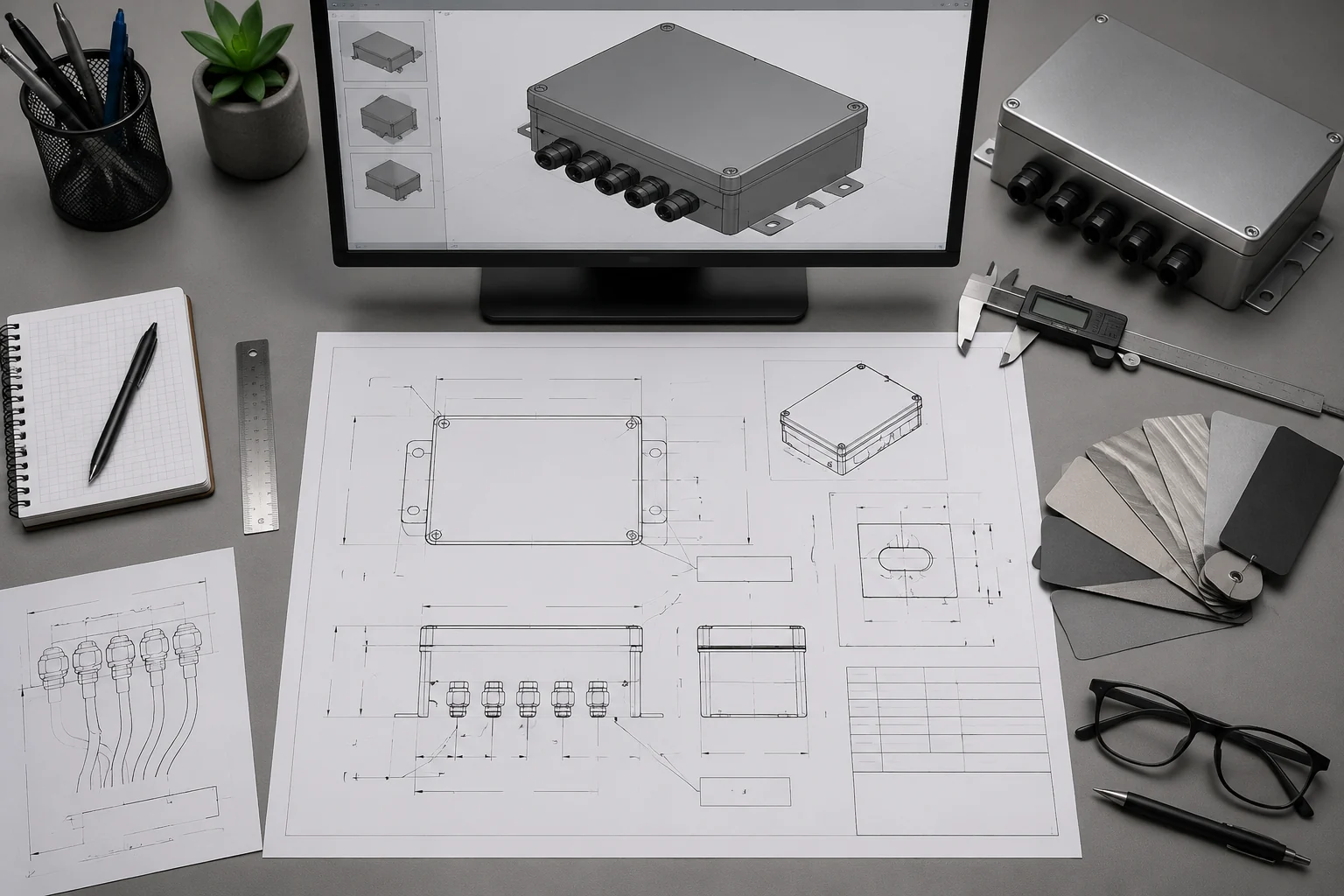
A useful RFQ does not need to be complicated, but it does need to be specific. Send:
- External dimensions or a 2D/3D drawing
- Internal component list and mounting layout
- Required IP or NEMA specification
- Actual water exposure: rain, splash, washdown or immersion
- Corrosion, salt, chemical, UV and temperature conditions
- Material and finish preference
- Door, lock, hinge and gasket requirements
- Cable-entry schedule and cutout locations
- Mounting method and fixing points
- Internal mounting plate, DIN rail or other supports
- Quantity, prototype requirement and revision status
- Required inspection documents or acceptance evidence
Ask the manufacturer to confirm what is included in the enclosure scope. An empty enclosure, a machined enclosure, a partially assembled cabinet and a complete electrical control panel are not the same deliverable.
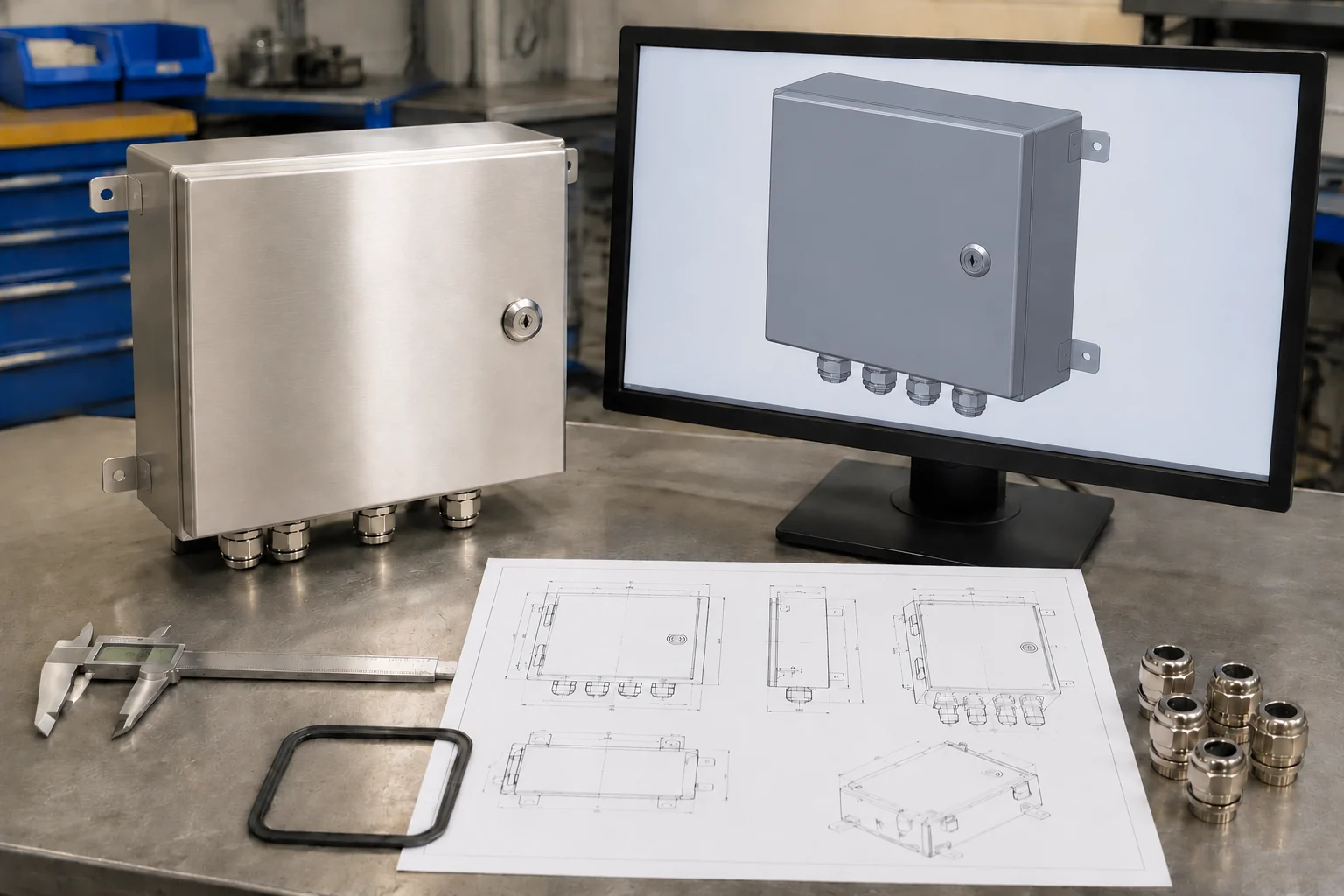
9. The short checklist
- The actual water exposure is written down.
- IP and/or NEMA requirements are identified without assuming a universal conversion.
- Material and corrosion exposure are reviewed together.
- Internal heat and service access are included in the layout.
- Cable entries and all cutouts are shown on the drawing.
- Door, gasket, hinge and latch geometry are reviewed.
- Accessories match the intended finished configuration.
- Field modifications are controlled.
- The supplier’s scope and evidence package are clear.
Frequently asked questions
Is an IP65 enclosure waterproof?
IP65 indicates a defined level of protection against dust and water jets under the applicable test conditions. It does not answer every outdoor question, such as corrosion, UV exposure, internal heat, cable-entry design or the effect of field modifications. Confirm the actual installation requirements before specifying it.
What is the difference between a waterproof and a weatherproof enclosure?
The words are often used loosely in product descriptions. For engineering and purchasing, use the specified IP or NEMA classification and describe the exposure directly. “Weatherproof” may refer to outdoor rain protection, while a project may also require washdown, corrosion resistance or immersion protection.
Is NEMA 4X the same as IP66?
No universal one-to-one conversion should be assumed. IP and NEMA use different scopes and test approaches. If a project requires both, verify both against the finished configuration and the applicable evidence.
Can I drill holes in a waterproof enclosure?
You can modify an enclosure only if the modification is designed, sealed and accepted as part of the finished configuration. A field-drilled hole, cable gland, window, fan or connector can change the water path.
Should I choose 304 or 316 stainless steel?
Choose based on the actual corrosion exposure, not the label alone. Salt, chlorides, chemicals, cleaning agents, temperature, surface finish and hardware all affect the decision. If the site information is incomplete, send the exposure details to the manufacturer before fixing the material.
What should I send to a waterproof enclosure manufacturer?
Send the dimensions, internal layout, water exposure, required rating, material, cable entries, cutouts, mounting method, quantity, drawings and required documents. The more of the finished configuration you define, the less room there is for an expensive assumption.
Need a custom waterproof enclosure?
Send your drawing, dimensions, material preference, required IP or NEMA specification, cable-entry schedule and quantity. FN Enclosure can review OEM-built wall-mounted enclosures, floor-standing enclosures and junction boxes against the project requirements. Unusual dimensions or opening layouts may require engineering review before production.
Sources
- IEC 60529, Degrees of protection provided by enclosures (IP Code). IEC publication page.
- NEMA, Enclosure Types. NEMA guidance PDF.
- NEMA, NEMA and IP Ratings. NEMA technical bulletin.