
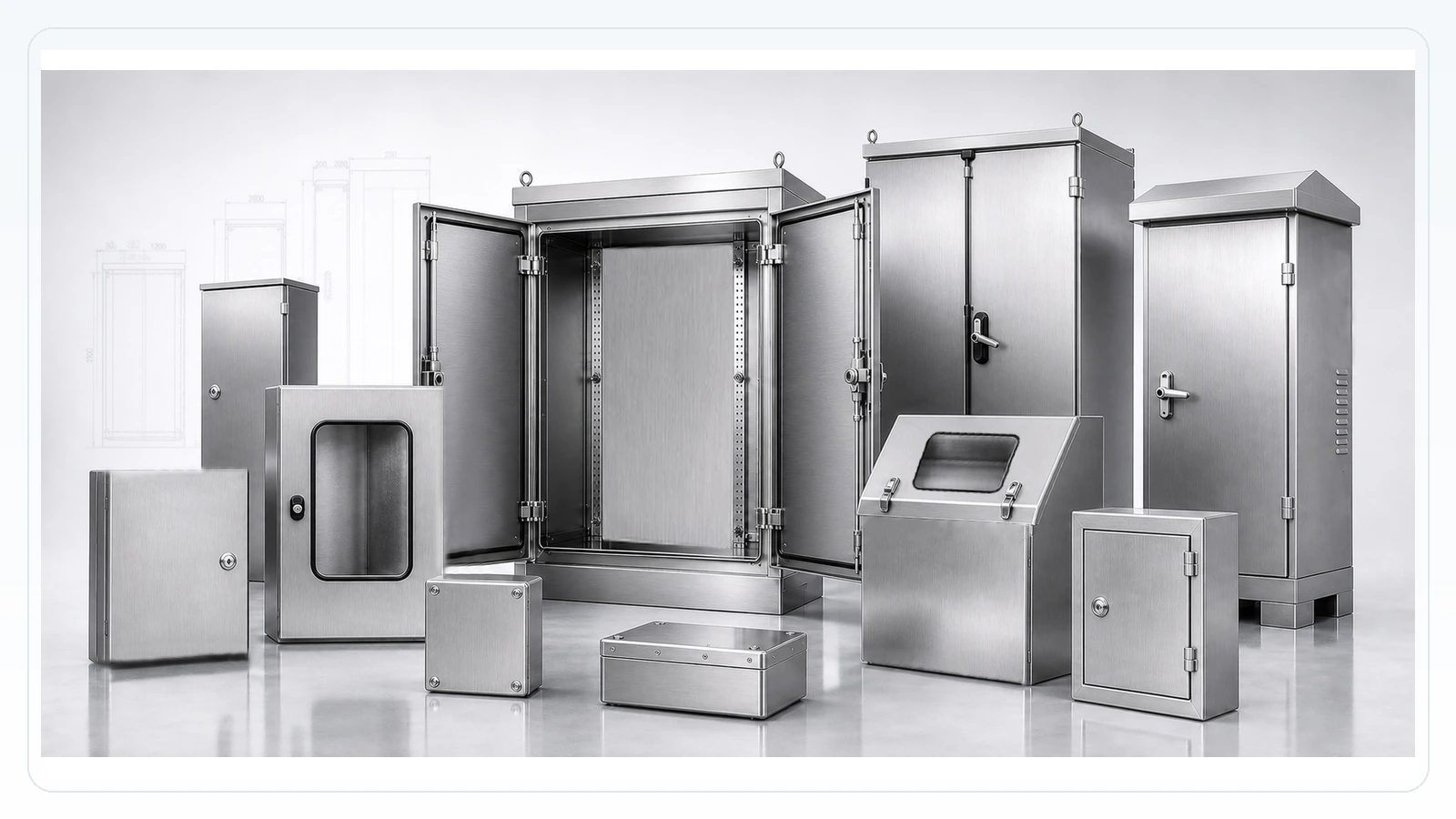

An electrical enclosure is a protective box, cabinet, or housing for electrical components and wiring. It keeps people away from live parts, helps protect the components from the installation environment, and gives the project a clear structure for mounting, wiring, access, and maintenance.
Why this matters:
Because in a real project, the enclosure is rarely \”just a box.\” A box in a clean indoor room, a junction box installed outdoors, and a stainless steel cabinet near humid or corrosive air all need different checks. If we only look at size, we can miss the details that cause problems later: cable entry, gasket compression, condensation, heat, corrosion, door hardware, and packaging.

What an Electrical Enclosure Does

An electrical enclosure is used to:
- It houses electrical parts such as terminals, switches, breakers, relays, controllers, and wiring.
- It helps reduce accidental contact with live or sensitive parts.
- It supports protection against dust, moisture, impact, corrosion, and unauthorized access.
- It organizes mounting plates, DIN rails, cable entry, locks, hinges, gaskets, and ventilation.
- It makes installation, inspection, and maintenance easier.
If you are choosing one for a project, do not start with only outside dimensions. Start with this question:
Where will this enclosure be installed, and what does it need to protect against?
For standard selection, start from electrical enclosures. If you already have drawings, cut-outs, mounting plates, gland plates, or packaging requirements, the better route is custom electrical enclosures.
Why This Question Matters
A buyer may say, “We just need one metal box.”
That sounds clear, but it is not enough for production. We still need to know what goes inside, where the box will be installed, how cables enter, whether the door needs sealing, whether components create heat, and how the enclosure will be packed and shipped.
Here is where small details become real problems:
- If the box is too small, wiring and maintenance become difficult.
- If the material is wrong, corrosion can start early.
- If the door is large but latch spacing is weak, the gasket may not compress evenly.
- If holes are drilled on site, coating and sealing can be damaged.
- If the enclosure is outdoors, condensation can happen even when rain does not enter.
- If packaging is weak, the door can arrive bent before installation begins.
So the enclosure is not just a shell. It is part of the project’s protection plan, layout plan, installation plan, and delivery plan.
Electrical Enclosure, Electrical Cabinet, and Junction Box: Are They the Same?
Not exactly, but people often mix the terms.
In one inquiry, a customer may write “electrical box,” “control cabinet,” “junction box,” and “enclosure” to describe related needs. That is normal. The practical difference is what job the product must do.
Term | Practical Meaning | Common Use | Buyer Note |
|---|---|---|---|
Electrical enclosure | Broad protective housing for electrical parts | Control, distribution, wiring, junction, outdoor, and custom projects | Best general term for product selection |
Electrical cabinet | Usually a larger enclosure, often floor-standing or equipment-style | Industrial control, power distribution, automation | Often needs more internal structure and support |
Junction box | Smaller box for cable junctions and wire connections | Field wiring and terminal connections | Cable entry, cover access, and sealing matter |
Distribution box enclosure | Housing for distribution components | Building or industrial power distribution | Component layout and access need review |
Control enclosure | Housing for control devices and wiring | Machines, pumps, HVAC, process equipment | Heat, layout, and service access matter |
If you are only browsing product categories, “electrical enclosure” is the right broad term. If you are sending an inquiry, tell the supplier what goes inside and where the enclosure will be installed.

What Types of Electrical Enclosures Are Common?
There is no single best type. The right enclosure depends on where it goes, what it holds, how it opens, how cables enter, and how much protection the project needs.
Wall-Mounted Electrical Enclosures
Use a wall-mounted enclosure when the components are not too heavy and the installation has a suitable wall, frame, or machine structure.
These are common for compact control, distribution, and junction applications. They save floor space and can be placed near equipment.
Before choosing one, check wall strength, box weight, mounting hole position, door opening direction, cable entry, and service space in front of the door.
Floor-Standing Electrical Enclosures
Use a floor-standing enclosure when the system needs more space, heavier equipment, or easier front access.
These are common in industrial control, power distribution, and automation projects. For this type, do not only check height and width. Also check base design, lifting points, internal frame support, mounting plate size, wiring space, door flatness, and export packaging.
A large cabinet can look fine in a drawing but still need stronger review during fabrication and shipping.
Junction Boxes
Use a junction box when the main job is wiring connection or cable junction.
The size is important, but it is not the only point. Cable entry size, cover access, wall thickness, gasket, grounding, and installation method also affect whether the box works well in the field.
Outdoor Electrical Enclosures
Use an outdoor electrical enclosure when the installation faces rain, dust, sunlight, humidity, temperature change, or corrosion risk.
But do not reduce outdoor selection to one word: “waterproof.” Outdoor projects may also involve condensation, UV exposure, salt air, chemical exposure, cable movement, insects, heat buildup, and packaging damage before installation.
For outdoor projects, review outdoor electrical enclosures and define the actual installation environment before discussing rating language.
Custom Electrical Enclosures
Use a custom enclosure when standard size or structure does not fit the project.
Custom work may include special size, material, finish, cut-outs, gland plates, mounting plates, DIN rails, windows, locks, hinges, brackets, ventilation, or export packaging.
If you want a faster quote, send drawings, component layout, installation photos, material preference, protection target, quantity, and packaging requirements.
Which Material Should You Choose?
Choose the material based on the environment, not only the price.
Material affects corrosion resistance, weight, cost, fabrication, surface finish, and maintenance.
Material | Common Use | Strength | What to Check |
|---|---|---|---|
Mild steel | Indoor industrial enclosures and cost-sensitive projects | Economical and easy to fabricate | Needs proper surface treatment |
Powder-coated steel | Indoor or protected industrial environments | Better appearance and surface protection | Pretreatment, coating adhesion, scratches, and cut edges |
Galvanized steel | Projects needing more corrosion support than untreated steel | Zinc coating helps in some environments | Cut edges, welding areas, and coating compatibility |
Stainless steel 304 | General corrosion-resistant applications | Good general stainless option | Not ideal for every coastal or chemical environment |
Stainless steel 316 | Harsher corrosion environments | Better corrosion resistance than 304 in many chloride-exposure cases | Higher cost, still needs correct fabrication and cleaning |
Aluminum | Lightweight enclosure applications | Lower weight | Strength, galvanic corrosion, and surface finish |
Plastic or fiberglass | Some light-duty or corrosion-sensitive uses | Non-metallic and corrosion resistant in some cases | UV, impact, fire, and project suitability |

So if someone asks, “Is stainless steel always better?” the honest answer is no.
It depends on where the enclosure will be installed, what it will face, how it will be fabricated, and how much corrosion resistance the project really needs.
If the project involves humidity, corrosion risk, or washdown-like conditions, review stainless steel electrical enclosures before choosing between 304 and 316.
What About IP Ratings and NEMA Types?
IP and NEMA terms help describe protection requirements, but they should not be used as empty marketing claims.
The IEC explains that IP ratings describe degrees of protection against solid objects and water. The first digit relates to protection against solid objects or dust. The second digit relates to water ingress protection. Source: IEC IP Ratings .
NEMA enclosure types are widely used in North America. NEMA’s guide lists enclosure type definitions for different indoor, outdoor, dust, oil, water, corrosion, and hazardous-location conditions. Source: NEMA Enclosure Types
Here is the practical version:
Topic | What It Helps With | What It Does Not Automatically Prove |
|---|---|---|
IP rating | Dust and water ingress protection language | That every custom hole, gland, gasket, or field modification keeps the same performance |
NEMA type | North American enclosure type selection language | That the specific product is certified unless documentation proves it |
Material grade | Direction for corrosion resistance | That corrosion cannot happen in a harsh environment |
Gasket design | Door sealing approach | That the door seals correctly if locks, hinges, and compression are poorly matched |
So if a project needs tested documentation or certified compliance, confirm that before production. Do not assume it from appearance, material, or a general product description.

Which Parts Should You Pay Attention To?
Do not only look at the body and door.
The accessories often decide whether the enclosure works well in the field.
Common parts include:
- enclosure body or shell
- door or removable cover
- hinge
- lock or latch
- gasket
- mounting plate
- DIN rail
- gland plate
- cable entry holes
- grounding point
- ventilation louvers
- fan and filter
- heater
- air conditioner
- window
- bracket, feet, lifting point, or base
- internal hardware and fasteners
A lock is not just a lock. It affects door compression.
A hinge is not just a hinge. It affects alignment and gasket contact.
A cable hole is not just a hole. It can become the highest-risk water entry point if it is drilled without planning.
That is why door, gasket, lock, hinge, cable entry, mounting plate, and packaging should be reviewed together.

How Do You Choose the Right Electrical Enclosure?
Use this order. It keeps the conversation practical.
- Confirm the installation environment. Is it indoor, outdoor, dusty, wet, humid, coastal, chemical, hot, cold, or vibration-prone?
- Confirm what goes inside. List the components, wiring, terminals, breakers, controls, heat sources, and future service space.
- Choose the enclosure form. Wall-mounted, floor-standing, junction box, distribution box, control enclosure, or custom cabinet.
- Choose material and finish. Mild steel, powder-coated steel, galvanized steel, stainless steel 304, stainless steel 316, aluminum, plastic, or fiberglass.
- Define the protection target. Dust, rain, splashing water, hose-directed water, corrosion, impact, access control, heat, or condensation.
- Review door and sealing design. Door size, gasket type, lock points, hinge spacing, compression, and opening direction.
- Plan cable entry. Gland plates, cable glands, cut-outs, bottom entry, side entry, back entry, and field drilling risk.
- Plan internal layout. Mounting plate, DIN rails, wiring duct, clearance, heat source location, and maintenance access.
- Review heat and condensation. Natural ventilation, fan/filter, heater, air conditioner, sun exposure, and day-night temperature change.
- Confirm packaging. Door protection, surface protection, accessory packaging, pallet, crate, and export handling.
This turns a vague “box” request into a project-ready enclosure specification.

What Mistakes Should You Avoid?
Most enclosure mistakes happen because the buyer chooses too early and reviews details too late.
Mistake 1: Choosing by Size Only
Outside dimensions do not tell the whole story. Internal clearance, wiring space, mounting plate position, cable entry, and maintenance access can decide whether the enclosure is usable.
Mistake 2: Using Indoor Enclosures Outdoors
Outdoor use brings rain, sunlight, temperature swing, condensation, dust, and corrosion risk. A standard indoor box may not support those conditions.
Mistake 3: Treating “Waterproof” as a Specification
“Waterproof” is too broad. Rain, splash, hose-directed water, temporary immersion, and condensation are different issues. Use defined protection language and confirm testing requirements where needed.
Mistake 4: Ignoring Cable Entry
Many enclosure failures happen around cable entry. Cut-outs, cable glands, sealing washers, burrs, coating damage, and gland plate position should be part of the early review.
Mistake 5: Forgetting Door Compression
A gasket cannot seal well if the door, hinge, and latch system do not compress it evenly. Large doors need special attention.
Mistake 6: Forgetting Packaging
The enclosure still has to survive transport. Powder-coated and stainless steel surfaces need protection. Large doors need support. Accessories need clear packing.

What Should You Send Before Requesting a Quote?
Send the project details early. That is the fastest way to reduce wrong assumptions.
Quote checklist:
- required size or drawing
- installation environment
- indoor or outdoor use
- material and finish preference
- wall-mounted or floor-standing requirement
- component list or internal layout
- mounting plate and DIN rail needs
- cable entry drawing or cable size
- door lock, hinge, gasket, window, or accessory needs
- expected protection target
- quantity
- packaging and shipping requirement
- required inspection, testing, or documentation
If you do not have a complete drawing, send photos, sketches, and component dimensions. A practical supplier can help turn rough information into a clearer specification.
For drawing review, cut-outs, mounting plate layout, or project-specific packaging, send project details through custom electrical enclosures or contact FN Enclosure.
Factory Note: What We Check First
When we review an enclosure inquiry, we do not start with only the box price.
We first ask: where will it be installed? What goes inside? Where do cables enter? Is the door large? Does the gasket need stronger compression? Is there heat inside? Could condensation happen? Will the surface survive packing and transport?
In factory review, the drawing is only the first part. We also check the actual installation environment, cable entry direction, gasket compression, door size, lock points, mounting plate position, and packaging route.
For one outdoor-style enclosure inquiry, the first request only listed size and stainless steel material. After reviewing the installation, the more important questions were cable entry from the bottom, gasket compression on a large door, internal heat from components, and surface protection during export packaging. The final specification needed a mounting plate, a defined cable-entry area, stronger packaging notes, and a clearer protection target.
That kind of review does not replace formal testing, but it reduces avoidable project mistakes.
Empty Enclosure, Hardware Fitting, and Electrical Assembly Are Different
This point is easy to miss.
An empty enclosure is a fabricated shell, box, or cabinet prepared to house electrical components.
Hardware fitting may include cut-outs, mounting plates, DIN rails, gland plates, locks, hinges, gasket, windows, and related mechanical accessories.
A complete electrical assembly may involve electrical components, wiring, testing, compliance documentation, and a different responsibility scope.
So do not mix these scopes in one vague request.
If you need enclosure fabrication and mechanical preparation, say that. If you need full electrical panel work, certified assembly, or specific test documentation, confirm the requirement separately before production.

FAQ
What is an electrical enclosure used for?
An electrical enclosure is used to house and protect electrical components, wiring, terminals, switches, breakers, or control devices. It also helps organize mounting, wiring, access, and maintenance.
Is an electrical enclosure the same as a junction box?
No. A junction box is one type of electrical enclosure, usually used for wiring connections. Electrical enclosure is the broader term and can include junction boxes, control boxes, distribution boxes, wall-mounted enclosures, and floor-standing cabinets.
What material is best for an electrical enclosure?
There is no single best material. Mild steel is common for indoor use, stainless steel is used for better corrosion resistance, galvanized steel can support some corrosion-protection needs, and aluminum is useful when weight matters. The best choice depends on the installation environment.
Does IP65 mean the enclosure is waterproof?
IP65 describes a defined ingress protection level. It should not be treated as a broad waterproof promise. Final performance can be affected by cut-outs, cable glands, gasket compression, installation, field drilling, and documentation requirements.
What should I check before buying an outdoor electrical enclosure?
Check rain, dust, sunlight, temperature change, condensation, corrosion, cable entry, gasket aging, door hardware, internal heat, mounting method, and packaging.
Can electrical enclosures be customized?
Yes. Common custom options include size, material, finish, cut-outs, gland plates, mounting plates, DIN rails, locks, hinges, windows, brackets, ventilation, and export packaging.
Need Help Choosing or Customizing an Electrical Enclosure?
If you are not sure which enclosure type, material, or protection approach fits your project, send us the information you already have. A complete drawing is helpful, but a sketch, component list, or installation photo is also enough to start a practical review.
For a more useful reply, include the installation environment, required size, material or finish preference, internal component layout, cable-entry direction, quantity, and any packaging, inspection, or documentation requirements.
Use the form below to tell us whether you need a standard enclosure, a custom empty enclosure, mechanical hardware fitting, or a project that requires further electrical-assembly review.