
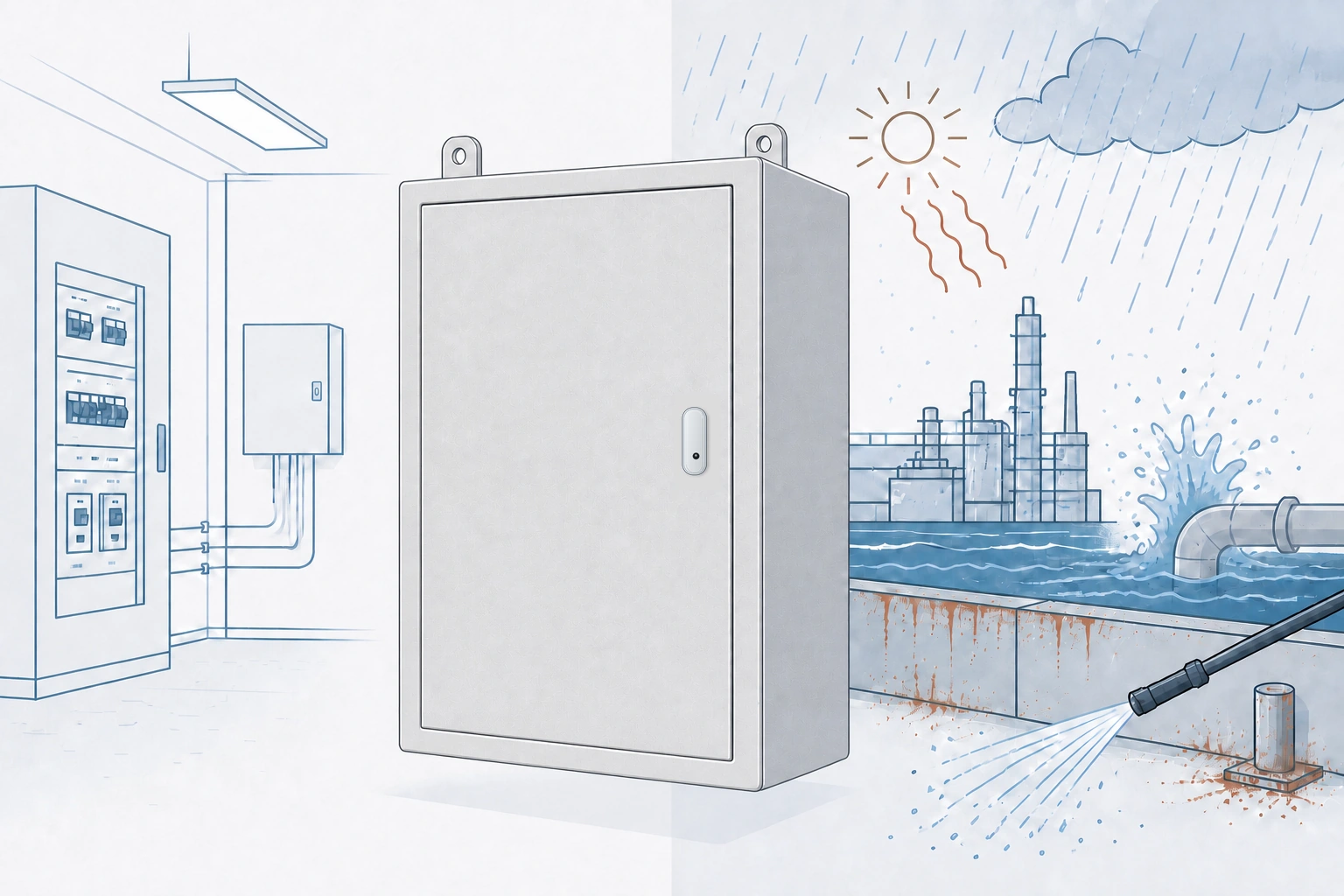

If you are comparing NEMA Type 1 vs NEMA Type 4X, start with the environment—not the number. Type 1 is a route for comparatively controlled indoor conditions. Type 4X deserves review when water, washdown, outdoor weather, or corrosion can reach the enclosure. The final decision is made by the finished assembly: door, gasket, latches, cable entries, accessories, mounting, and field modifications included.
NEMA Type 1 vs NEMA Type 4X: Quick Answer
Here is the practical split:
- Review a Type 1 route for an indoor enclosure in a controlled area where rain, spray, washdown, salt, and corrosive chemicals are not part of the requirement.
- Review Type 4X when the enclosure may see outdoor weather, hose-directed water, washdown, salt-laden air, or corrosive cleaning and process chemicals.
- Stop treating it as a Type 1 vs Type 4X choice when the project also involves hazardous locations, fire integrity, immersion, unusual impact, or a separate IP, IEC, UL, CSA, ATEX, or local requirement.
So, is NEMA Type 4X better? Not automatically. It is designed for a different exposure profile. Specifying it for a dry indoor room can add material, thermal, maintenance, and documentation requirements without solving a real problem.
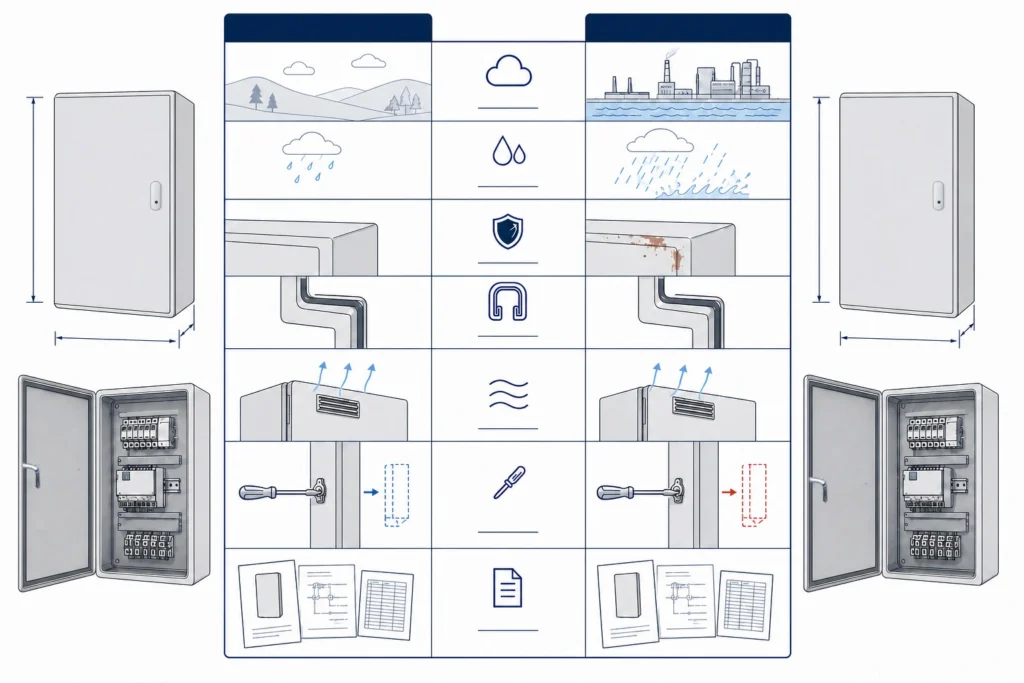
Quick Comparison Table
| Selection factor | NEMA Type 1 starting point | NEMA Type 4X review point |
|---|---|---|
| Typical installation | Controlled indoor area | Indoor process area, sheltered outdoor, or outdoor installation with water and/or corrosion exposure |
| Water | No rain, spray, or washdown requirement | Define rain, splash, hose direction, pressure, temperature, duration, and cleaning frequency |
| Corrosion | Not the main design driver | Review salt, chloride, chemicals, material, finish, fasteners, and maintenance |
| Dust and solids | Indoor dust conditions are documented | Consider windblown dust, sand, process particles, and cleaning residue |
| Door and gasket | Check the finished door seal | Check gasket path, compression, door stiffness, latch points, hinges, and aging |
| Openings | Record every opening | Treat cable glands, windows, fans, cooling units, drains, and field cut-outs as part of the boundary |
| Thermal management | Size around the internal heat load | Balance sealing with solar load, condensation, cooling, heating, and filter maintenance |
| Field changes | Control changes through drawings | Recheck the rating route after drilling, cutting, replacing, or adding accessories |
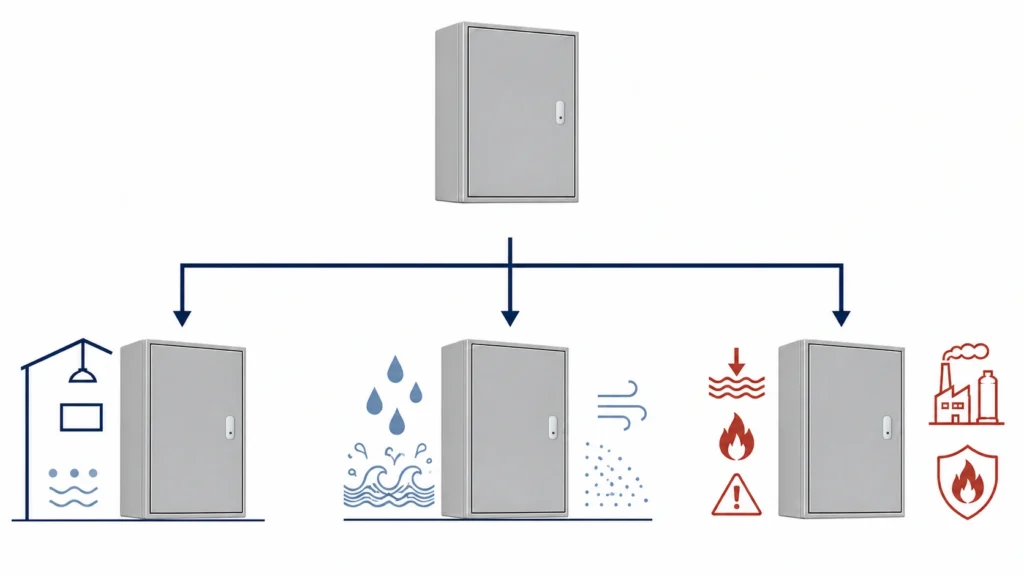
How to Choose Between NEMA Type 1 and Type 4X
1. Start with what can reach the enclosure
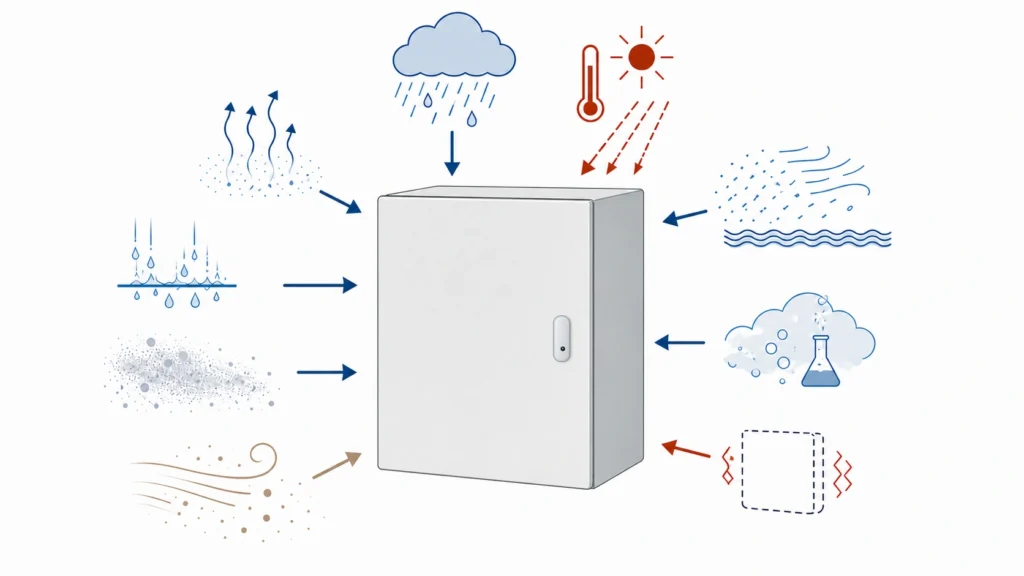
“Indoor” and “outdoor” are only starting labels. Ask what the enclosure will actually face.
A controlled electrical room may be a reasonable Type 1 starting point. A food-processing room, pump room, wastewater area, cold-chain facility, tunnel, coastal building, or plant floor may be indoors and still expose the enclosure to humidity, condensation, dust, vibration, cleaning agents, or water.
For an outdoor or semi-outdoor enclosure, record:
- rain, wind-driven spray, splash, or hose-down;
- salt air, marine exposure, chloride, chemical vapor, detergent, or wastewater;
- dust, sand, conductive particles, or abrasive contamination;
- ambient temperature, solar load, humidity, dew point, condensation, and altitude;
- vibration, impact, transport shock, public access, and vandalism risk.
For a fuller input list, see the outdoor electrical enclosure design checklist.
2. Name the water mechanism
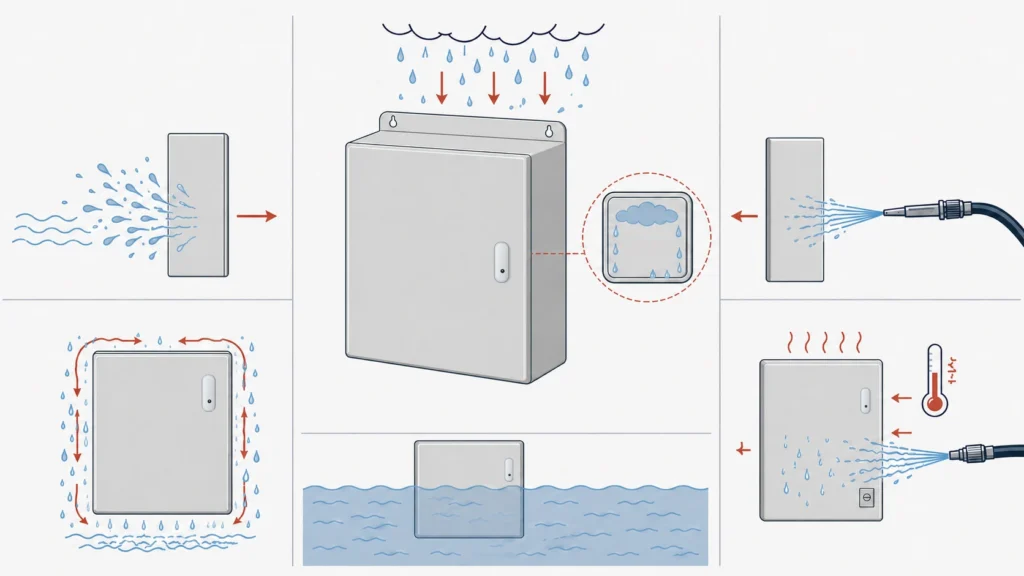
“Water-resistant” does not tell a fabricator what to build or a buyer what to verify.
Rain, ordinary spray, a direct hose stream, high-pressure washdown, hot water, and immersion are different exposures. Record the water source, direction, pressure or flow, temperature, distance, duration, and cleaning frequency. If detergents, alkaline agents, acids, chlorinated products, or antibacterial chemicals are used, record those too.
A Type 4X review may be appropriate for washdown, but the label does not settle the chemistry, gasket, fastener, finish, drainage, or accessory questions.
3. Review corrosion as a system
Type 4X discussions often lead to stainless steel. That is only the beginning.
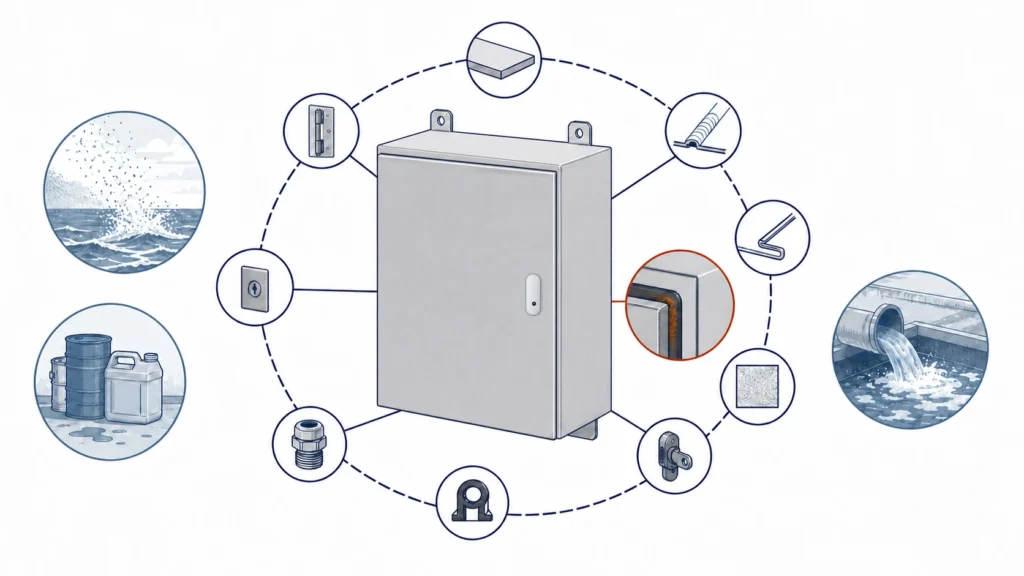
304 stainless steel may fit some indoor or moderately corrosive applications. 316 or 316L is often considered when chloride, marine, coastal, or more aggressive cleaning exposure enters the design discussion. Neither grade proves a finished NEMA Type by itself.
Review the whole system:
- sheet and component grades;
- welds, folds, seams, and exposed edges;
- surface finish and passivation requirements where applicable;
- fasteners, hinges, locks, brackets, and dissimilar-metal interfaces;
- cable glands, windows, fans, cooling units, and other penetrations;
- cleaning chemistry, concentration, temperature, and contact time;
- scratches, field cuts, coating damage, and touch-up requirements.
The right question is not “Which material is strongest?” It is “Which material and finish fit this exposure, structure, heat load, and maintenance plan?”
4. Define the finished enclosure, not just the shell
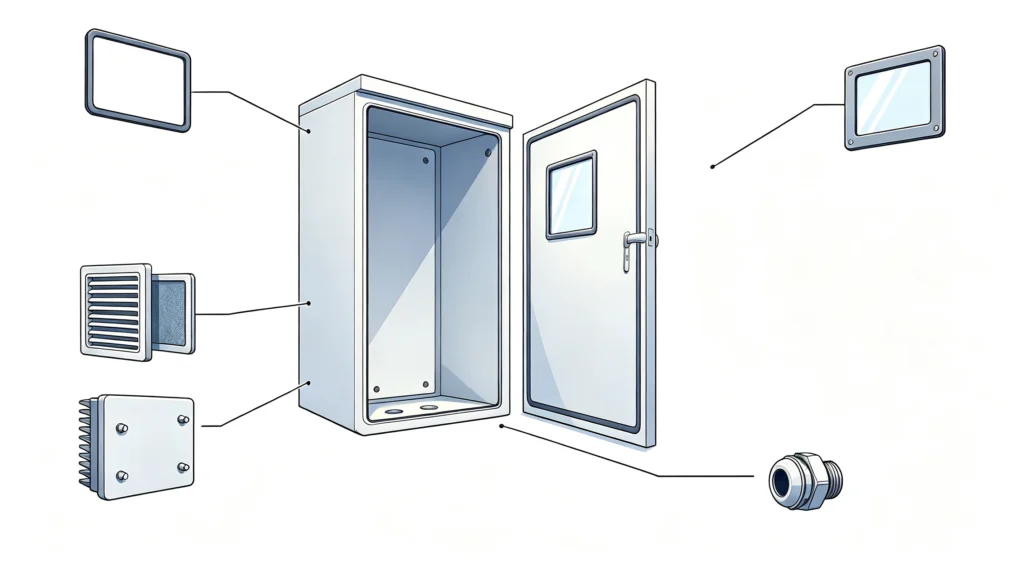
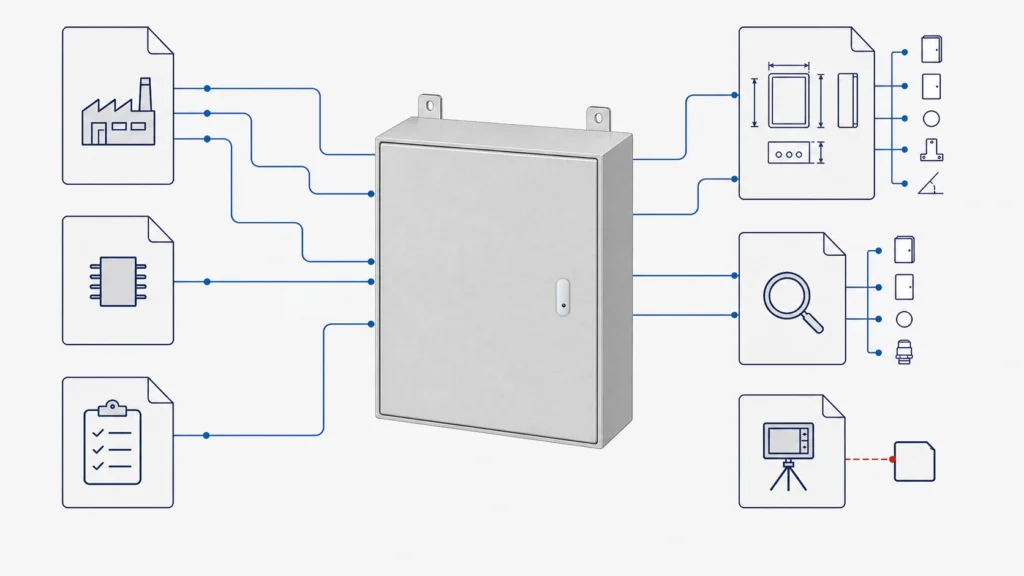
An empty shell and a finished enclosure are not the same object.
A door-mounted HMI, display window, pushbutton, fan, filter, air conditioner, heat exchanger, cable gland, gland plate, or field cut-out changes the boundary around the equipment. The review should cover the body and seams, door geometry, gasket compression, latch loading, hinges, every penetration, mounting orientation, drainage, and later maintenance.
This is where many comparisons become unfair. You cannot compare two enclosure ratings while changing the door construction, gasket compression, cable-entry system, fan, window, installation angle, or field opening. A gasket, gland, fan, or cut-out can change the question being tested.
5. Confirm what the evidence actually covers
A supplier page, a component datasheet, an inspection record, a controlled drawing, a test report, and a third-party certification are different kinds of evidence. One should not be presented as another.
Before accepting a Type 1 or Type 4X statement, ask whether it applies to the quoted dimensions, door arrangement, openings, accessories, mounting orientation, installation method, and field modifications. If those details are missing, the rating conversation is not finished.
Our Case: What Changes the Decision
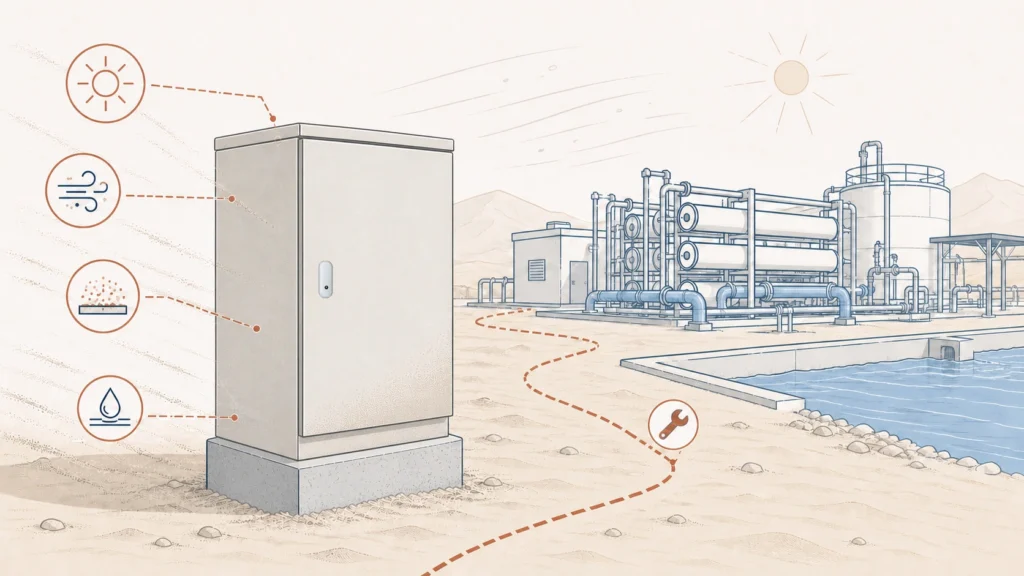
1. Desalination Plant: Outdoor Desert Exposure
source: Desalination Plant .
This case concerns an outdoor desalination-plant application. The setting matters: a cabinet in a desert environment may face strong solar loading, high ambient temperature, airborne dust, and sand before rain ever becomes the main concern. The public page does not state a material, NEMA Type, or complete tested configuration that should be copied into another project.
That changes the selection conversation. The enclosure may need a weather strategy, a realistic thermal plan, protection against dust accumulation, and a maintenance approach that works when surfaces and interfaces are repeatedly exposed to abrasive particles. A Type 1 assumption is not an appropriate outdoor starting point. The final Type 4X or other route still depends on the actual site conditions, accessories, and acceptance requirements.
Engineering takeaway: “Outdoor” is not a complete specification. Ask about solar heat, ambient temperature, sand, dust, service access, and cleaning—not only rain.
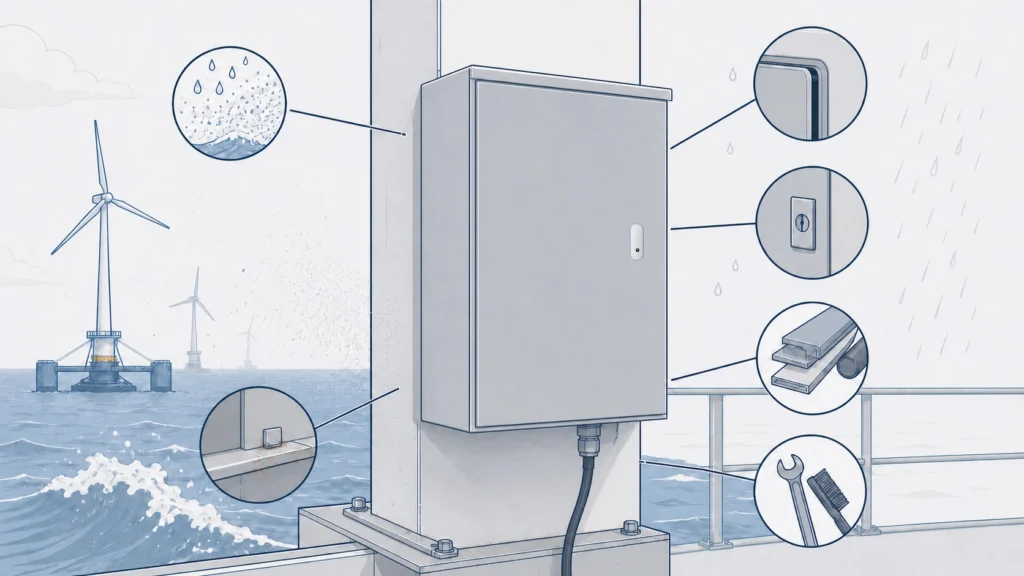
2. Floating Wind Farm: Marine Water and Corrosion
source: Floating Marine Wind Farm .
The describes a floating offshore wind-farm environment with water, humidity, marine exposure, and corrosion concerns. It references 316/316L stainless steel and uses IP66/IP67 terminology. Those are the source’s terms; they should not be rewritten as automatic NEMA Type 4X equivalence.
For a marine enclosure, the buyer has more than one question to settle. What water can reach the cabinet? Is chloride exposure continuous or intermittent? Which surfaces, fasteners, hinges, locks, and cable-entry parts share the same corrosion strategy? Where is the enclosure mounted, and how will it be inspected or cleaned? A stainless grade and an IP label are useful inputs, but neither one alone proves the required finished NEMA Type.
Engineering takeaway: Separate water ingress, chloride exposure, material selection, installation position, and corrosion maintenance. Marine service should not be reduced to “use stainless steel and choose the higher number.”
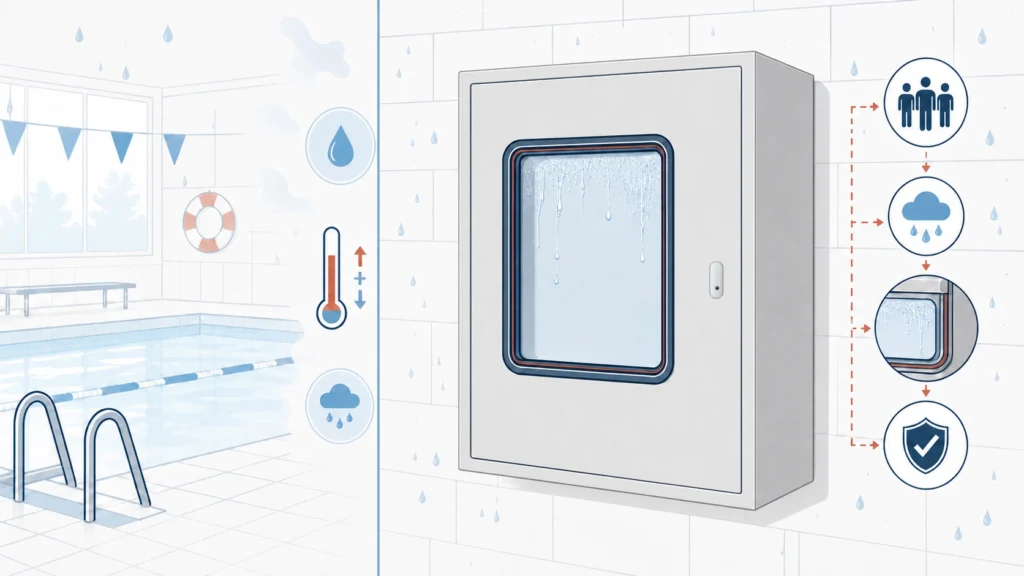
3. British Swimming LCD Enclosure: Indoor Humidity and Condensation Risk
source: British Swimming LCD Enclosure .
The British Swimming example places an LCD enclosure near a swimming-pool environment. The relevant threats are not limited to splashing water: humidity, temperature changes, water damage, public access, and protection of the display all appear in the application context. The page references an IP66 enclosure approach and temperature-management or condensation concerns. Any outcome claim remains specific to the publisher’s configuration.
The configuration matters because a display window creates another interface, while temperature changes can create condensation even when no visible leak is found. Mounting structure, door sealing, display protection, and thermal or condensation control should therefore be reviewed together. Type 4X may deserve review, but the project still needs its own exposure and configuration check.
Engineering takeaway: Indoor does not automatically mean mild. A pool room can require a more careful enclosure review than a dry electrical room.
4. Food and Pharmaceutical Washdown: Hygienic Configuration
source: Hygienic Stainless Steel Enclosure for Food and Pharmaceutical Production.
Project page focuses on a food and pharmaceutical cleaning area. It discusses stainless steel, a sealed door, a sloped hygienic top, cable entries, cut-outs, drainage, accessories, and IP66/IP69K terms. The page is a supplier-published project description, not independent third-party validation. IP69K should not be treated as interchangeable with NEMA Type 4X.
The details show why hygienic design is not a material-only decision. A sloped top can change how liquid sits on the enclosure. Drainage affects where water and residue go. Cable entries, field openings, fasteners, door seals, and gasket compression determine whether the cleanable outer form remains a credible protection boundary after the enclosure is equipped. Cleaning chemistry and contact time also belong in the review.
Engineering takeaway: In a washdown area, review geometry, drainage, seals, entries, accessories, and cleaning chemistry as one system. Do not let a high washdown term replace a defined requirement.
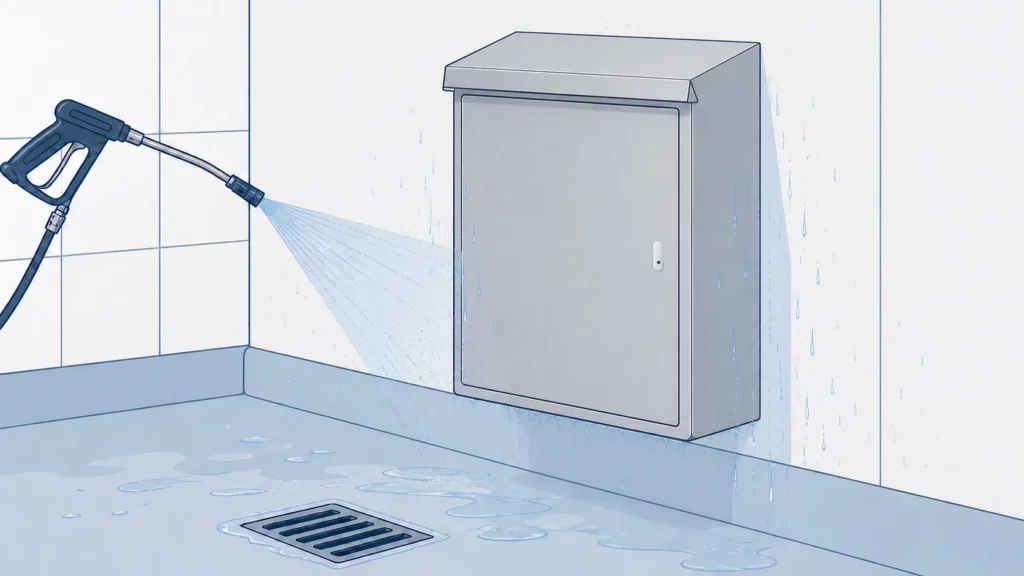
5. Food Processing with Forced-Air Ventilation: Sealing Versus Heat
source: Forced-Air Ventilation of Electrical Enclosures in a Food Processing Facility .
Describes a food-processing scenario involving high-pressure cleaning and antibacterial agents. The cabinet contains PLC, VFD, and user-interface equipment, and the page discusses a NEMA Type 4X enclosure together with ventilation, filters, and temperature-control considerations. These details belong to the publisher’s technical scenario, not to FN performance evidence.
The engineering tension is easy to see: the cabinet needs a sealed boundary against the process environment, but the components inside still produce heat. A fan or filter may help with temperature, yet it also introduces an interface that must be specified, installed, maintained, and reviewed. Cooling equipment, heaters, thermostats, and hygrostats add their own openings, controls, and service requirements.
Engineering takeaway: A Type 4X label does not finish the thermal design. Review sealing and heat removal together, then verify the complete accessory configuration.
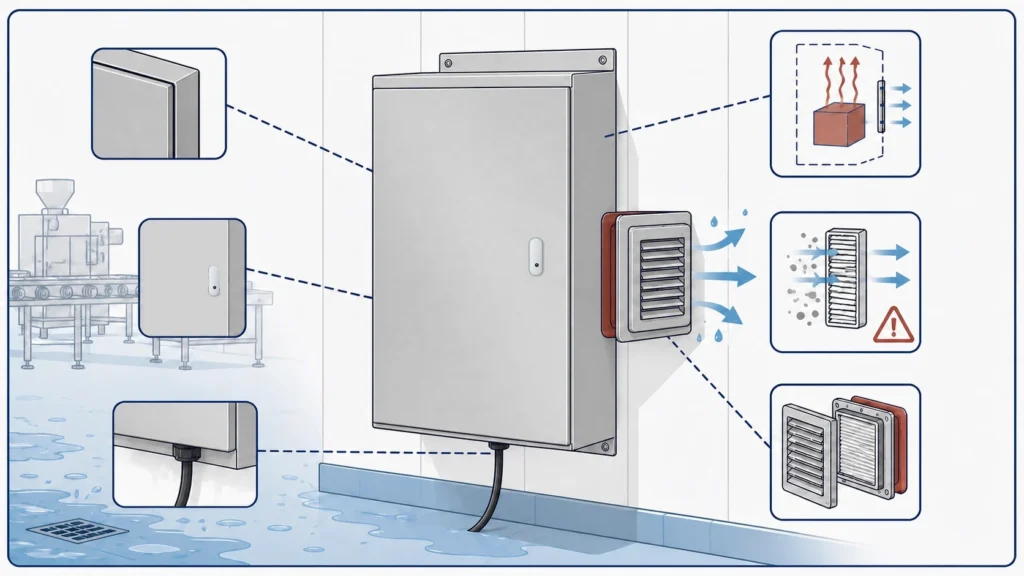
When NEMA Type 1 May Be Enough
A Type 1 route may fit when the project is genuinely controlled:
- the enclosure is indoors;
- rain, spray, hose-down, and outdoor weather are not part of the exposure;
- salt, corrosive chemicals, and aggressive cleaning are not design drivers;
- dust, impact, vibration, and temperature stay within documented conditions;
- the door, gasket, openings, cable entries, and accessories are defined;
- the mounting orientation and maintenance method are known;
- the customer drawings and acceptance requirements do not call for another rating or standard.
That is a conditional route, not a rule that “indoors equals Type 1.”
For a broader project decision process, see how to choose the right electrical enclosure for your project.
When NEMA Type 4X Deserves Review
Start a Type 4X review when one or more of these conditions is present:
- outdoor or semi-outdoor installation;
- wind-driven rain, splashing water, hose-down, or washdown;
- coastal air, marine exposure, salt, or chloride;
- cleaning chemicals, process chemicals, or corrosive vapors;
- high humidity, condensation, or rapid temperature changes;
- food, beverage, pharmaceutical, or hygienic cleaning;
- an explicit project requirement for NEMA Type 4X;
- a corrosion-resistant material and finish that must match a defined exposure.
“Deserves review” is intentional. The final route may be Type 4X, another NEMA Type, an IP requirement, a hazardous-location standard, a fire-integrity standard, or a project-specific acceptance plan.
For coastal and material questions, see corrosion-resistant electrical enclosures for coastal environments when that page is part of the approved site architecture.
Cost, Maintenance, and the Risk of Over-Specification
Type 4X can change more than the empty-box price. Material, finish, fasteners, gasket design, cable-entry hardware, washdown-compatible accessories, thermal management, inspection, and maintenance can all affect the project cost and service plan.
That does not make Type 4X automatically too expensive, or Type 1 automatically economical. Compare quotes on the same dimensions, material, openings, accessories, documentation, and supply scope. Otherwise, the lower quote may simply leave out the interfaces the project needs.
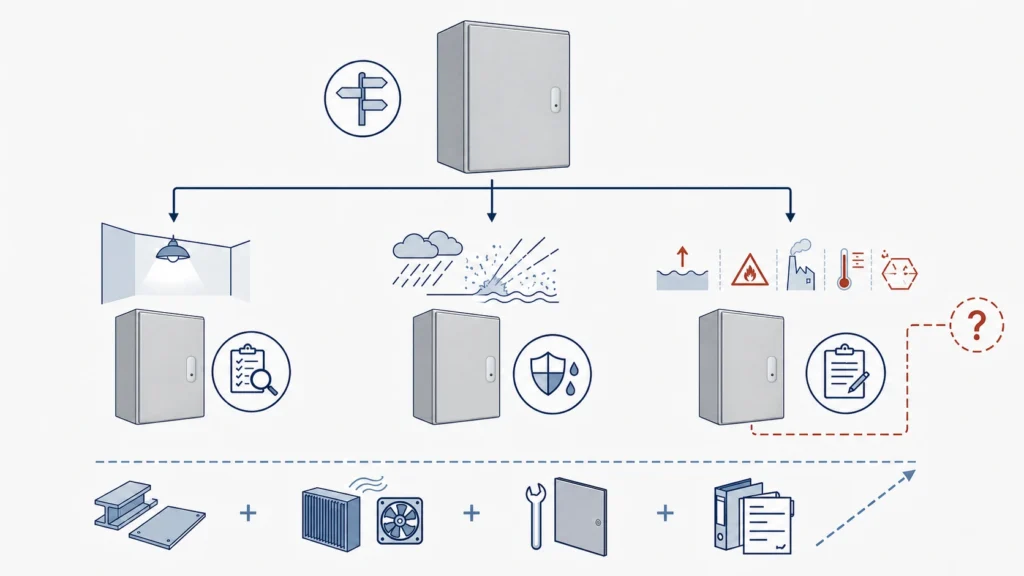
When Neither Type Label Is Enough
Do not force the project into a Type 1 vs Type 4X answer when:
- the enclosure may be submerged or face unusual water conditions;
- the location is hazardous or potentially explosive;
- fire resistance or circuit functional integrity is required;
- the customer specifies a separate IP, IEC, UL, CSA, ATEX, or local standard;
- the enclosure contains significant heat-producing equipment;
- a fan, air conditioner, heat exchanger, window, or large cable-entry system is required;
- openings will be cut after delivery;
- the supply scope includes internal assembly, wiring, testing, or a complete panel;
- the required evidence, inspection plan, or acceptance authority is not defined.
Ask for the governing standard, approved drawing, opening schedule, environmental data, test or inspection requirements, and responsibility for field modifications before assigning a rating route.
NEMA Type 4X and IP Ratings Are Not the Same System
NEMA Types and IEC ingress-protection ratings use different classification systems. Do not treat “NEMA 4X equals IP66” as a one-to-one conversion. An IP rating does not automatically address the corrosion-related requirements associated with Type 4X, and a NEMA Type does not replace every IP, hazardous-location, fire, or project-specific requirement.
The related IP65 vs IP66 electrical enclosures guide uses the same decision discipline:
Exposure first. Finished assembly second. Evidence third.
For related product references, see IP65 electrical enclosures and IP66 electrical enclosures.
Exposure first: define the actual water, corrosion, dust, heat, humidity, and cleaning conditions.
Finished assembly second: compare the door, gasket compression, latch points, hinges, cable glands, windows, fans, filters, cooling units, orientation, drainage, and field cut-outs—not just the shell label.
Evidence third: confirm that the stated protection applies to the quoted finished configuration. A supplier page, component datasheet, drawing, inspection record, test report, and third-party certification are not interchangeable.
IP66 is not a shortcut for “safer outdoors.” It does not by itself solve corrosion, condensation, overheating, immersion, or a badly sealed cable entry. If water is found inside a cabinet, also check pressure cycling, condensation, cable wicking, drainage, and interface defects before simply raising the IP target.
For background, consult the NEMA enclosure types reference and NEMA 250 scope and contents information.
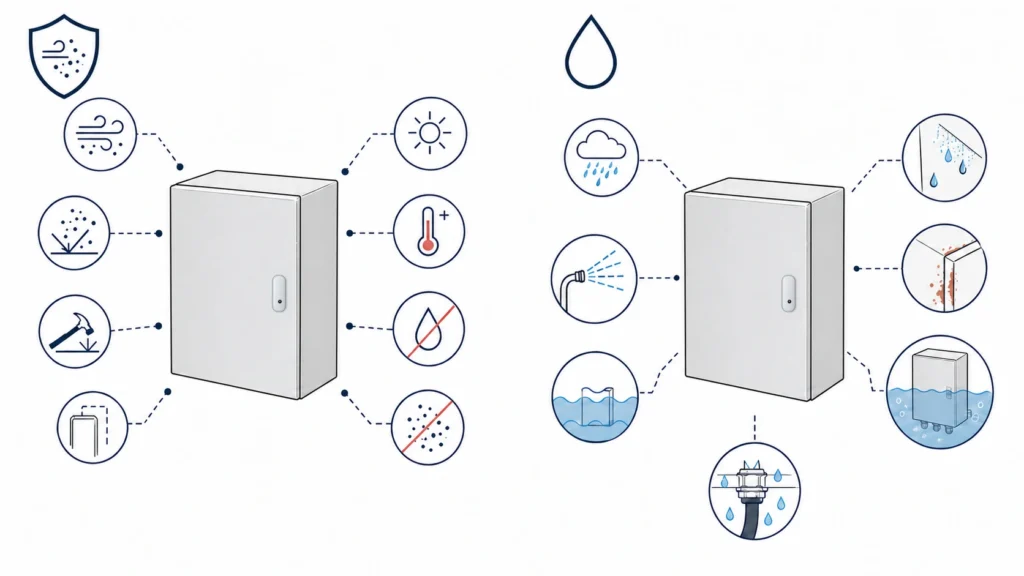
RFQ Checklist for NEMA Type 1 or Type 4X Enclosures
Send these details with an enclosure inquiry:
- Project country, installation site, and governing customer or authority requirements.
- Indoor, outdoor, sheltered outdoor, or process-area location.
- Rain, spray, splash, hose-down, washdown, or submersion exposure.
- Water pressure, temperature, direction, duration, and cleaning frequency.
- Cleaning or process chemicals, including concentration and temperature where known.
- Ambient temperature, solar exposure, humidity, dew point, condensation risk, and altitude.
- Dust, sand, conductive particles, vibration, impact, transport shock, and public access.
- Material, surface finish, fasteners, hinges, locks, and gasket expectations.
- Dimensions, door arrangement, wall-mounted electrical enclosures or floor-standing installation, and service clearance.
- Internal components, heat dissipation, mounting plate, DIN rail, brackets, or rack requirements.
- Window, HMI, display, pushbutton, fan, filter, air conditioner, heat exchanger, heater, and thermostat requirements.
- Cable-entry locations, gland types, conduit interfaces, and the complete opening schedule.
- Any cut-outs or modifications planned after delivery.
- Quantity, sample or first-article requirements, inspection points, and documentation needs.
- Clear supply scope: empty enclosure, modified enclosure, assembled panel, or another defined scope.
A clear RFQ makes quotes easier to compare and prevents the enclosure label from hiding unresolved interfaces.
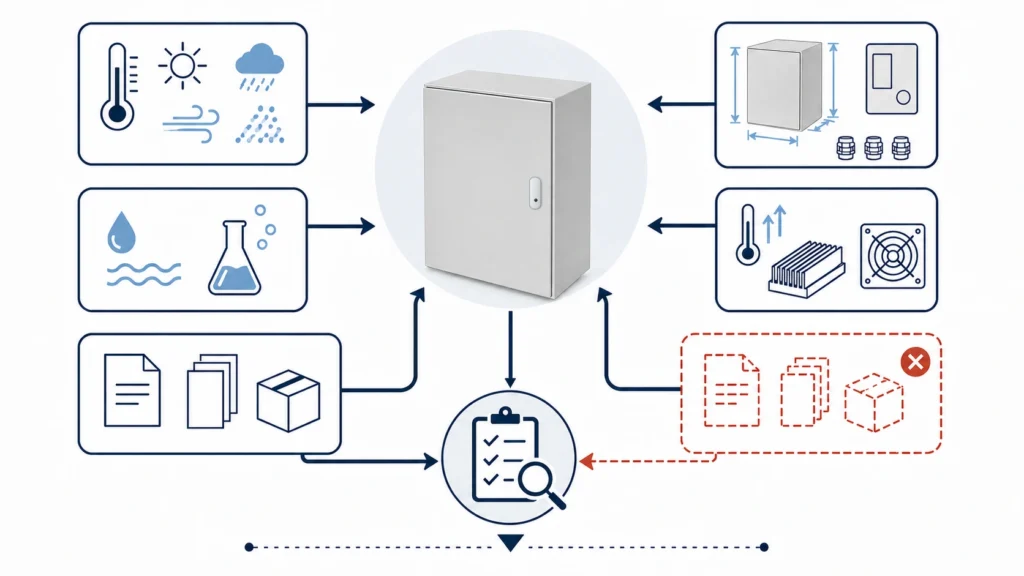
Choose the Right Project Route
- Controlled indoor project with no water or corrosive exposure: review a Type 1 route against the drawings and acceptance requirements.
- Outdoor, washdown, marine, coastal, humid, or corrosion-sensitive project: review Type 4X or another suitable rating and material combination.
- Incomplete conditions, complex accessories, field modifications, or special standards: send the drawings and exposure information for a custom enclosure review.
FN Enclosure supports project-based enclosure discussions around dimensions, materials, openings, and configuration. Depending on the form and mounting method, also review modular electrical enclosures, outdoor electrical enclosures, or junction boxes. Send your exposure and configuration inputs or review custom electrical enclosures from drawings.
FAQ
What is the main difference between NEMA Type 1 and NEMA Type 4X?
Type 1 is a starting point for comparatively controlled indoor conditions. Type 4X deserves review where water exposure and corrosion concerns are part of the project. The final decision depends on the complete configuration and the required evidence.
Can a NEMA Type 1 enclosure be used outdoors?
Do not use Type 1 as the default for outdoor, rain, spray, washdown, or other water exposure. Review the actual environment and the applicable project standard first.
Is NEMA Type 4X always better than Type 1?
No. Type 4X addresses a different exposure profile. For a controlled indoor project, choosing it only because the number is higher may add cost, thermal, material, and maintenance requirements without solving a real problem.
Does stainless steel automatically make an enclosure NEMA Type 4X?
No. Stainless steel is one input. The door, gasket, seams, openings, cable entries, accessories, installation, and finished-assembly evidence also matter.
Is NEMA Type 4X the same as IP66?
No one-to-one equivalence should be assumed. NEMA Types and IP ratings have different scopes and should be checked against the project’s actual acceptance requirements.
Do cable glands, windows, and fans affect enclosure selection?
Yes. Each penetration or mounted accessory can change the finished enclosure boundary. Specify cable entries, windows, fans, filters, cooling units, and field cut-outs with the enclosure.
What information should I send for an enclosure quotation?
Send the installation environment, water and cleaning exposure, corrosion conditions, temperature and condensation data, dimensions, material, openings, cable entries, accessories, quantity, drawings, acceptance requirements, and supply scope.