
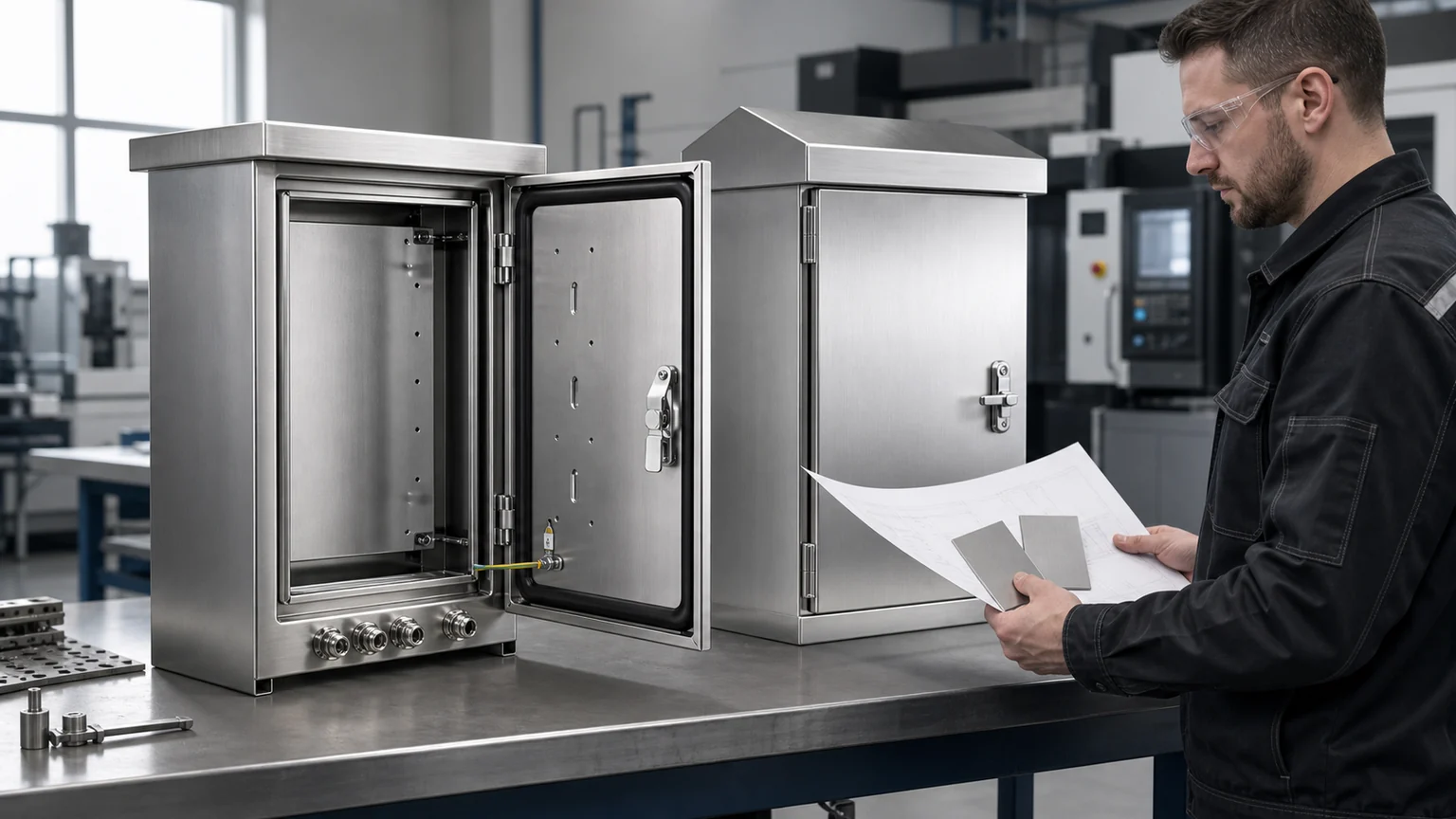

304 stainless steel is often the practical starting point for controlled industrial locations with low chloride exposure. Choose 316 or 316L as the stronger candidate when marine salt, deicing salts, chloride-bearing washdown, or persistent wet crevices raise the risk of pitting and crevice corrosion. The grade is only one part of the decision because weld cleanup, surface finish, hardware, cable entries, drainage, and maintenance can change the field result.
Use the coastal corrosion guide for the wider material-system decision, then use this page to decide whether the stainless grade itself matches the chloride, washdown, fabrication, and maintenance conditions.
Engineering rule: The expensive grade can still fail at the cheapest interface. Select the alloy by exposure, then verify the fabricated condition, interfaces, accessories, and drainage.
Quick answer: what matters most
- Use 304 or 304L as the baseline candidate for indoor, controlled, low-chloride service when regular cleaning and inspection are realistic.
- Evaluate 316 or 316L when the enclosure faces marine aerosol, road salt, chloride-bearing cleaning chemicals, persistent wetting, or difficult-to-clean crevices.
- For welded enclosures, compare the complete fabrication specification, not just the sheet certificate. Heat tint, embedded iron, rough welds, and incomplete surface restoration can reduce local corrosion resistance.
- Do not use NEMA 4X, IP65, or IP66 as substitutes for alloy selection. These classifications answer enclosure-protection questions, not every material-compatibility question.
- Review the body, door, gland plate, fasteners, hinges, latches, grounding points, windows, cable fittings, and gasket as one enclosure system.
- Put exposure, cleaning chemistry, temperature, finish, post-weld treatment, accessories, rating target, and required evidence into the RFQ before comparing prices.
Use this guide when
- Writing or approving an RFQ: Check whether exposure, fabrication, interfaces, and evidence are defined before suppliers price the material.
- Reviewing a drawing material line: Confirm that 304, 304L, 316, or 316L applies to the body, door, gland plate, hardware, and other exposed parts.
- Approving welded fabrication or a first article: Inspect heat tint, weld cleanup, finish, contamination control, and inaccessible crevices.
- Changing washdown conditions: Recheck cleaner composition, concentration, temperature, contact time, frequency, and final rinse.
- Installing or replacing accessories: Verify cable glands, windows, hinges, latches, drains, fans, and field penetrations against the environment and rating target.
For available formats and project options, see FN stainless steel electrical enclosures.

304 vs 316 Stainless Steel Electrical Enclosures at a Glance
The useful comparison is not “good stainless versus better stainless.” It is a comparison between the expected corrosion mechanism and the condition of the enclosure after fabrication. Type 304 is a widely used chromium-nickel austenitic stainless steel. Type 316 adds molybdenum, which improves resistance to chloride-driven pitting and crevice corrosion. According to the International Molybdenum Association, Type 316 normally contains about 2% to 3% molybdenum and has a typical PREN of about 24, compared with about 18 for Type 304.
PREN helps compare alloy families, but it does not predict enclosure life. It does not account for actual chloride concentration, temperature, evaporation, deposits, crevice geometry, contamination, maintenance, or failure consequence.
| Decision factor | 304 or 304L | 316 or 316L | What the buyer should verify |
|---|---|---|---|
| Typical selection position | Baseline candidate for controlled, low-chloride environments | Higher-margin candidate for chloride exposure and persistent wetting | Installation, salt source, temperature, wet time, and maintenance |
| Typical PREN comparison | About 18 | About 24 | Use for alloy comparison only, not life prediction |
| Localized corrosion | Lower resistance relative to 316 | Higher resistance relative to 304 | Crevices, deposits, weld condition, drainage, and finish |
| Welded fabrication | Evaluate 304L when low carbon is required | Evaluate 316L when low carbon and molybdenum are required | Heat-tint removal, contamination control, and surface restoration |
Quick Selection Matrix by Environment
| Environment or exposure | Starting candidate | Why | Required verification |
|---|---|---|---|
| Controlled indoor, low chloride | 304 or 304L | Practical baseline when humidity and cleaning are controlled | Condensation, cleaners, weld condition, maintenance |
| Outdoor inland, little road salt | 304/304L or 316/316L | Outdoor exposure alone does not choose the grade | Wet time, drainage, deposits, failure consequence |
| Coastal or marine salt aerosol | 316 or 316L candidate | Greater chloride pitting and crevice-corrosion margin | Wind, deposits, sheltered crevices, cleaning, maintenance |
| Roadside or deicing-salt exposure | 316 or 316L candidate | Chloride deposits can concentrate during wet-dry cycles | Splash path, bottom details, mounting interfaces, rinse |
| Chloride-bearing washdown | 316 or 316L candidate | Repeated chemical exposure can raise localized-corrosion risk | Cleaner composition, concentration, temperature, contact time |
| Strong or uncertain chemicals at elevated temperature | Specialist review | Ordinary 316 may still be unsuitable | Chemical compatibility data and corrosion-engineering review |
A well-fabricated and maintained 304 enclosure can outperform a poorly detailed 316 enclosure in the wrong application. A correctly specified 316L enclosure can provide useful corrosion margin, but it is not immune to chloride attack, stagnant deposits, contamination, or incompatible chemicals.

Why Chloride Exposure Changes the Material Decision
Chlorides can destabilize the passive surface that normally protects stainless steel. The attack is usually local rather than uniform. Most of a cabinet can look acceptable while corrosion begins at a gasket edge, rough weld, fastener seat, label corner, gland plate, or salt deposit that stays wet. This is why a grade comparison must examine where salts arrive, concentrate, and remain in contact with the finished enclosure.
The word “outdoor” does not define this risk. An inland enclosure with good drainage and little road salt may present a lower chloride challenge than an indoor food-processing enclosure repeatedly cleaned with chloride-bearing chemicals. A coastal enclosure can receive marine aerosol even when it is not directly splashed. A roadside cabinet can collect deicing salt, and a shaded bottom flange can remain wet after the front face dries.
According to IMOA stainless steel selection system, alloy grade is only one input. Surface finish, crevices, direct salt exposure, natural washing, and maintenance also change corrosion risk. The method was developed for architectural selection, so it should not be copied as an electrical-enclosure calculator. Its risk factors are still useful for identifying deposits, sheltered surfaces, and maintenance limitations.
When marine aerosol, deicing salt, or sheltered deposits drive the decision, review the broader coastal corrosion risks for electrical enclosures. Use that system-level review to define exposure before the RFQ reduces the requirement to a material code.

When 304 Stainless Steel Is the Practical Choice
304 or 304L is a reasonable starting candidate when the installation has low chloride exposure, controlled humidity, predictable cleaning, and accessible surfaces. Typical examples include protected automation cabinets, utility rooms, dry production areas, and general industrial locations where salt-bearing chemicals are not used. Indoor placement alone is not enough. The buyer still needs to check condensation, process vapors, cleaning products, cooling-water leaks, nearby chemical storage, and contamination introduced during installation.
A strong 304 specification describes more than the alloy. It identifies the required finish, weld condition, fastener material, gasket compatibility, cable-entry plan, cleaning method, and inspection access. It also controls carbon-steel dust transferred by shared tools, wire brushes, grinding areas, racks, clamps, or handling equipment. For welded construction, 304L may be evaluated because its lower carbon content helps reduce sensitization risk during heat input. That benefit is different from the molybdenum-related chloride resistance that distinguishes 316 from 304.
304 becomes easier to defend when failure consequence is limited and the enclosure can be inspected and cleaned. It becomes harder to defend when access is difficult, downtime is expensive, salts can concentrate, or maintenance is uncertain. Do not select it only because a location is called “normal” or “industrial.” Ask what can wet the enclosure, where liquid can remain, how often deposits are removed, and what happens if corrosion reaches a sealing face, latch, grounding point, or cable entry.
For project factors beyond material, use this electrical enclosure selection checklist.

When 316 or 316L Is Justified
316 or 316L becomes easier to justify when chloride exposure is credible and localized corrosion would create meaningful cost or safety consequences. Marine aerosol, road salt, chloride-bearing washdown, brackish water, cooling-water leakage, swimming-pool atmospheres, and sheltered outdoor deposits can all move the decision toward 316. The exposure must still be defined because severe chemistry, high temperature, or concentrated deposits may exceed what ordinary 316 can tolerate.
The distinction between 316 and 316L matters when welding enters the specification. According to the Outokumpu Supra 316L/4404 datasheet, 316L is the low-carbon alternative to 316. Its lower carbon content reduces carbide precipitation caused by heat input and improves resistance to intergranular corrosion. It does not remove the need for weld cleanup and surface restoration, and it should not be described as having unlimited chloride resistance.
An IMOA marine exposure example shows the value and the limits of material evidence. At one research facility, a Type 316 test panel retained its original brushed appearance after 56 years, while a Type 304 panel showed rust staining after 12 years. These were test panels at one location, not complete electrical enclosures with welds, gaskets, cable entries, hardware, and maintenance variables.
Use 316 or 316L as a higher-margin candidate when the exposure and failure consequence support the premium. If chemistry or temperature remains uncertain, request a corrosion review instead of assuming that the next common stainless grade closes the question.

Why a 316 Enclosure Can Still Corrode After Fabrication
The material certificate describes the starting metal. It does not describe every local condition created by cutting, forming, welding, grinding, handling, assembly, and field installation. A 316 sheet can have the specified chemistry and still become vulnerable at a weld, contaminated surface, rough crevice, or damaged finish. The drawing, process route, inspection plan, and final assembly therefore deserve the same attention as the alloy line on the bill of materials.
Weld heat tint and the heat-affected surface
According to the British Stainless Steel Association, a chromium-depleted layer can form beneath weld heat tint and reduce local corrosion resistance. Where corrosion performance matters, visible tint and the affected surface should be handled by an appropriate post-weld cleaning process. Specifying 316L does not restore a poorly finished weld. The RFQ should define exposed surfaces, final appearance, cleanup expectations, and acceptance criteria.
Surface contamination and restoration
Carbon-steel dust can be transferred by shared tools, grinding areas, racks, clamps, or handling equipment. The resulting rust may be mistaken for stainless-grade failure. According to worldstainless, pickling removes fabrication-related contamination, while passivation forms or restores a stable protective surface condition. These terms should be defined as process and verification requirements, not used as vague marketing labels.
Crevices and stagnant liquid
Gaps around hinge leaves, latch brackets, gasket edges, washers, nameplates, and gland plates can retain contaminated water. Oxygen depletion inside a narrow gap can create conditions favorable to crevice corrosion. Cleanable geometry, smooth exposed surfaces, fewer unnecessary overlaps, and dependable drainage can matter as much as the grade upgrade.
Mixed metals and damaged surfaces
Dissimilar hardware, scratches, embedded particles, field drilling, and unsuitable cut-edge treatment can introduce local attack or staining. Review fasteners, hinges, mounting brackets, grounding hardware, cable fittings, and installation methods. The label “316 enclosure” is incomplete if exposed accessories use unsuitable materials or finishes.

NEMA 4X and IP Ratings Do Not Choose the Alloy for You
NEMA Type and IEC IP classifications address enclosure protection under defined conditions. They do not function as universal corrosion-life predictions, and they do not automatically select 304 or 316. According to the official NEMA enclosure type definitions, Type 4X addresses windblown dust, rain, sleet, snow, splashing water, hose-directed water, external icing, and an additional level of corrosion protection. Type 4X is a complete-enclosure performance classification, not a stainless-steel grade.
Reject both shortcuts: “316 means Type 4X” and “Type 4X means the enclosure is made from 316.” The first ignores the door, gasket, hinges, latches, fittings, openings, windows, and verification. The second assumes a material that the classification does not prescribe. Different materials can be part of assemblies designed for a target Type, but the exact tested or assessed configuration must support the claim.
NEMA\’s technical FAQ for enclosures explains that an IP code cannot be treated as directly equivalent to a NEMA Type designation. It also states that the overall Type rating of a field-installed assembly is limited by the least severe rating among its components. A 316 body therefore cannot compensate for a lower-rated cable fitting, window, fan, drain, operator, or field-made penetration.
Material grade and ingress protection answer separate questions. The guide to IP65 vs IP66 electrical enclosures explains how gasket design, door flatness, compression, cut-outs, and cable entries affect the final protection target.

The Complete Enclosure System Decides the Field Result
Use the FN Three-Layer Stainless Enclosure Review to keep a material decision connected to the completed product. It is a quote-scope framework, not a service-life calculator or a substitute for project-specific chemical compatibility and corrosion review.
| Review layer | Questions to answer | Typical omission |
|---|---|---|
| 1. Exposure | What chloride source, temperature, wet time, deposit, cleaning process, and maintenance condition will the enclosure face? | “Outdoor,” “coastal,” or “washdown” used without measurable conditions |
| 2. Fabrication | What grade, weld condition, finish, heat-tint treatment, contamination control, and surface restoration are required? | A material certificate is accepted while the completed surface remains undefined |
| 3. Interfaces | Do hardware, hinges, latches, glands, windows, grounding points, gaskets, drainage, and field penetrations match the exposure and rating target? | A 316 body is combined with unsuitable or lower-rated components |
Localized corrosion often begins at an interface rather than in the center of a flat sheet. Trace the failure path: the contaminant reaches the enclosure, collects at a detail, remains wet, and attacks a vulnerable surface. The result can be staining, sealing-face damage, a seized latch, poor grounding contact, or leakage around a cable entry.
Review the third layer as one connected system:
- Door and gasket: Check sealing-face flatness, gasket material, joint position, compression, replacement method, and whether liquid can remain behind the gasket edge.
- Hinges and latches: Check material compatibility, shielded crevices, drainage, fasteners, lubricant compatibility, and repeated operation.
- Cable entries and gland plates: Confirm gland and plug materials, gland-plate sealing, cut-edge condition, installation torque, and cable direction.
- Windows, fans, filters, drains, and operators: Treat each accessory as a possible limit on protection rating and chemical compatibility.
- Mounting and grounding points: Review washers, studs, brackets, welds, bare contact areas, and dissimilar metals while preserving electrical bonding requirements.
- Top and bottom geometry: Avoid water traps and provide drainage paths without compromising the specified enclosure protection.
Internal moisture is a separate problem from external alloy selection. Upgrading from 304 to 316 does not remove condensation caused by temperature cycling, humid air, pressure changes, or inadequate heat and ventilation. Review why condensation forms inside outdoor electrical enclosures before finalizing heaters, vents, drains, orientation, and maintenance access.
A reliable specification connects alloy, fabrication, interface materials, environmental controls, and evidence. Leaving one of these areas undefined allows a quotation to match the material note while missing the installation risk.

How to Choose 304 or 316: A Step-by-Step Engineering Process
A repeatable process prevents a project from jumping from a vague word such as “outdoor” directly to a material decision. It also gives every supplier the same exposure and fabrication scope. Steps 1–4 define exposure and consequence, Steps 5–7 define the fabricated enclosure and interfaces, and Steps 8–10 define evidence and lifecycle acceptance.
- Step 1: Define the installation. State location, salt sources, shelter, orientation, temperature, humidity, dust, vapors, sunlight, and inspection access. Industry labels are not complete specifications.
- Step 2: Identify chloride sources. Include marine aerosol, deicing salt, cooling water, cleaners, disinfectants, process splash, and transported contamination. Record composition, concentration, temperature, contact time, frequency, and rinse method where known.
- Step 3: Map wetting and deposits. Check where liquid strikes, flows, evaporates, and remains, especially around gaskets, ledges, welds, labels, hinges, latches, washers, gland plates, and mounting surfaces.
- Step 4: Define the failure consequence. Separate cosmetic staining from functional damage. Include access, shutdown, travel, removal, rewiring, recommissioning, and replacement lead time.
- Step 5: Select the candidate alloy. Start with 304/304L for controlled low-chloride service. Evaluate 316/316L as chloride exposure, wet time, access difficulty, or failure consequence increases. Escalate severe or uncertain chemistry.
- Step 6: Define the fabricated condition. State grade, welding, finish, heat-tint acceptance, contamination control, edge treatment, and post-weld cleaning or passivation requirements.
- Step 7: Match interfaces and accessories. Identify hinge, latch, fastener, gland plate, cable fitting, plug, window, drain, fan, operator, and grounding materials, ratings, and compatibility.
- Step 8: Separate alloy from NEMA/IP. The material specification defines grade and fabrication. The protection specification defines rating, configuration, openings, accessories, and evidence.
- Step 9: Define inspection evidence. Request material identification where needed, drawing control, first-article checkpoints, finish and weld inspection, accessory documents, and agreed testing.
- Step 10: Compare lifecycle consequences. Compare the alloy premium with cleaning, access, downtime, and replacement exposure. Price testing or specialist review when important inputs remain unknown.
The result should be a quote-ready specification that explains why the grade is requested and what the completed enclosure must preserve.

Cost, Fabrication, and Lifecycle Consequences
316 generally carries a material premium over 304, but a universal percentage is not credible. The final difference depends on thickness, quantity, availability, nesting yield, finish, hardware, welding, post-weld treatment, inspection, and packaging. Suppliers must price the same complete scope. Comparing a basic 304 enclosure with a 316 enclosure that also includes upgraded hardware and treatment does not isolate alloy cost.
Lifecycle review should follow the failure path that matters. Cosmetic staining on an accessible cabinet may be manageable through cleaning. Corrosion at a gasket land, cable entry, hinge, grounding point, or latch can require shutdown, access equipment, rewiring, and recommissioning. At a remote site, these activities may cost more than the cabinet body.
Do not ask whether 316 is always cheaper over a fixed number of years. Ask three narrower questions: Which failure mode is credible? What is the consequence if it occurs? Which material and fabrication changes reduce that risk at a justifiable cost? If 316 is selected, document the mechanism it addresses. If 304 is retained, document the controls that support it, such as low chloride exposure, cleanable geometry, inspection access, and predictable maintenance.
Avoid fixed service-life, savings, and maintenance claims unless project evidence supports them. The defensible commercial record is a traceable decision showing exposure assumptions, quote difference, evidence requested, and residual risk accepted by the project team.
Factory Engineering Note: What I Check Before I Accept the Material Line
When I review a stainless enclosure RFQ, I do not start by circling 304 or 316. I print the drawing and mark every place where liquid, salt, grinding dust, or a dissimilar metal can remain after fabrication and installation. The first pass usually covers the door return, gasket land, hinge leaf, latch bracket, welded corner, roof seam, gland plate, mounting feet, grounding stud, label area, and bottom cable entries. If the drawing shows a flat horizontal ledge, an overlapping bracket, or a blind crevice, I treat that geometry as part of the corrosion specification.
My next check is whether the bill of materials is internally consistent. A line that says “316 stainless enclosure” is incomplete if the drawing does not identify the door, body, gland plate, fasteners, hinges, latches, studs, and field-installed fittings. I also look for carbon-steel contact during fabrication and for operations that occur after the final surface treatment. A clean enclosure can be contaminated again by drilling, grinding, marking, or installing unsuitable hardware.
For welded units, I review the visible and hidden welds, heat-tint acceptance, dressing method, exposed surface direction, and access for cleaning. I do not accept “passivated” as a complete instruction. I want the process requirement, applicable standard or supplier procedure, acceptance method, and surfaces included in the scope. If the factory does not perform that treatment in-house, the quotation should identify the qualified external process and the evidence returned with the batch.
The final check is commercial. I convert every undefined point into a quotation risk: additional polishing, rejected appearance, replacement hardware, rework after testing, or disagreement over the first article. A precise material line reduces those risks before production. The practical lesson is simple: the grade decision becomes reliable only when the drawing, process route, accessories, inspection, and installation assumptions agree.
Project Case: Turning a “316 Required” Note into a Quote-Ready Specification
In this composite case, I am reviewing an RFQ for 48 wall-mounted control enclosures measuring 800 × 600 × 250 mm and fabricated from 1.5 mm stainless sheet. The original drawing says “316 stainless, IP66, brushed finish,” but it does not define the L grade, hardware, weld cleanup, gland-plate construction, washdown chemistry, or accessory ratings. The units will be installed outdoors near a coast, cleaned weekly, and serviced through a shutdown and a two-person site visit.
The risk map identifies fourteen bottom cable entries, two external hinges, a quarter-turn latch, one viewing window, a grounding stud, four rear mounting points, welded door corners, and a flat top that can retain deposits near the wall. Because the chloride concentration in the washdown liquid is unknown, the team keeps chemical compatibility as an open item instead of declaring 316 suitable for every cleaner.
| Review item | Original RFQ | Quote-ready basis |
|---|---|---|
| Material | “316 stainless” | 316L body, door, and removable gland plate |
| Exposure | Coastal outdoor service and weekly washdown | Salt exposure recorded; washdown chemistry remains an open compatibility item |
| Fabrication | Brushed finish only | Weld cleanup, visible finish, contamination control, and surface restoration defined |
| Interfaces | Hardware, cable entries, window, grounding, and drainage not coordinated | Compatible external hardware and documented accessory ratings reviewed as one system |
| Verification | IP66 note only | Drawing approval, accessory evidence, and first-article checkpoints before the remaining 47 units |
| Open items | 21 ambiguous drawing and RFQ points | 3 controlled open items |
Illustrative decision comparison
Added specification scope: USD 225 per enclosure, or USD 10,800 for the batch.
One remote replacement visit: USD 16,650 before production-loss costs.
Decision: accept the defined upgrade without claiming a guaranteed service life or payback period.
The project does not become quote-ready when “316” is added to the drawing. It becomes quote-ready when exposure, fabricated condition, interfaces, evidence, and open items are defined together. The measurable result is a comparable supplier scope, three visible open items, and a first article with agreed acceptance checkpoints—not a promise of corrosion-free years.

What to Specify in the RFQ
A good RFQ shows the manufacturer the exposure, fabrication, interface, and evidence requirements before material is purchased. It also prevents the supplier from pricing only the visible body while treating the gland plate, hardware, finish, testing, or documentation as later changes.
- Installation country, site type, indoor or outdoor location, shelter, mounting orientation, and access conditions.
- Marine salt, deicing salt, cooling water, process splash, cleaner, or other chloride sources.
- Temperature, humidity, solar exposure, condensation risk, wetting frequency, drying opportunity, and maintenance interval.
- Cleaner or process chemical name, available composition, concentration, temperature, contact time, frequency, and final rinse.
- Body, door, gland plate, fastener, hinge, latch, mounting, grounding, and external hardware materials.
- Required 304, 304L, 316, or 316L grade, including material identification or certificate needs.
- Dimensions, sheet thickness, weld locations, cut-outs, gland plates, mounting parts, and supplier scope.
- Finish, roughness where relevant, grain direction, visible-weld acceptance, heat-tint treatment, contamination control, and post-weld surface treatment.
- NEMA Type or IP target, installed orientation, cable fittings, plugs, windows, fans, filters, drains, operators, and penetrations.
- Drawing approval, first-article checkpoints, dimensional and finish inspection, packaging, labeling, documentation, and batch consistency.
- Failure consequence, inspection access, spare strategy, and conditions that require a corrosion specialist.
- Alternatives the supplier should price, such as 304L versus 316L, finish options, hardware, or outsourced surface treatment.
According to the official ASTM A967/A967M-25 page, the standard covers chemical passivation treatments for stainless steel parts and tests used to verify treatment effectiveness. It does not prove suitability for a specific chloride environment, establish a NEMA/IP rating, or guarantee service life. State the applicable edition, required process or performance result, acceptance method, and documentation.
Need a quotation based on defined exposure and fabrication inputs? Send the environment, cleaning conditions, target rating, drawings, cut-outs, hardware, finish, and evidence requirements for a custom stainless steel enclosure review.
FAQ
Is 316 stainless steel always better than 304 for an electrical enclosure?
No. 316 normally provides greater chloride pitting and crevice-corrosion resistance, but the practical choice depends on exposure, fabrication, maintenance, and failure consequence. 304 or 304L may suit controlled low-chloride service. Marine salt, road salt, chloride washdown, persistent wetting, or difficult maintenance can justify 316 or 316L. Neither grade is corrosion-proof.
Does NEMA 4X mean the enclosure must be made from 316 stainless steel?
No. NEMA Type 4X is a complete-enclosure performance classification, not a material grade. The body, door, gasket, openings, fittings, accessories, and evidence must support the claim. A 316 sheet specification does not establish Type 4X compliance, and Type 4X does not require every enclosure to use 316.
Is IP66 proof that an enclosure will resist salt or cleaning chemicals?
No. IP66 addresses dust and powerful water jets under specified test conditions. It does not prove compatibility with marine salt, deicing salt, bleach, process chemicals, cleaning agents, or long-term deposits. Chemical exposure must be specified separately, and installed accessories must preserve the intended protection level.
Should a welded enclosure use 316 or 316L?
316L is often evaluated for welded construction because lower carbon content reduces carbide precipitation from heat input and improves resistance to intergranular corrosion. Post-weld finishing is still necessary. Define the grade, weld condition, heat-tint cleanup, surface restoration, contamination control, and acceptance requirements.
Can 316 stainless steel still rust?
Yes. Chlorides, persistent wetting, deposits, heat tint, contamination, crevices, incompatible chemicals, or mixed metals can challenge the passive surface. 316 normally provides more chloride-related margin than 304, but it is not immune. Diagnosis should identify the moisture path, deposits, fabrication condition, and accessory materials.
What information should I send before requesting a 304 or 316 enclosure quote?
Send the environment, chloride sources, cleaner and temperature, wetting and drying conditions, condensation risk, dimensions, thickness, weld and finish requirements, hardware, accessories, cable entries, NEMA/IP target, maintenance access, evidence requirements, and failure consequence. Mark unknown chemistry as an open item rather than assuming compatibility.
Request a Quote Based on the Actual Exposure
Not sure whether 304, 304L, 316, or 316L is appropriate? Send the installation environment, cleaning conditions, dimensions, quantity, target protection rating, and available drawings. We will review the quote-critical inputs and identify any open items before the enclosure scope is priced.