
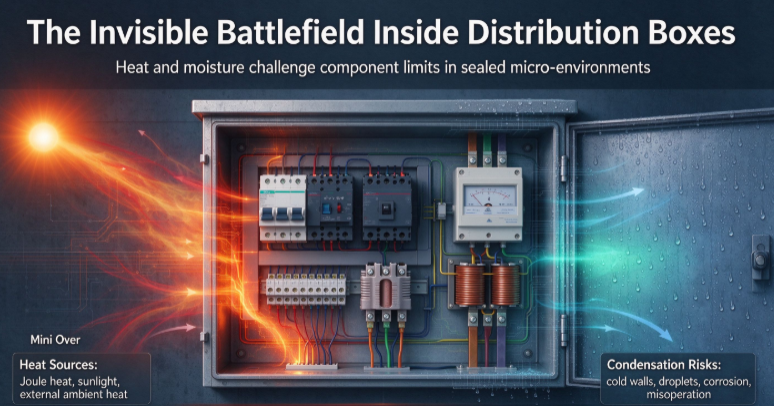

People often overlook environmental control inside distribution boxes, calling it the “invisible battlefield” of electrical equipment.
On the surface, a sealed metal enclosure protects internal circuit breakers, contactors, and terminal blocks.However, heat and moisture constantly challenge component physical limits in this sealed space.
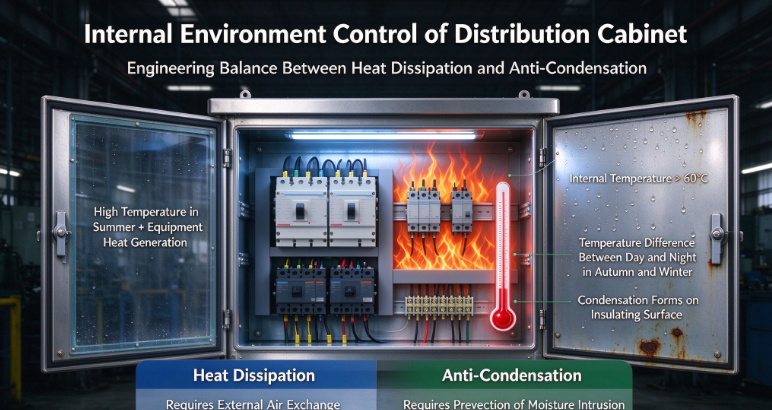
In summer, high temperatures plus operating heat can easily push internal temperatures past 60°C. This far exceeds the 40°C limit for low-voltage appliances.In autumn and winter, day-night temperature differences cause condensation to creep onto insulation surfaces. This creates short-circuit and corrosion risks.
Heat dissipation and anti-condensation are fundamentally competing engineering demands. Heat dissipation requires air exchange with the outside. Anti-condensation requires isolating moisture.Understanding this conflict is the starting point to avoid “overheating downtime” and “condensation short circuits.”
I. Where Does High temperatures Come From: An Underestimated Sealed Space
Distribution box heat sources are not complex, but people often underestimate them.
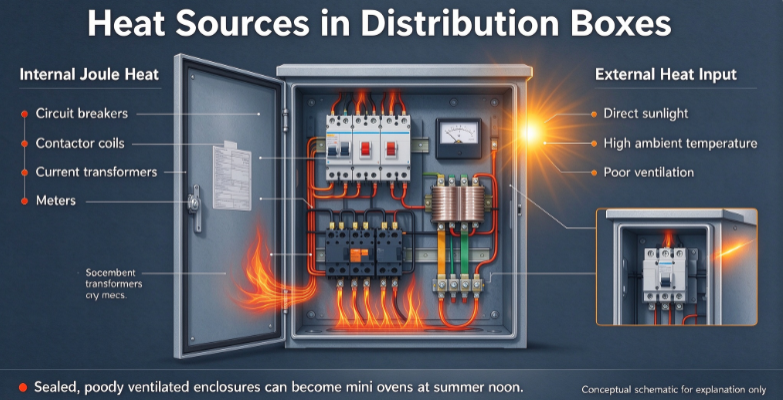
First, internal components generate Joule heat continuously under long-term power. This includes circuit breakers, contactor coils, current transformers, and meters.
Second, external environments input heat. Outdoor boxes face direct sunlight. The surface temperature far exceeds ambient temperature. These two factors combine. A poorly ventilated sealed box becomes a mini “oven” at summer noon.
International Standards clearly define the normal working environment for low-voltage appliances. The upper ambient temperature limit is 40°C. The 24-hour average must not exceed 35°C.However, actual internal temperatures frequently exceed 60°C in outdoor scenarios like rural grid renovations.
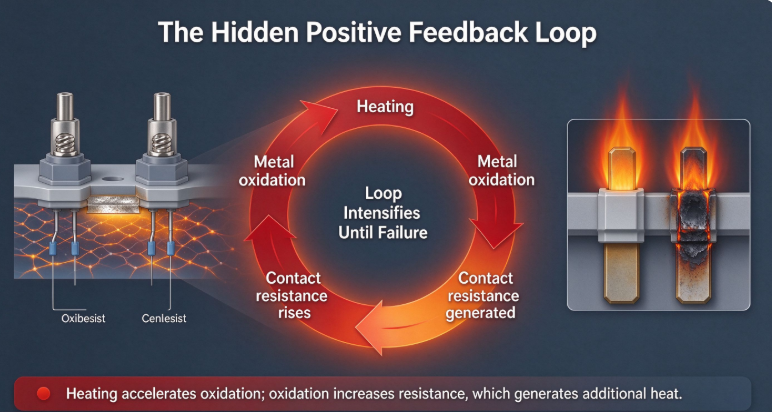
When temperatures cross the threshold, consequences follow in a chain. Insulation materials age faster. Contactor coil resistance drifts, causing unreliable engagement. Electronic trip unit settings shift.A more hidden risk exists. High heat accelerates metal oxidation. Contact resistance rises. This creates a positive feedback loop: “heating—oxidation—resistance increase—more heat.” The loop continues until joints burn out or components fail completely.
II. Choosing a Heat Dissipation Path: From Passive Airflow to Active Heat Exchange
Engineers must design heat dissipation based on protection ratings, installation environments, and heat loads. They cannot simply “drill holes and add fans.”
Natural convection is the most basic and reliable method.
For indoor boxes with low protection requirements, install louvers or vent holes at the top and bottom. Hot air rises, and cold air sinks. This chimney effect creates continuous airflow.This method needs no extra energy, but cooling capacity is limited. Furthermore, holes lower the protection rating.
Forced air cooling is a more active intervention.
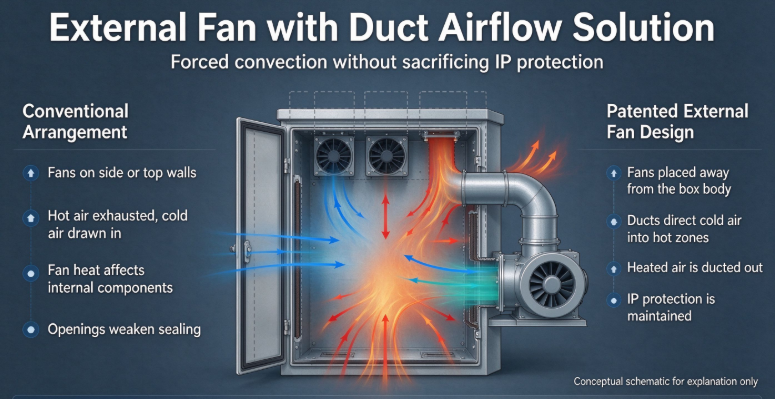
Install exhaust fans on side or top walls. Fans extract hot air while low-level intakes draw in cold air, forming a directed airflow path.In a patented technical solution, engineers deliberately place fans away from the box body. Ducts direct cold air into hot zones and exhaust the heated air.
This design deserves attention. Fans generate their own heat. Fan openings also compromise the sealing structure.Placing the fan externally and using ducts achieves forced convection without sacrificing IP protection.
For high-protection scenarios, heat exchangers are a compromise.
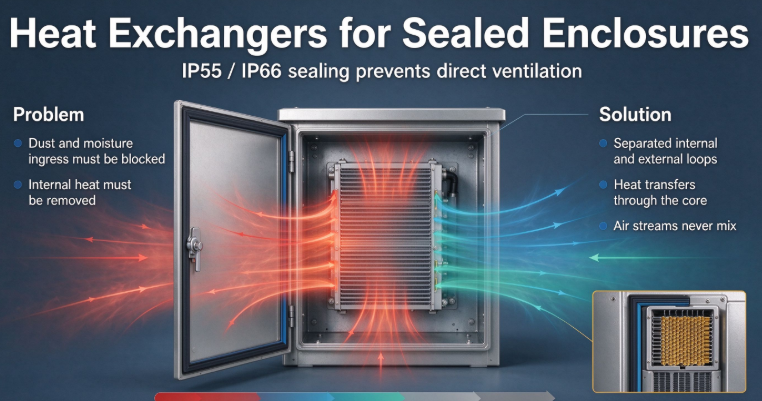
Direct ventilation is impossible when boxes require IP55 or IP66 sealing.
Internal heat exchangers transfer heat through isolated internal and external loops. Internal air passes through the core and transfers heat to external air. The two air streams never touch, completing heat dissipation under sealed conditions.This solution is less efficient than direct ventilation. However, it maintains the box’s isolation against moisture and dust.
III. Causes of Condensation: A Conspiracy of Temperature Difference and Humidity
High temperatures is a visible performance killer. Conversely, condensation is an invisible safety assassin.
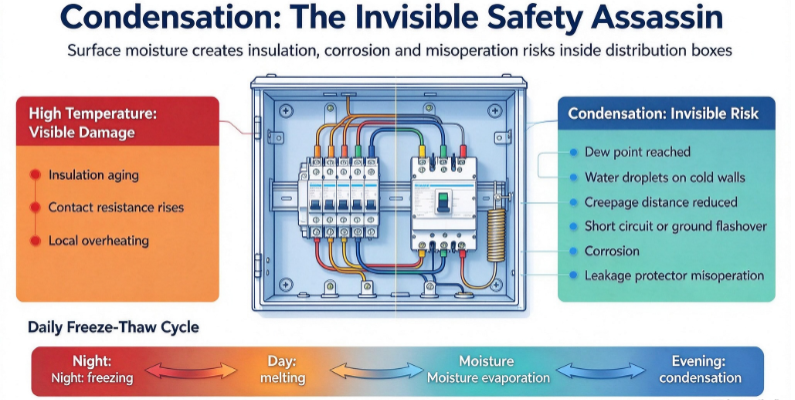
Condensation conditions are not complex. Internal air moisture content stays constant. When a surface temperature drops below the dew point, water vapor precipitates into liquid water on that surface.Distribution boxes frequently create these conditions. Day-night temperature differences cause walls to cool rapidly. Warm, moist internal air touches cold metal inner walls. Water droplets condense on surfaces and components.
The harms of condensation are compound.Condensed water attaches between breaker terminals. This directly shortens the creepage distance and may cause phase-to-phase short circuits or ground flashovers at normal operating voltages.Long-term moisture corrodes metal conductors and spring mechanisms. Increased contact resistance causes local overheating, compounding the high-temperature problem.
More troublesome, leakage current increases in damp environments. Leakage protectors may misinterpret this as real leakage and trip frequently. This affects power continuity and masks the true fault signal.Notably, condensation does not only happen in the rainy season.
Water freezes at night in winter. It melts during the day as temperatures rise, then evaporates into vapor. In the evening, temperatures drop and it condenses again. This daily cycle erodes insulation materials more persistently than one-time flooding.
IV. Engineering Logic of Anti-Condensation: Either Lower Humidity or Raise Temperature
Anti-condensation follows only two core approaches. Keep the internal air dew point below the surface temperature, or keep the surface temperature above the dew point.In engineering practice, the two usually work together.
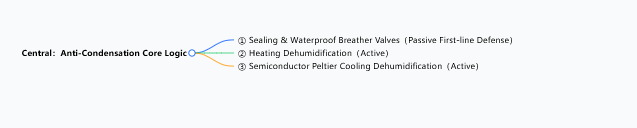
Sealing and breather valves form the first line of defense.
Raising the protection rating to IP54 or above effectively blocks external moisture.However, complete sealing is unrealistic. Temperature changes cause pressure fluctuations. Sealing rings may age under repeated stress.Waterproof breather valves solve this conflict. They allow air molecules to pass and balance pressure differences. Meanwhile, they block liquid water. This prevents the “breathing effect” from inhaling moist air without sacrificing sealing.
Heating dehumidification is the most direct active method.
Install aluminum alloy heaters with temperature and humidity controllers. Heating starts automatically when sensors detect humidity at a threshold (e.g., 85%RH). This raises internal air temperature above the dew point. Water vapor then cannot condense on component surfaces.This solution’s logic is not to “drain water out.” Instead, it is to “keep water in a gaseous state.”
For small boxes with low heat loads, heating dehumidification proves cost-effective and reliable over the long term. It is the most common configuration in humid areas.
Semiconductor cooling dehumidification offers another path.
Unlike heating, thermoelectric dehumidifiers use the Peltier effect. They condense water vapor into liquid water at the cold end. A drain pipe then leads the water outside.The advantage is that it does not raise internal temperature. This suits temperature-sensitive scenarios or where heating might affect component lifespan.
However, dehumidification capacity is limited. It usually suits small boxes or serves as an auxiliary method.
V. Collaborative Design: The Balance Point Between Heat Dissipation and Anti-Condensation
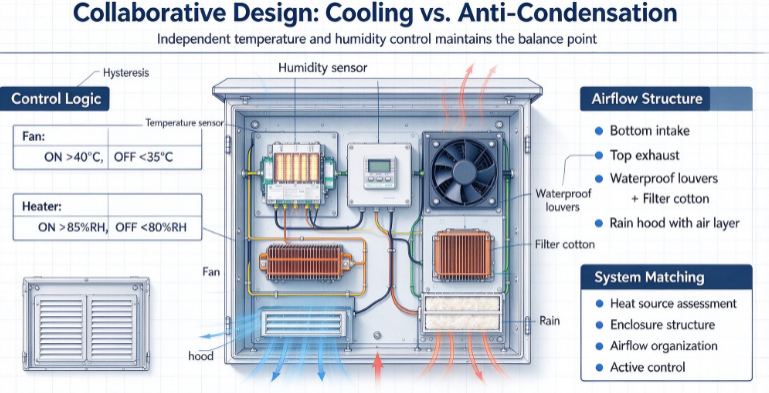
Treating heat dissipation and anti-condensation separately often creates conflicts.Ventilation holes introduce moisture. Over-sealing traps heat.Truly effective solutions make trade-offs under a framework of joint temperature and humidity control.The popularity of smart temperature and humidity controllers makes this collaboration possible.
Here is a common control logic. Fans start when temperature exceeds 40°C and stop below 35°C. Heaters start when humidity exceeds 85%RH and stop below 80%RH.
The two control loops judge independently and execute separately. This avoids single-goal errors like “introducing moisture for cooling” or “overheating for dehumidification.”Setting hysteresis (the difference between start and stop values) prevents frequent device cycling near critical points.
At the structural level, good airflow design balances both needs.Place intakes at the bottom and exhausts at the top. This uses the natural upward flow of hot air to create stable airflow. Install waterproof louvers and filter cotton at bottom intakes. This draws in cold air while intercepting most liquid water and coarse dust.
For outdoor boxes, adding a rain hood on top creates an independent air layer between the interior and exterior. These measures relieve heat loads without sacrificing protection.Ultimately, avoiding “overheating downtime” relies on more than one component’s performance. It depends on system matching across heat source assessment, enclosure structure, airflow organization, and active control strategies.
A distribution box maintains an internal temperature below 45°C at summer noon. It also keeps inner walls dry during the plum rain season. Its value does not lie in the advanced nature of a single technology. Instead, it lies in controlling the conflict between heat dissipation and anti-condensation at an acceptable balance point.
This balance point is the true bottom line for long-term stable operation of electrical equipment.
VI.Conclusion
Ultimately, a distribution box is far more than a simple metal shell. It is a critical micro-environment that requires precise engineering control. Heat dissipation and anti-condensation will always remain competing forces. You cannot fully embrace the outside air without letting moisture in. You cannot seal the box completely without trapping the heat. Therefore, true reliability comes from compromise and intelligent design. By combining smart controllers, structural airflow optimization, and targeted active cooling or heating, engineers can achieve this delicate harmony. When a distribution box stays cool in the summer sun and dry in the winter chill, it fulfills its highest purpose: protecting the electrical system quietly, safely, and continuously.