
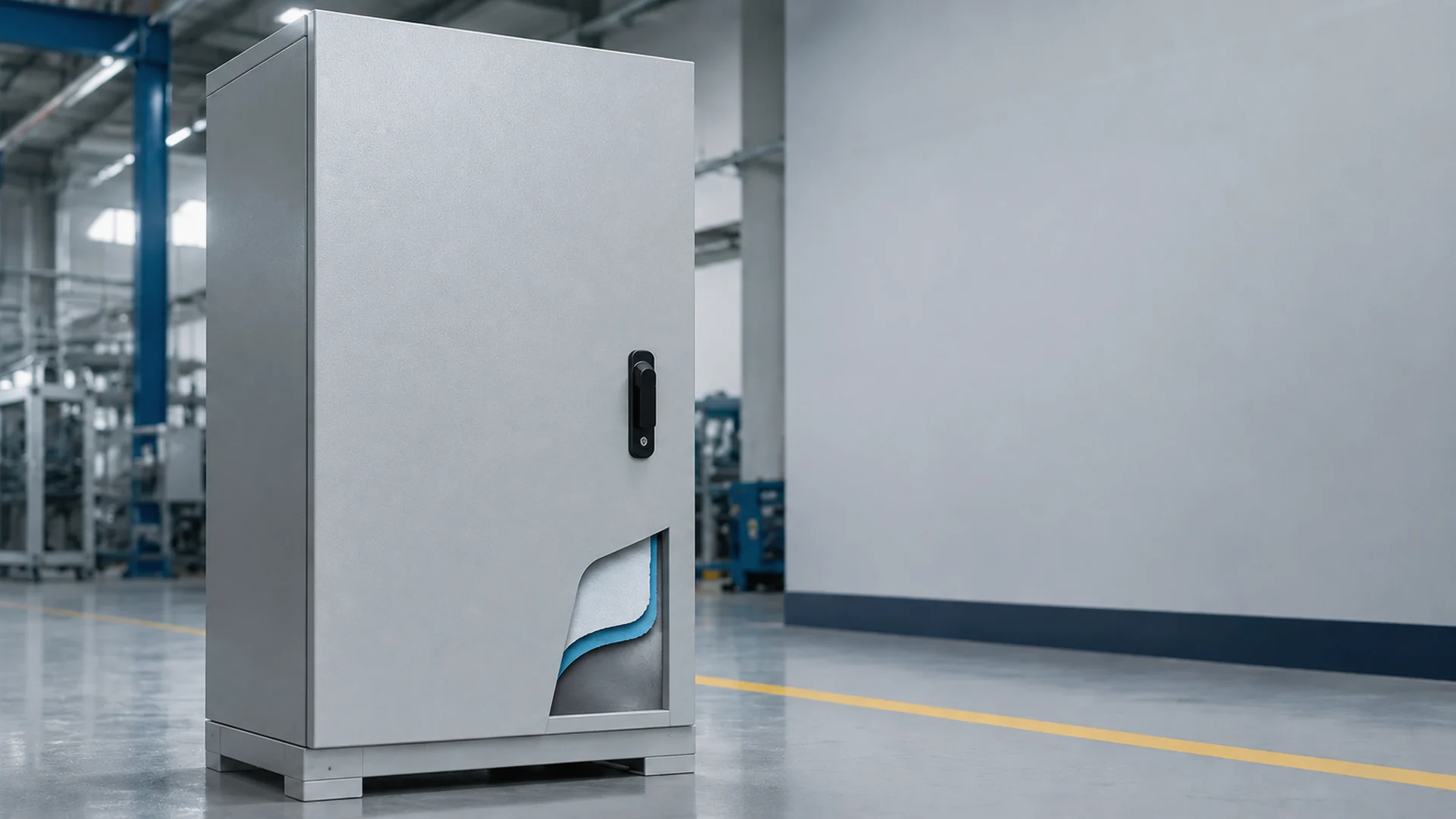

If a coating specification stops at “RAL 7035 polyester powder, 80–100 μm,” it is incomplete.
Quick answer: A powder-coated steel electrical enclosure is a practical option when a project needs fabricated steel, a controlled color or texture, and a coating system matched to the installation environment. The purchase decision should cover the substrate, pretreatment, powder, cure, edge treatment, and inspection—not color and film thickness alone.
Color and film thickness describe the finish you can see. They do not tell you whether oil was removed from the steel, whether laser scale remained around a cutout, whether the conversion coating covered the part evenly, or whether the powder reached its required cure condition.
Those details decide how well the coating stays attached once the enclosure meets condensation, washdown water, scratches, sharp edges, or outdoor humidity.
Our position is simple: pretreatment is part of the enclosure’s corrosion-control system, not a cosmetic extra. If a supplier cannot explain the pretreatment route, you do not yet have enough information to compare coating quotations.
A practical way to check the process is the 4C Pretreatment Check:
| Check | What it covers | What you should ask for |
|---|---|---|
| Clean | Oil, dust, fingerprints, weld residue, laser oxide, and rinse quality | Cleaning method, surface condition before coating, and controls for fabricated areas |
| Convert | Iron phosphate, zinc phosphate, zirconium/thin-film treatment, or another defined route | Chemistry family, substrate compatibility, process stages, and intended exposure |
| Cure | Powder manufacturer’s time-and-temperature requirement | Powder data sheet and the method used to verify part-metal temperature |
| Confirm | Adhesion, film thickness, appearance, edges, cutouts, masking, and test evidence | Inspection records, acceptance criteria, and project-specific test reports when required |
This check does not require you to become a coating chemist. It gives you four clear subjects to discuss before the first enclosure enters production.
When is a powder-coated steel electrical enclosure the right choice?
Powder-coated steel often fits indoor and general industrial projects that need a fabricated enclosure, a controlled color or texture, and a practical route to custom cutouts, mounting details, and assembly. The coating system still has to match humidity, condensation, washdown, chemicals, and maintenance access.
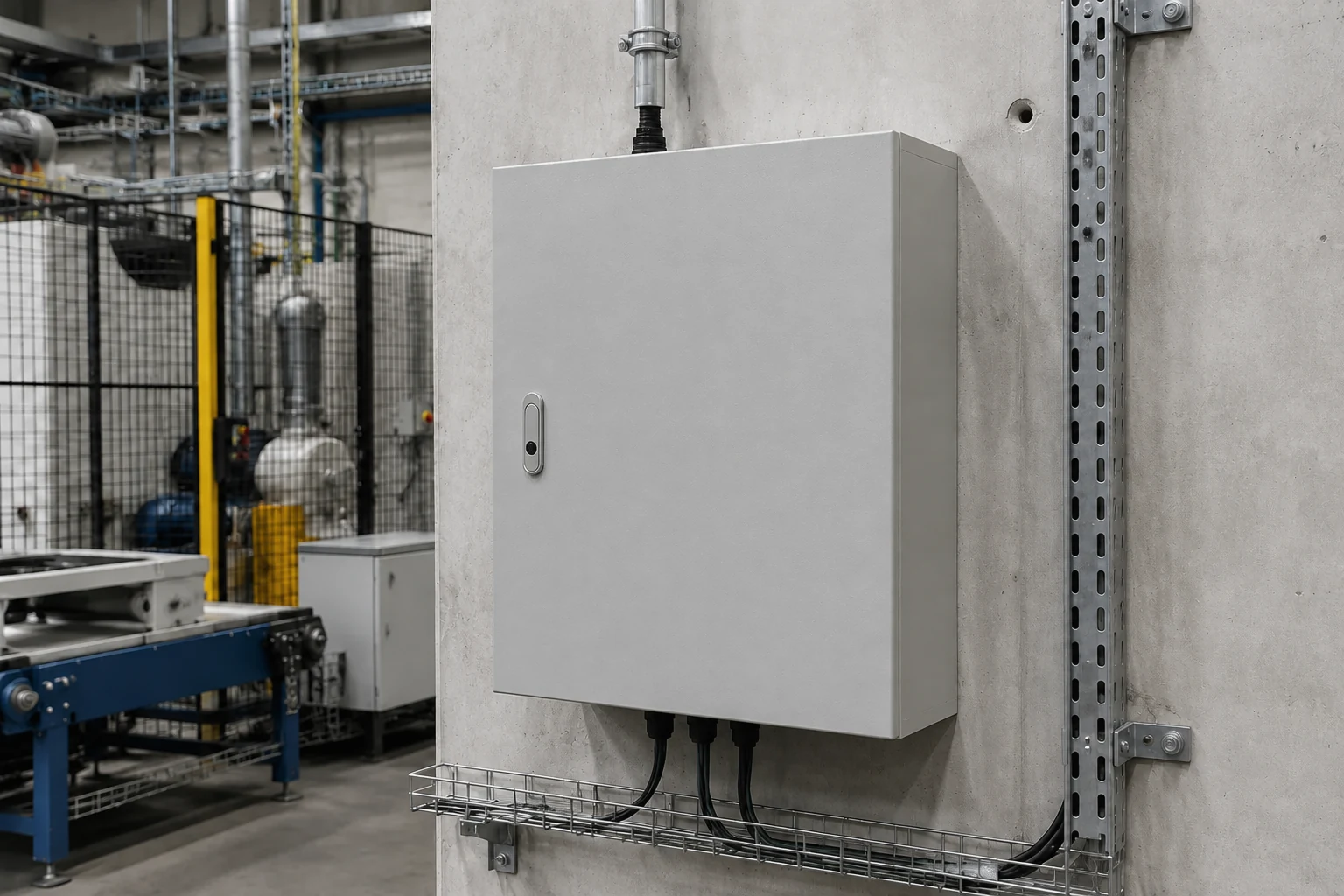
For severe coastal, chemical, or continuously wet exposure, review the substrate before asking the powder to carry the whole corrosion risk. Galvanized steel, stainless steel, aluminum, or a zinc-plus-powder system may be more appropriate. Use our guide to compare galvanized and powder-coated steel enclosure finishes before locking the material.
The purpose of this article is narrower: once powder-coated steel is a realistic option, it shows you how to verify cleaning, conversion treatment, cure, geometry, inspection, and RFQ evidence.
Why a good-looking enclosure can still fail early
Picture a new cabinet door. The surface is smooth, the color is even, and the film-thickness reading is within the specified range.
Now look at the lower door edge, a cable-entry cutout, or the area beside a weld. If contamination or oxide remained under the coating, that spot becomes the weak point. A chip or thin edge lets moisture reach the steel. Rust then develops at the steel–coating interface and can spread under film that still looks intact a few millimeters away.
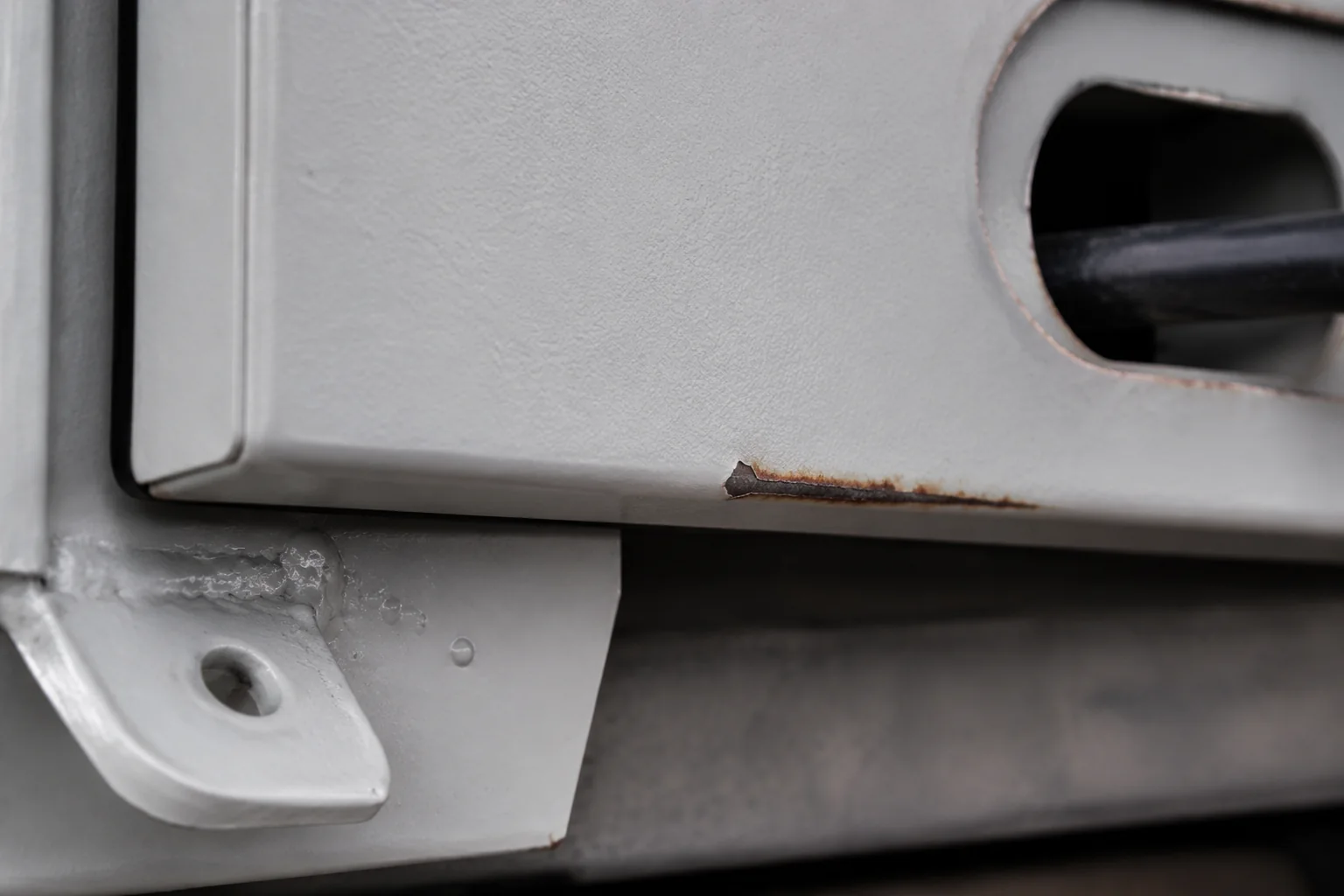
That is why coating problems often appear first as:
- rust creeping from a cut edge;
- bubbles around a seam or welded bracket;
- peeling near a handle, hinge, or mounting point;
- loss of adhesion around oily or poorly rinsed areas;
- early corrosion on the lower edge where water sits after washdown.
Adding more powder is not the first fix. A thicker topcoat over a poorly prepared surface simply hides the same weak interface under more material.
What a sound pretreatment sequence looks like
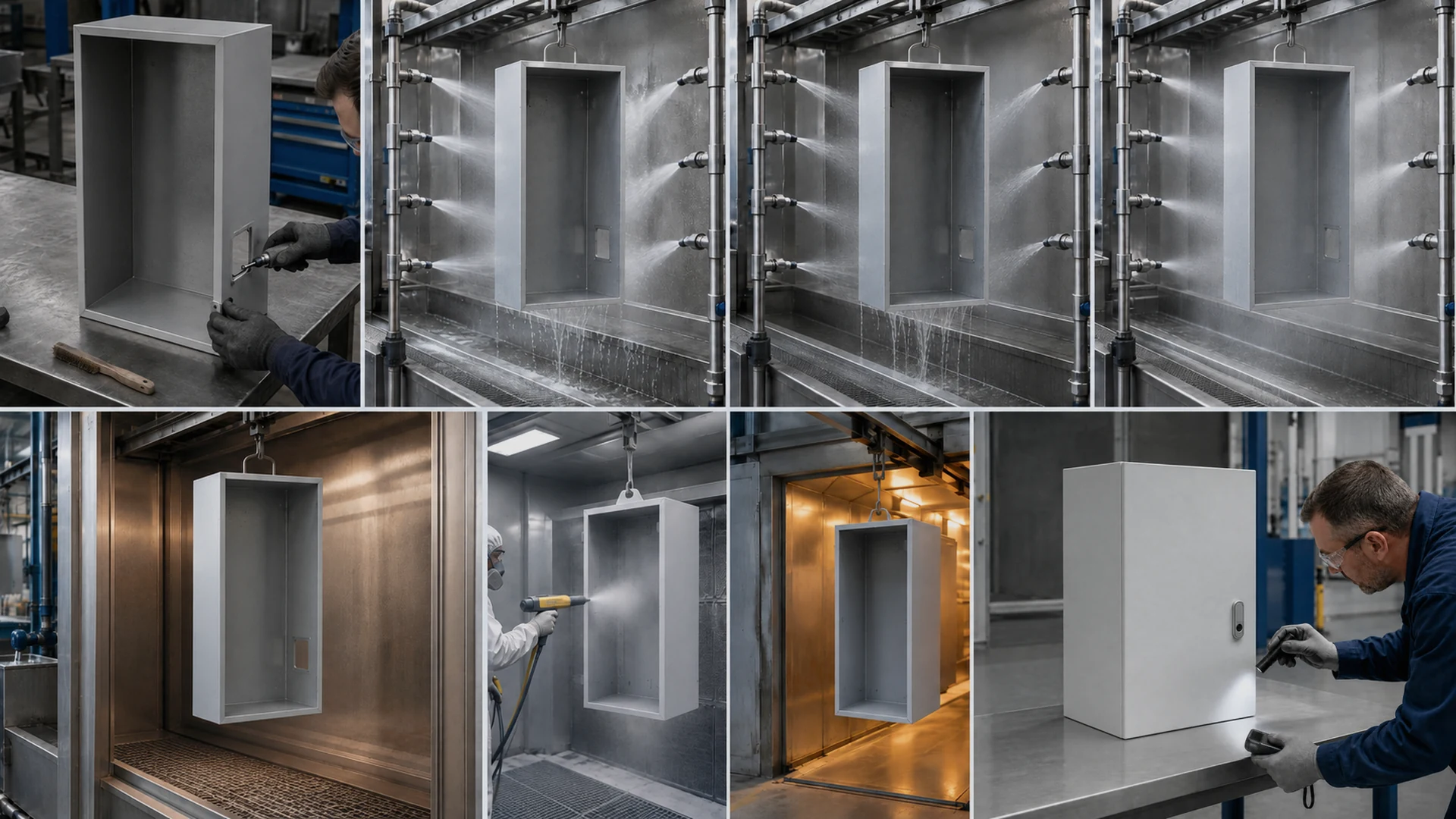
The exact line depends on the substrate, chemistry, production volume, environmental controls, and required performance. Still, a controlled process normally follows the same logic.
1. Prepare the fabricated part
Pretreatment begins before the washer.
Burrs, weld spatter, laser-cut oxide, heavy scale, and sharp projections can interfere with cleaning and leave thin or poorly bonded areas. Drainage also matters. A folded channel that traps cleaning solution can carry contamination into later stages.
Before coating, review:
- laser-cut and plasma-cut edges;
- welded seams and heat-affected areas;
- ground repairs;
- folded hems and water traps;
- threaded holes and grounding points;
- cutouts added after the main fabrication stage.
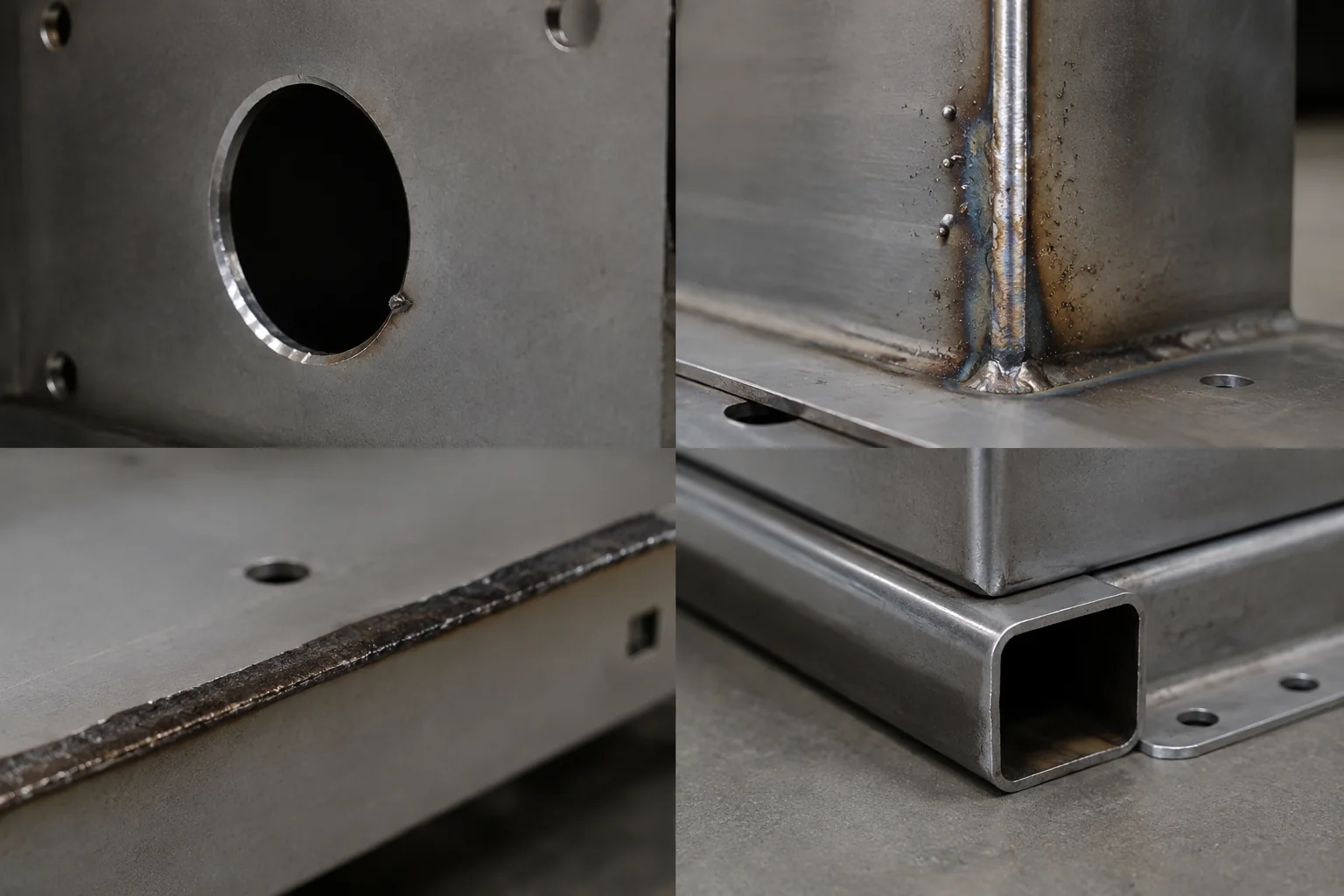
This is where enclosure design and finishing meet. A coating line cannot reliably correct geometry that traps liquid or hides contamination.
2. Remove oil and shop contamination
Sheet steel collects forming lubricant, fingerprints, dust, marking residue, and particles during cutting, bending, welding, and handling.
Cleaning must remove that contamination without leaving a new residue. If water beads or pulls away from parts of the surface, the steel may not be uniformly clean. A water-break-free surface is a useful process check, although the acceptance method should match the supplier’s documented procedure.
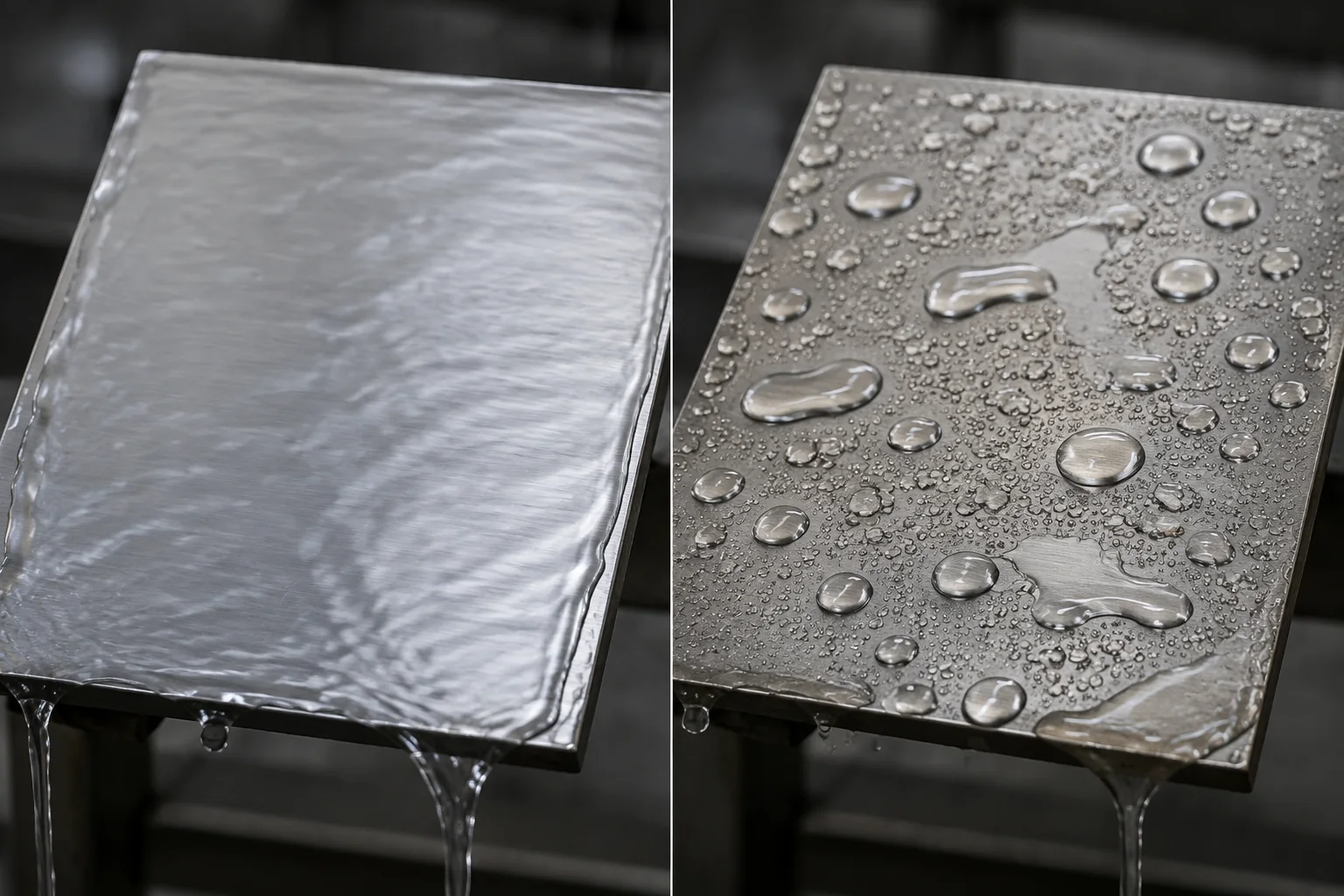
Do not ask only, “Do you clean the parts?” Ask what the cleaner must remove and how the line confirms that the surface is ready for the next stage.
3. Rinse without carrying contamination forward
A rinse is not an empty stage between cleaning and conversion coating. It stops cleaner carryover from disturbing the next bath.
Poor rinsing can leave alkaline residue, dissolved salts, or contaminated water on the steel. Those residues sit exactly where you do not want them: under the conversion layer and powder film.
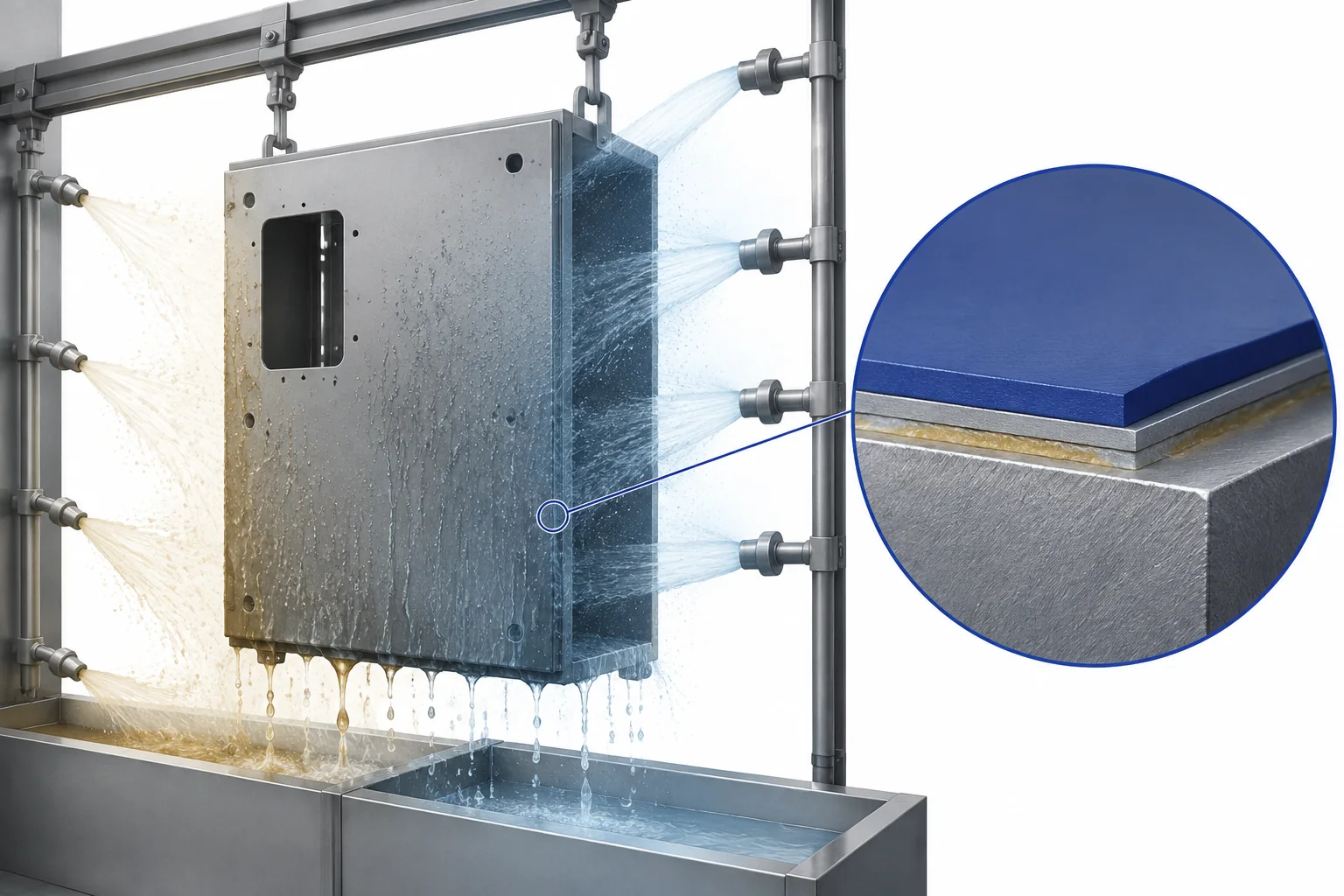
For demanding work, ask how the supplier controls rinse-water quality, overflow, replacement, conductivity, and final drying. The useful answer is a process control, not “we rinse every part.”
4. Apply the conversion treatment
The conversion layer improves the surface condition for coating adhesion and corrosion resistance. Common routes for steel include iron phosphate, zinc phosphate, and zirconium or other thin-film systems.
The chemistry name alone is not enough. Bath condition, concentration, temperature, contact time, water quality, part cleanliness, and rinse control all affect the result.
A well-run iron-phosphate line can outperform a poorly controlled “premium” chemistry. Process control comes before marketing labels.
5. Dry the part completely
Water left in seams, hems, threaded areas, or folded channels can create staining, flash rust, outgassing, or adhesion problems.
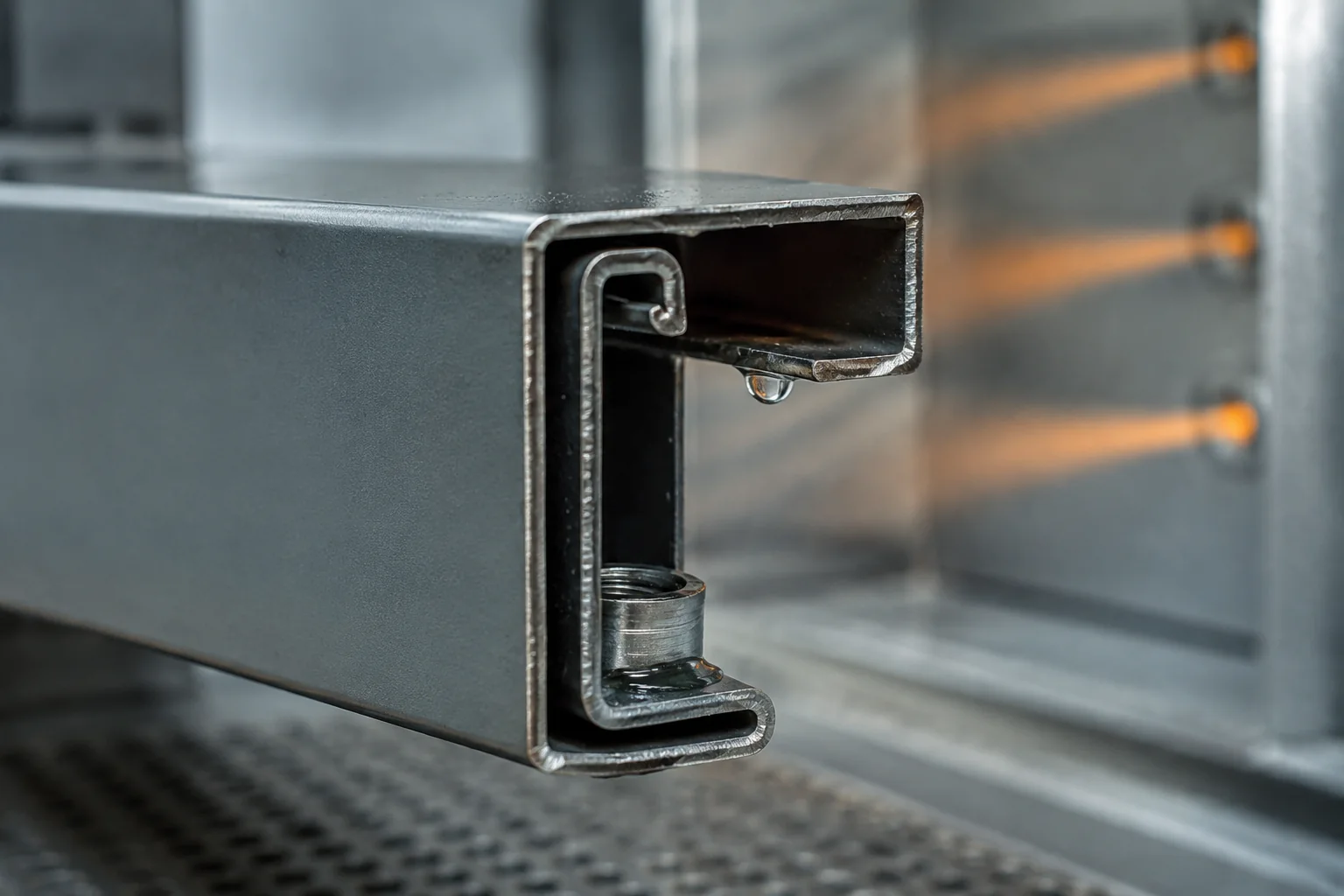
The enclosure should enter powder application dry and free from new contamination. That includes contamination introduced after pretreatment through gloves, hooks, storage, or excessive waiting time.
6. Apply and cure the powder
Powder type, film build, electrostatic settings, grounding, gun position, part geometry, and line speed affect coverage. Cure then converts the deposited powder into the final coating film.
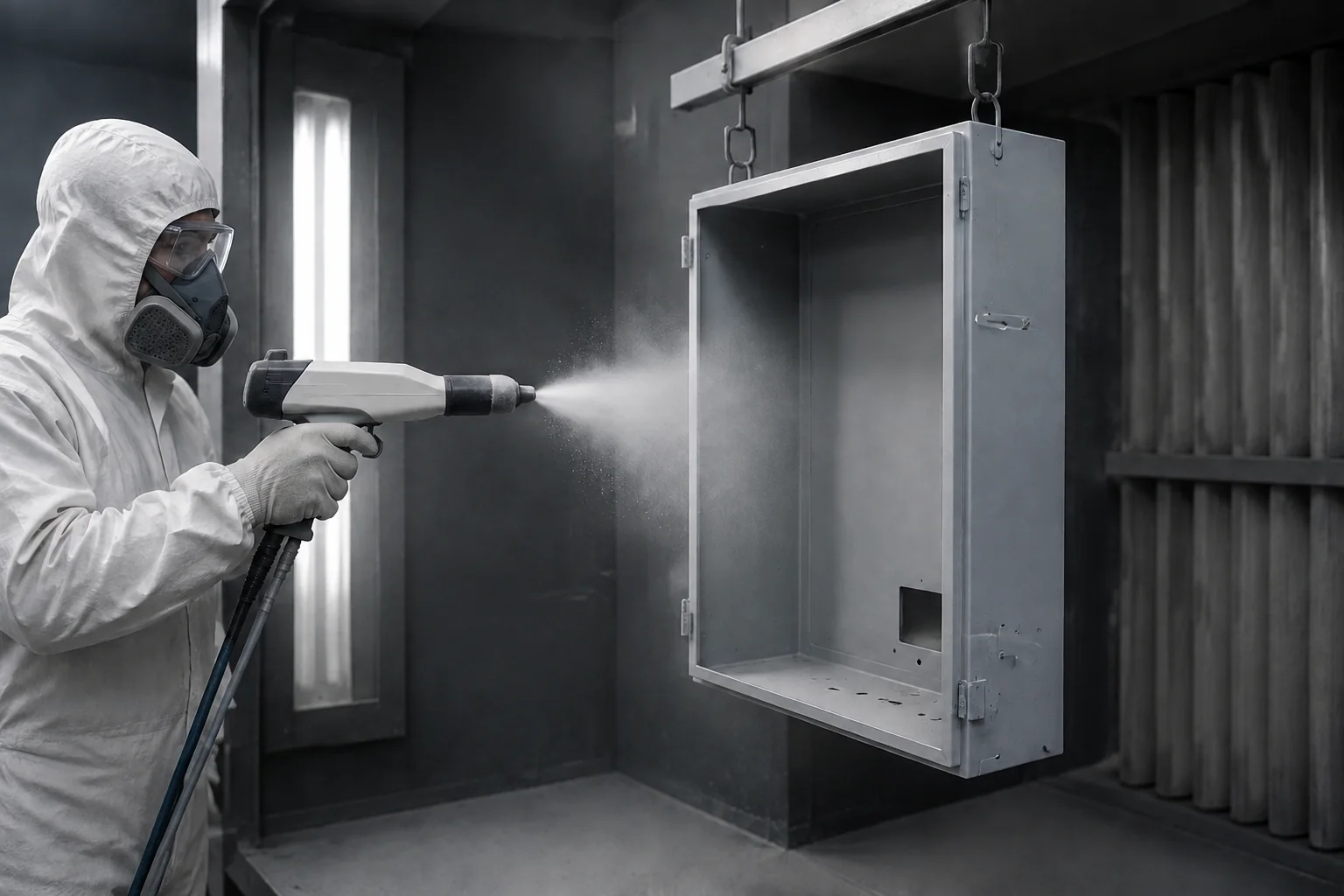
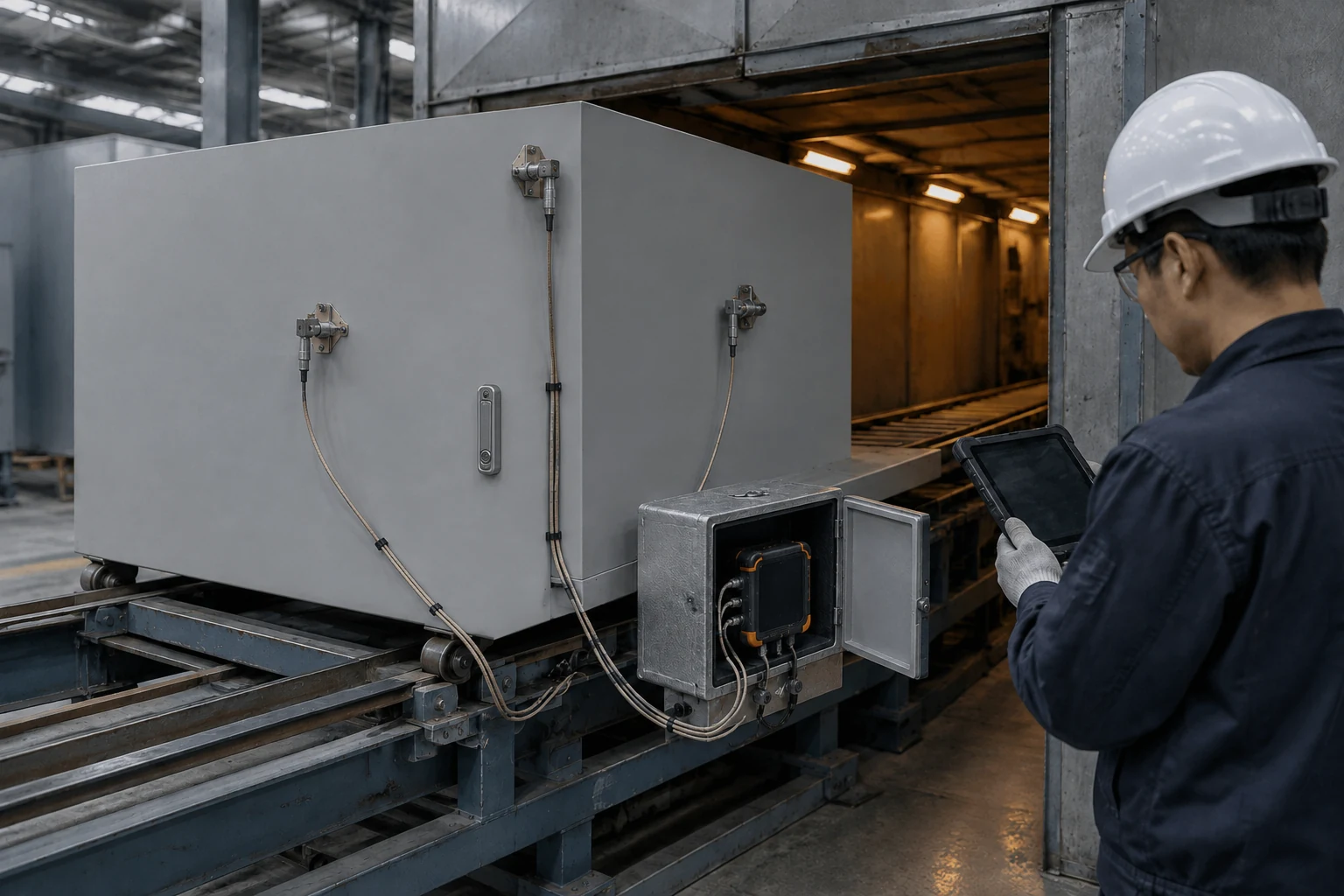
The useful cure question is not, “What is the oven temperature?” It is, “How do you confirm that the metal reaches the powder manufacturer’s required cure condition?”
Air temperature and part-metal temperature are not the same. A heavy backplate and a thin door can heat at different rates even when they travel through the same oven.
7. Inspect the complete enclosure, not only a flat panel
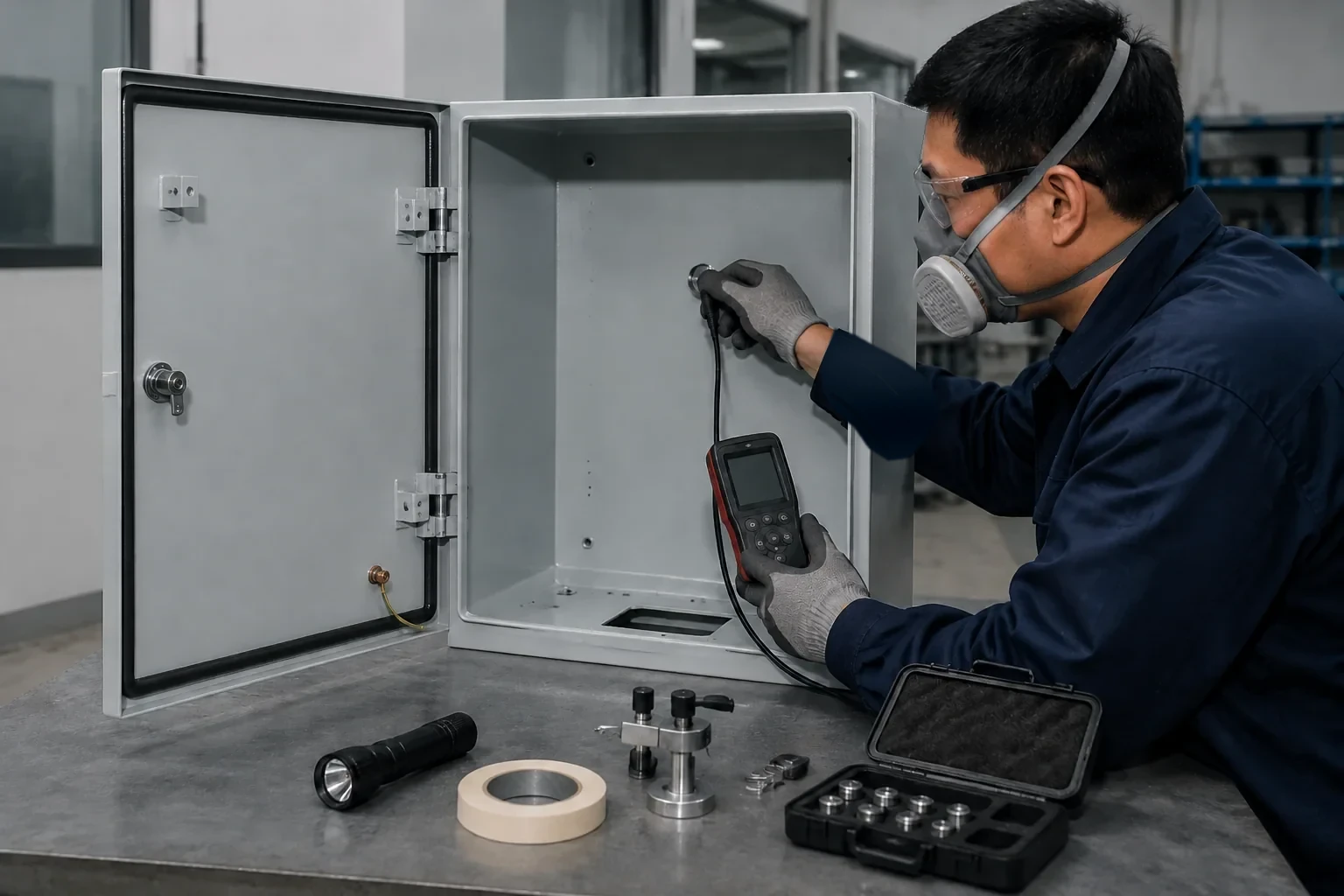
Flat test panels are useful for process comparison, but enclosure geometry creates its own risks.
Inspection should include:
- external corners and lower door edges;
- cable-entry and ventilation cutouts;
- welds, ground areas, and repaired surfaces;
- hinge, latch, and handle interfaces;
- masked grounding studs and threaded holes;
- seams that can retain water;
- visible contamination, craters, pinholes, bubbles, and bare spots.
The part most likely to fail is rarely the broad, easy-to-spray center of the door.
Iron phosphate, zinc phosphate, or zirconium: which route fits the job?
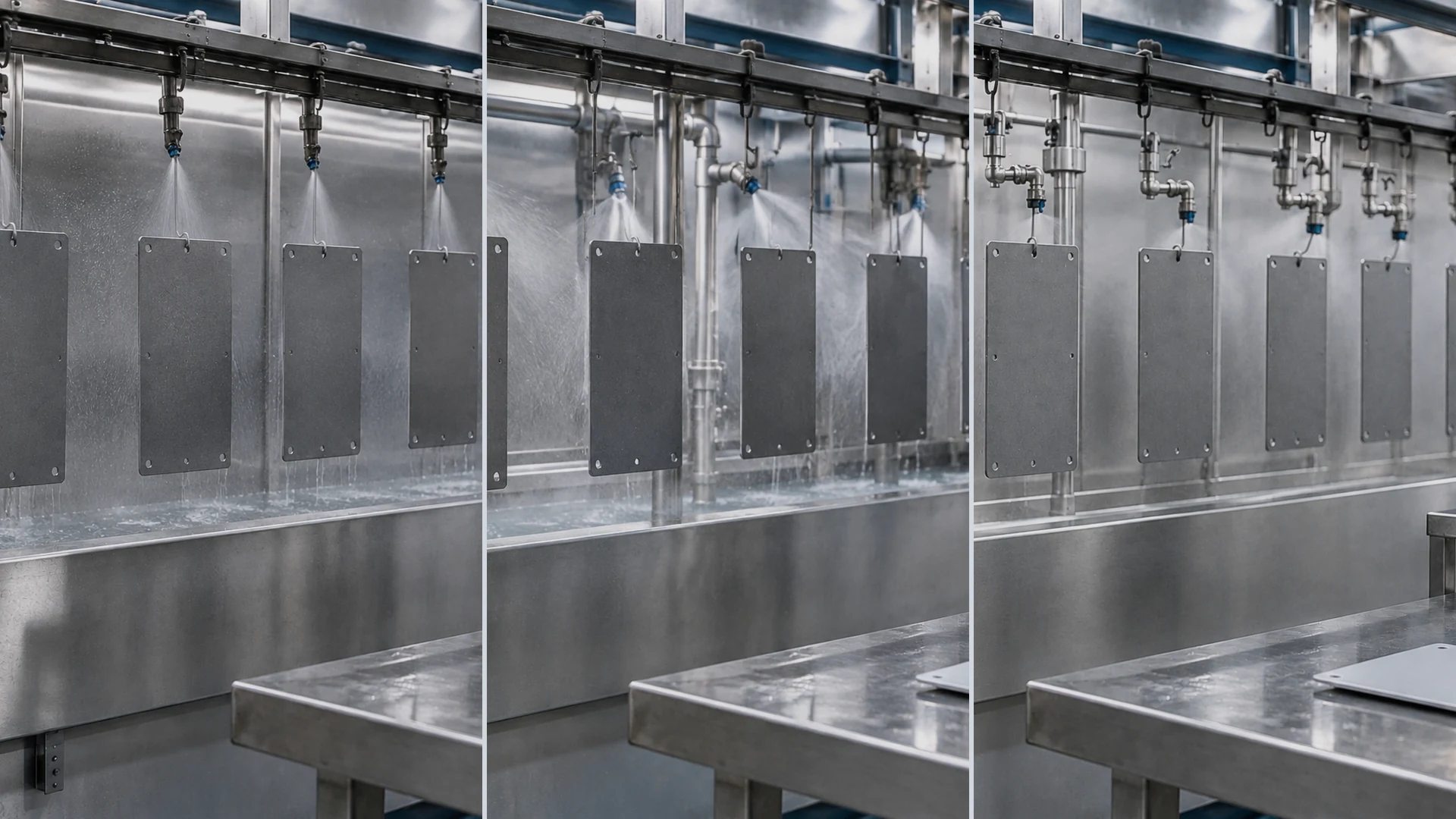
There is no useful “best pretreatment” without an exposure condition and a complete coating system.
| Pretreatment route | Where it often fits | What to examine before approval |
|---|---|---|
| Iron phosphate | Indoor and general industrial steel applications with moderate corrosion demands | Cleaning quality, coating consistency, rinse control, powder system, and project test requirement |
| Zinc phosphate | More demanding corrosion-control systems and applications that justify a heavier crystalline conversion layer | Number of stages, sludge and bath control, substrate mix, system cost, and verified performance with the selected powder |
| Zirconium or other thin-film treatment | Multi-metal lines, lower-temperature processes, and systems designed around modern thin-film chemistry | Water quality, bath control, coating compatibility, supplier experience, and evidence from the actual system |
| Mechanical preparation plus a defined coating system | Heavy scale, weld cleanup, repair work, or parts that need abrasive preparation | Surface profile, dust removal, time before coating, inaccessible areas, and whether a conversion stage is still required |
For chemistry details, compare the supplier’s production data with Henkel’s iron-phosphating overview, TIGER’s pretreatment guide, and published zinc-phosphate corrosion research.
Not sure which route belongs in the RFQ?
Send the substrate, installation environment, enclosure dimensions, cutouts, finish requirement, and quantity. Those six inputs are enough to identify the coating decisions that still need to be defined before quotation.
Do not select the chemistry from a table alone. Start with the enclosure’s environment, substrate, fabrication method, expected maintenance, and corrosion requirement. Then ask the finisher to define the complete route.
For sheltered indoor equipment, a controlled iron-phosphate system may be entirely appropriate. For outdoor, coastal, washdown, chemical, or high-condensation service, the decision may extend beyond pretreatment to galvanized steel, stainless steel, aluminum, a primer-plus-powder system, or another material and coating combination.
If the project is exposed to salt or aggressive chemicals, review our guides to corrosion-resistant electrical enclosures for coastal environments and 304 vs 316 stainless steel electrical enclosures.
Enclosure details that deserve extra attention
A coating specification is applied to a three-dimensional fabricated part, not an ideal laboratory rectangle.
Sharp edges and cutouts
Powder can build differently at corners and complex edges. A freshly cut hole may also carry burrs, oxide, or handling contamination.
Define whether cutouts are made before coating. If field cutouts are unavoidable, include an approved edge-repair method rather than leaving exposed steel around cable entries.
Welds and ground areas
Welding changes the local surface. Spatter, soot, oxide, grinding marks, and crevices can remain beside an otherwise clean sheet.
The drawing or inspection plan should identify visible weld quality, cleanup expectations, and any areas where grinding must not weaken the joint or distort the panel.
Grounding points and masked threads
Electrical bonding points often need bare conductive contact. Threads may also need masking to maintain fit.
These exposed areas should be intentional, limited, and protected by the final assembly design. Random bare steel is a defect; a controlled grounding point is a functional feature.
Seams and water traps
A horizontal hem or deep folded channel can hold rinse water during production and rain or wash water in service.
If water can sit against an edge, the design deserves review before the coating specification is finalized. Drainage and orientation often solve more than another line of paint wording.
Outdoor use changes the questions
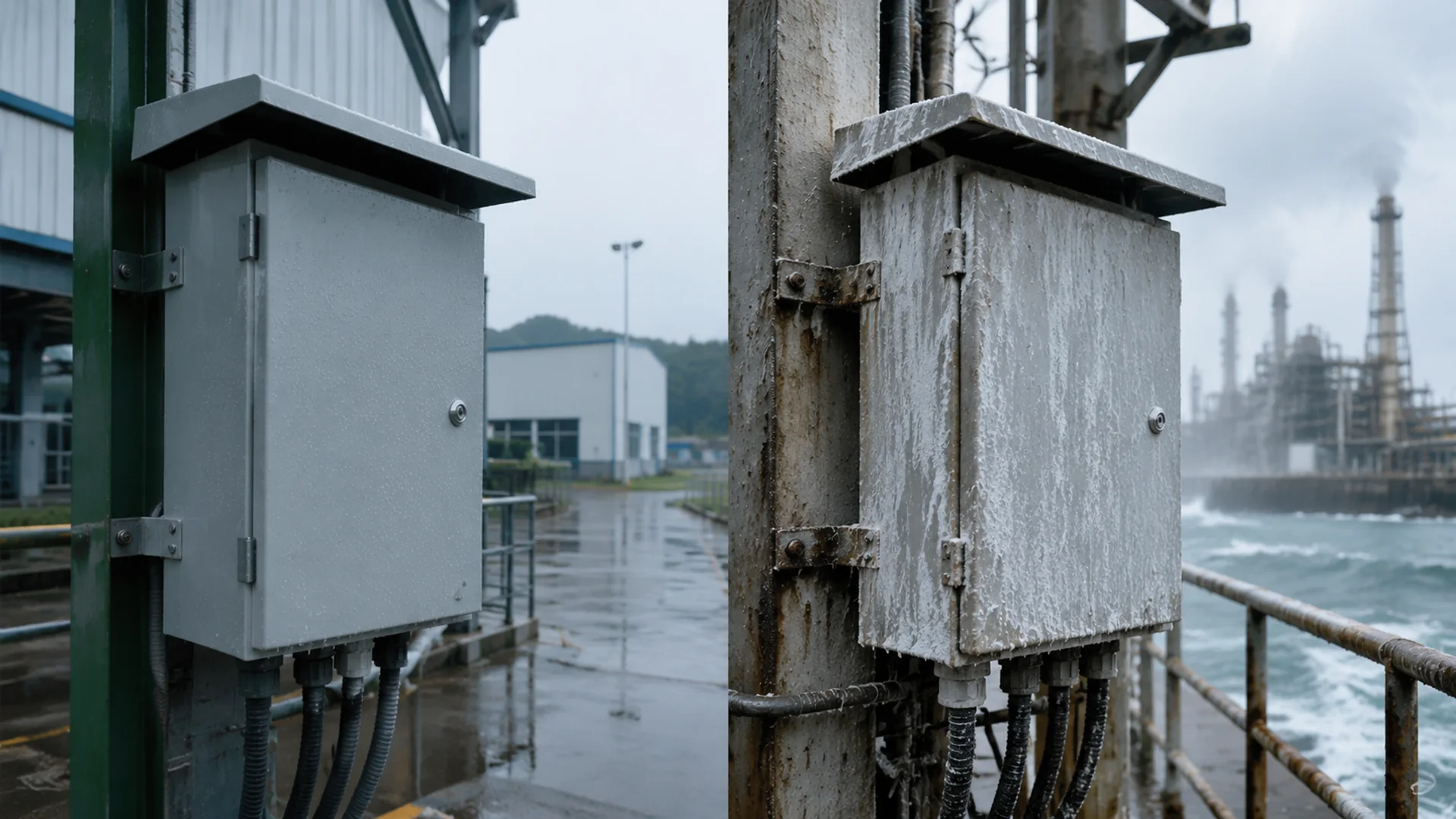
“Outdoor” is not a single exposure category.
A cabinet under a canopy in a dry inland site faces a different coating load from a roadside telecom enclosure, a coastal solar cabinet, or equipment washed with alkaline cleaner every day.
Before choosing powder-coated steel, define:
- Is the enclosure directly exposed to rain or sheltered?
- Will condensation form inside or on the steel surface?
- Are chlorides, fertilizer, cleaning chemicals, process fumes, or road salt present?
- Will water collect on lower edges, roofs, or mounting channels?
- Can scratches be inspected and repaired during service?
- What service interval and appearance expectation does the project have?
Use the answers to choose the substrate and coating system. Powder-coated mild steel remains a practical option for many controlled environments. Where exposure is severe or maintenance access is poor, spending more on the substrate can be more effective than asking a basic coating system to carry the whole corrosion risk.
For project-specific construction choices, see outdoor electrical enclosures and the outdoor electrical enclosure design checklist.
How to read coating test evidence
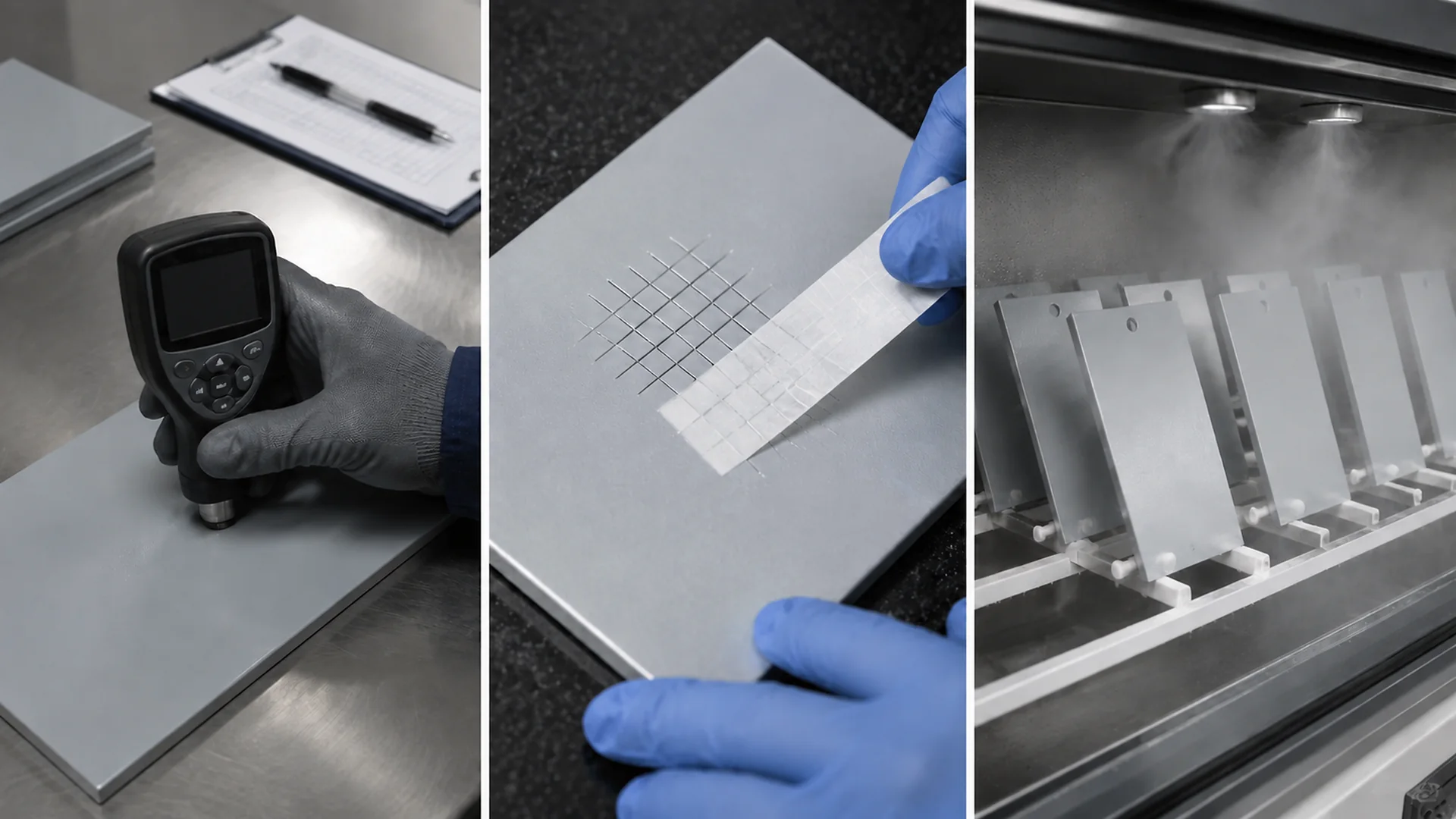
Test reports are useful when you know exactly what was tested.
Film thickness
Film thickness helps confirm application consistency and compliance with the selected powder system. It does not describe surface cleanliness, conversion-coating quality, cure, or edge preparation.
Record where readings are taken. A good average on broad flat surfaces can miss a thin lower edge or difficult corner.
Adhesion testing
Cross-cut or tape adhesion methods, such as ASTM D3359, can show whether a coating remains attached after a defined cut-and-tape procedure.
Ask for the test method, substrate, pretreatment, powder, cure condition, and acceptance rating. “Adhesion passed” is too vague to compare suppliers.
Salt-spray testing
ASTM B117 defines a controlled salt-fog exposure practice. Use the result to compare defined coating systems under the same test conditions.
Do not convert 500 or 1,000 test hours into a fixed number of outdoor service years. Real service includes changing wet and dry periods, sunlight, temperature, pollutants, scratches, geometry, maintenance, and installation details. ISO 12944-6 likewise places laboratory testing inside a broader corrosion-protection and durability-planning system rather than a universal hour-to-year conversion.
When reviewing a report, ask:
- Was the specimen a flat panel or a fabricated enclosure?
- Was the panel scribed?
- What steel and pretreatment were used?
- Which powder product and film thickness were tested?
- How was corrosion around the scribe evaluated?
- Does the tested system match the quoted production system?
A test report becomes useful when it connects to your actual specification.
Enclosure ratings
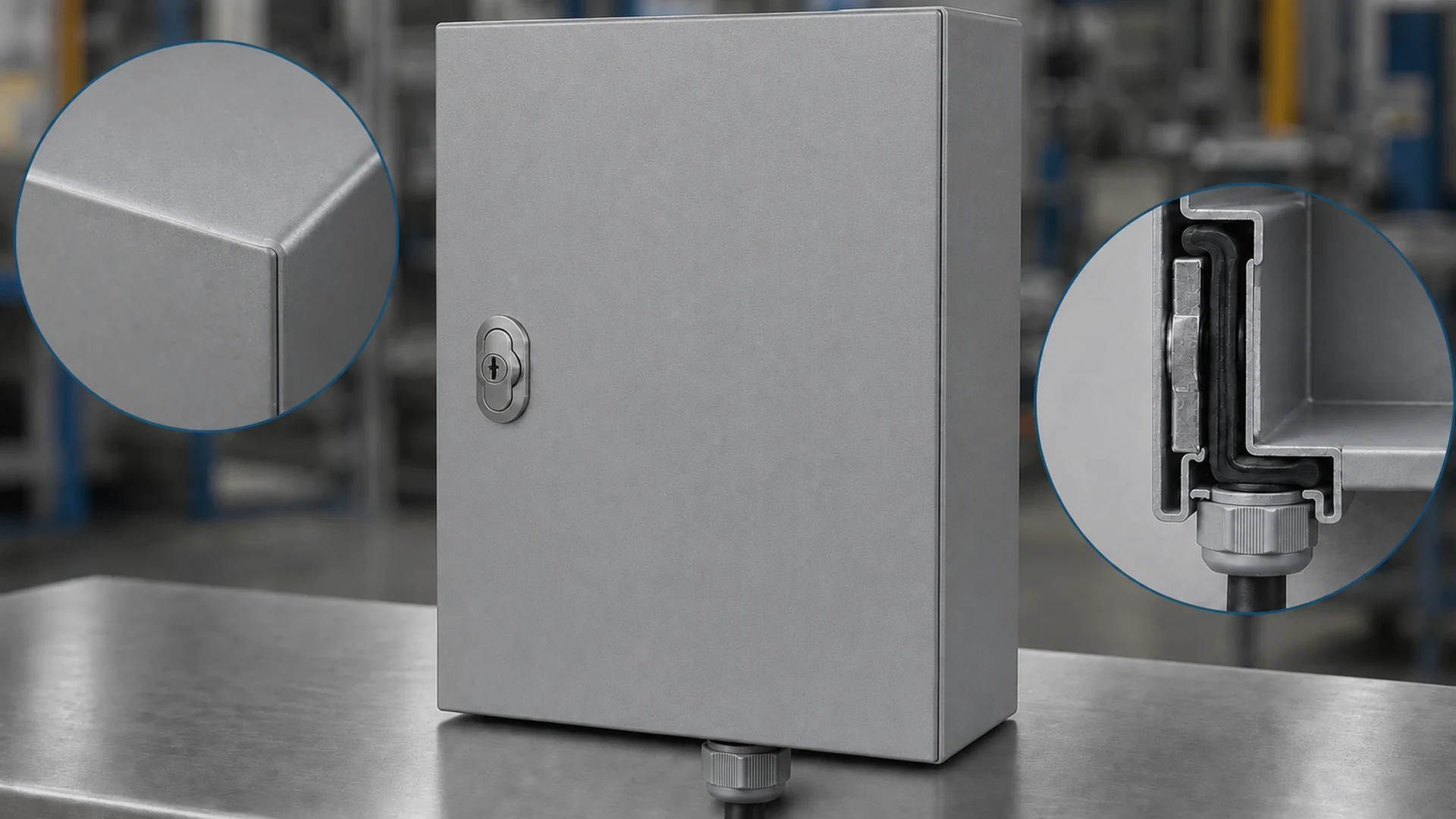
Use IP or NEMA enclosure ratings to discuss ingress protection and enclosure construction. Use the coating specification and corrosion evidence to discuss the finish.
Keeping those two subjects separate makes the RFQ clearer. A well-pretreated coating does not close an unsealed cable entry, and a well-designed gasket does not correct contamination under the powder film. NEMA’s enclosure-type guidance treats environmental protection as a complete-enclosure classification, not a coating description.
What to put in the RFQ or drawing
You can copy this structure into an RFQ and adjust it with the coating supplier:
Substrate: Specify steel grade or approved material.
Fabricated surface condition: Remove oil, dust, burrs, loose scale, weld spatter, and coating-interfering residue. Define the treatment of laser-cut edges, welds, and ground areas.
Pretreatment: State the approved chemistry family or required performance route. Require a controlled cleaning, rinsing, conversion, and drying process compatible with the substrate and powder system.
Powder system: Identify manufacturer/product family when project-controlled, resin type, color, gloss or texture, and intended exposure.
Film thickness: State the agreed target range and measurement method, including critical edges or difficult geometry when applicable.
Cure: Follow the powder manufacturer’s specified cure window and verify using part-metal temperature or an agreed equivalent control.
Masking and contact points: Mark grounding studs, threads, gasket lands, hardware interfaces, and other no-coat areas on the drawing.
Inspection: Define appearance, adhesion, thickness, cure, edge coverage, repair, and documentation requirements.
Packing and handling: Prevent metal-to-metal abrasion, trapped moisture, and damage to coated edges during transport.
This wording gives engineering, purchasing, fabrication, and the coating supplier the same checklist. It also exposes missing decisions while changes are still inexpensive.

Seven questions to ask the enclosure supplier
- What must be removed from the fabricated steel before conversion treatment?
- Which pretreatment chemistry will be used, and why does it fit this exposure?
- How are rinse-water quality and bath condition controlled?
- How are laser-cut edges, welds, hems, and trapped-water areas handled?
- How is cure confirmed on the actual part, not only by oven setpoint?
- Which surfaces are masked, and how are exposed contact points protected by the assembly?
- What inspection or test evidence will accompany this project?
A supplier does not need to hand over every confidential process setting. They should be able to explain the route, the control points, and the evidence you will receive.
The purchasing decision in one sentence
Buy the coating system, not the color sample.
A useful quotation connects substrate, fabricated surface condition, pretreatment, powder, cure, geometry, inspection, and service environment. If one of those links is missing, clarify it before comparing price.
If you are developing a custom electrical enclosure from drawings, send the material, dimensions, cutouts, installation environment, finish requirement, and order quantity with the RFQ. That information lets the manufacturing route be reviewed before the finish is locked in. Send the project details when the drawing package is ready.
Frequently asked questions
Can steel be powder coated without chemical pretreatment?
It can be coated after other forms of surface preparation, but the correct route depends on the steel condition and the required corrosion performance. For repeat production, define the complete preparation and coating system instead of approving powder application as a standalone step.
Is zinc phosphate always better than iron phosphate?
No single chemistry wins every project. Zinc phosphate may support more demanding corrosion systems, while iron phosphate can suit many indoor and general industrial applications. Compare the complete system, process control, cost, waste treatment, and verified performance.
Does a thicker powder film solve poor pretreatment?
No. Thickness cannot remove oil, oxide, salts, or weak residue from the steel–coating interface. Correct the surface-preparation problem first.
Does pretreatment determine an IP65 or IP66 rating?
Pretreatment supports coating adhesion and corrosion control. IP65 and IP66 depend on the complete enclosure design, including seams, doors, gaskets, cable entries, hardware, assembly, and validation. See the project pages for IP65 electrical enclosures and IP66 electrical enclosures.
What evidence should I request?
Request the pretreatment and powder-system description, powder technical data, film-thickness records, cure-control method, visual inspection criteria, and any adhesion or corrosion report required by the project. Make sure the tested substrate and process match the quoted production route.
References
- ASTM International, ASTM D3359 — Standard Test Methods for Rating Adhesion by Tape Test: https://store.astm.org/standards/d3359
- ASTM International, ASTM B117 — Standard Practice for Operating Salt Spray (Fog) Apparatus: https://store.astm.org/standards/b117
- International Organization for Standardization, ISO 12944-6 — Laboratory performance test methods and the ISO 12944 corrosion-protection series: https://www.iso.org/standard/51378.html
- National Electrical Manufacturers Association, NEMA Enclosure Types: https://www.nema.org/docs/default-source/products-document-library/nema-enclosure-types.pdf
- Henkel, Iron phosphating: https://next.henkel-adhesives.com/nz/en/articles/iron-phosphating.html
- TIGER Coatings, Powder Coating Pretreatment: A Complete Guide: https://www.tiger-coatings.com/in-en/about/tiger-blog/powder-coating-pretreatment-a-complete-guide
- Coatings (MDPI), A Comparative Study on the Anti-Corrosive Performance of Zinc Phosphate in Powder Coatings: https://www.mdpi.com/2079-6412/12/2/217