


Electrical enclosures form the first line of defense for equipment. They go far beyond simple “metal boxes for housing electrical components”—in outdoor environments with salt fog, high coastal humidity, chemical corrosion, and wide day-night temperature swings, the enclosure material directly shapes the service life of your entire power distribution system and drives its failure rate.
Pick the wrong material, and you may deal with minor issues like rust and peeling paint that spoil the appearance. In the worst cases, you lose protection entirely and damage the internal components. Buyers often struggle when they face three mainstream options—cold-rolled steel sheet, 304 stainless steel, and 316L stainless steel—and ask: Which one should I choose? This article walks you through the selection logic across four dimensions: protection rating, corrosion resistance, cost, and application scenarios.At the same time,Here are a few fun facts to share with you
What Are the Characteristics of These Three Materials?
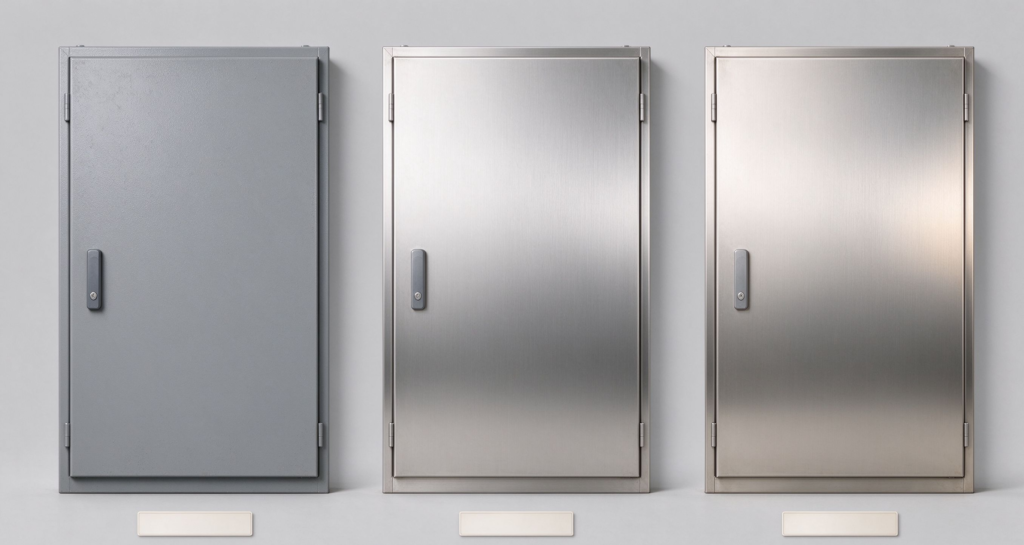
Cold-rolled steel sheet
A high-strength steel sheet that manufacturers produce through cold rolling, it serves as the “economical choice” for electrical enclosures. Once we galvanize it or apply outdoor-grade electrostatic powder, it delivers strong mechanical strength and impact resistance. FN enclosure builds its outdoor metal surveillance cabinets, surface-mounted and flush-mounted metal distribution boxes, and similar products from 1.2mm high-quality cold-rolled steel sheets. We pair each sheet with a nine-step pretreatment process and a double-layer anti-corrosion coating, so the finished cabinet reaches IP66 protection.
304 stainless steel
An austenitic stainless steel that contains nickel and chromium, it stands as the “standard choice” for humid and corrosive environments such as food processing, pharmaceuticals, and coastal industries. It naturally resists rust, corrosion, and flame; when you brush-finish the surface, the cabinet combines lasting protection with a clean industrial look.FN enclosure builds its flush-mounted and surface-mounted stainless steel distribution boxes, outdoor stainless steel distribution boxes, and stainless steel meter boxes from premium 304 stainless steel, with 316L available on request.
316L stainless steel
By adding molybdenum to the 304 composition, this grade boosts pitting corrosion and salt-spray resistance significantly, so it becomes the “top-of-the-line choice” for chemical, marine, and high-salt-spray environments. We upgrade every FN enclosure stainless steel product to 316L whenever customers request it.
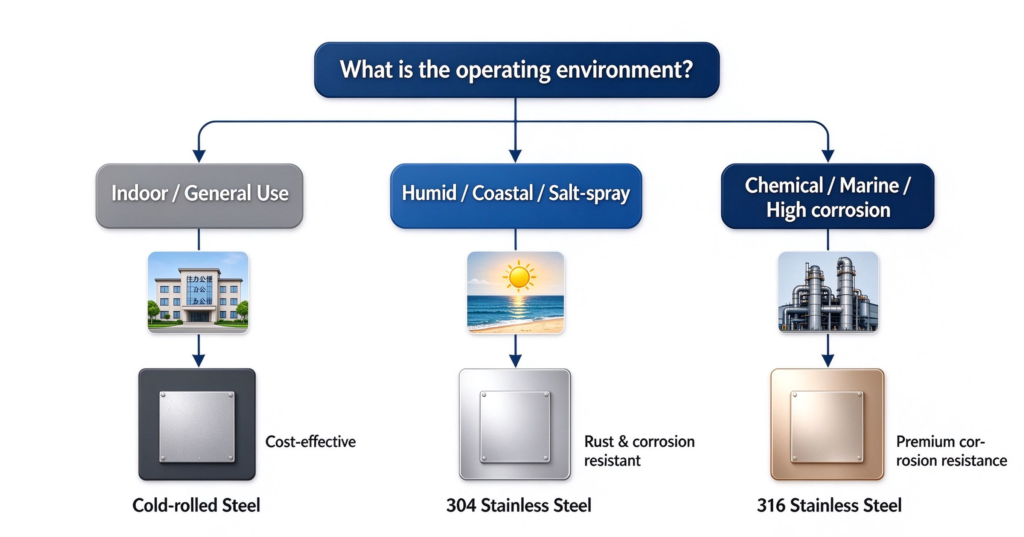
How to choose Under Complex Operating Conditions? A Clear Logical Framework
Once you clearly understand the operating conditions, selecting the right model is straightforward:
Standard indoor environments (residential, office buildings, commercial spaces): Cold-rolled steel cabinets are fully sufficient and offer the best value for money. Surface-mounted or recessed metal distribution boxes are typical examples.
Humid, coastal, or high-salt-fog environments (food processing, chemical laboratories, underground parking garages, coastal areas): 304 stainless steel is the top choice for its rust resistance, corrosion resistance, and long service life. FN enclosure products explicitly state in their descriptions that they are suitable for these scenarios.
Chemical processing, marine engineering, and highly corrosive environments: Upgrade to 316L to ensure long-term stability in extreme conditions.
Protection Ratings Are Equally Critical: The Difference Between IP55 and IP66
Beyond material, the protection rating is another key criterion. The two digits following “IP” indicate the level of protection: the first digit represents protection against solid foreign objects (dust), and the second digit represents water resistance.
IP55: Dust-tight and protected against water jets; suitable for general outdoor applications.
IP66: Fully dust-tight and resistant to powerful water jets; capable of withstanding torrential rain and sandstorms, making it the top choice for harsh outdoor operating conditions.
The entire product line from FN enclosure offers customizable protection ratings ranging from IP55 to IP66. Each enclosure is equipped with a waterproof breather valve, sealing gaskets, and a double-layered inner-outer door structure to effectively prevent condensation, facilitate heat dissipation, and ensure a dry and stable internal environment.

Paint Colors and Surface Finishes: More Than Just Gray and Stainless Steel
Many customers assume electrical cabinets come only in gray or stainless steel. In fact, we customize cold-rolled steel cabinets in any RAL color code—common choices include RAL 7035 Light Gray, RAL 7032 Beige Gray, RAL 5015 Industrial Blue, and RAL 9001 Off-White. For specific projects, we also match custom colors to your VI brand identity. Besides the standard brushed finish, we sandblast stainless steel panels, mirror-polish them, or apply a partial brushed texture. Add screen-printed logos on top, and the enclosure matches your brand’s visual identity.
For accessories, we offer several door lock options: standard key locks, link-type top-and-bottom locks, and combination locks. Every door frame ships with standard EPDM rubber gaskets that resist aging and UV rays. We install a waterproof vent valve and a rain visor on the top to handle outdoor conditions. At the bottom, we add knock-out holes, cable glands, and a grounding busbar as needed. These small details directly affect your on-site installation efficiency and long-term durability.
Several Typical Application Scenarios
Solar Power Generation: For PV combiner boxes and DC distribution boxes, we typically specify outdoor-rated 304 stainless steel, with IP65 as the minimum rating.
Electric Vehicle Charging: We build charging station enclosures and freestanding charging cabinets from either powder-coated cold-rolled steel or stainless steel—you choose based on your site.
Construction Sites: Temporary distribution boxes and front/rear door cabinets demand high strength and impact resistance; we recommend thick-walled cold-rolled steel models for these jobs.
Security and Surveillance: We ship outdoor surveillance equipment enclosures and network cabinets with IP66 rating and anti-condensation breather valves as standard.
Water Treatment and Chemical Processing: For humid and corrosive environments, we specify 316L stainless steel cabinets with double doors to handle the toughest conditions.

How Do You Determine Panel Thickness? Thicker isn’t Always Better
Many customers ask right off the bat, “Can you make it 3 mm thick?” In reality, thickness should be determined based on the cabinet dimensions and intended use; blindly increasing thickness will only drive up costs and shipping weight.
Small cabinets (within 300 × 400 mm, wall-mounted): 0.8–1.2 mm is sufficient; the door won’t warp, and the structural strength is adequate.
Medium-sized cabinets (400×600mm to 800×1000mm): We recommend 1.2–1.5mm to ensure the doors remain flat and do not sag over time.
Large freestanding cabinets (1000×2000mm and larger): Use 1.5–2.0mm for the main cabinet body, with thicker material for the base and load-bearing frame, supplemented by reinforcing ribs.
Temporary on-site cabinets / environments prone to frequent impacts: We recommend using thick-walled models of 1.5 mm or thicker for superior impact resistance and durability.
FN enclosure standard stock thicknesses range from 0.5–2.0 mm; special heavy-duty cabinets exceeding 2.0 mm can also be custom-made upon request. When you place an order, we’ll provide thickness recommendations based on your dimensions and installation environment—no need for you to calculate it yourself.
Three Common Questions from Customers
Q: 304 and 316L look similar—how can I tell them apart?
A: It’s hard to tell them apart just by looking. On site, you can apply a drop of stainless steel testing solution to a hidden surface for a quick read. For bulk orders, we provide a material certificate for every batch, so you can trace the composition of each sheet.
Q: Will a cold-rolled steel cabinet still rust if it’s powder-coated?
A: If we pretreat cold-rolled steel properly and coat it with outdoor-grade powder, the cabinet lasts over ten years in dry indoor spaces. But if we chip the coating somehow and the cabinet sits in high humidity for months, rust starts at the damaged spot and spreads from the base metal. For long-term outdoor use, pick stainless steel.
Q: Can I order standard dimensions first and add cutouts later?
A: You can cut holes in a standard cabinet on site, but you scratch the coating and drop the protection rating. Better: send us the cutout layout, lock positions, and sight glass size before you order. We machine everything to your drawings before shipment, so your crew just bolts it on site—faster, and the seal stays intact.
Why Choose FN enclosure
As a comprehensive manufacturing enterprise specializing in the R&D and production of distribution box enclosures, FN enclosure offers the following advantages:
Comprehensive Material Options: We offer a full range of materials, including cold-rolled steel, 304, and 316L, and support customization based on specific operating conditions—so you never have to compromise on a single material.
Flexible Customization: Dimensions, cutouts, structure, spray paint colors, and screen printing can all be customized to your needs. We support ODM/OEM and provide rapid response from drawings to prototypes.
Worry-Free Export: Waterproof, dustproof, and corrosion-resistant properties have all passed professional testing. Our products are exported to Europe, the Middle East, and Southeast Asia, and we support various trade terms including FOB, CIF, CNF, letters of credit, and wire transfers.
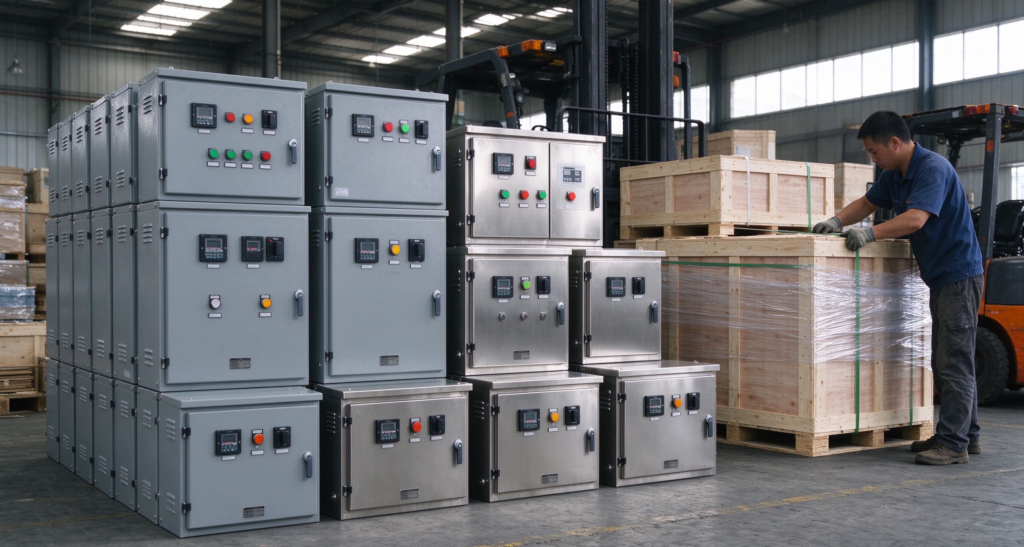
If you need material selection advice or would like to receive a detailed product catalog and customization solutions, please contact FN enclosure—we’ll help you make the right choice, from materials to protection, all in one place.
We fabricate both grades in our own shop — see our stainless steel electrical enclosures.